⭐ Must-see · Al Hosn, downtown Abu Dhabi, 4 km from central Abu Dhabi
Qasr Al Hosn
Where the city began, around a single freshwater well
🎧 Listen to this guide · about 6 min
Pop your earphones in and we'll walk you round.
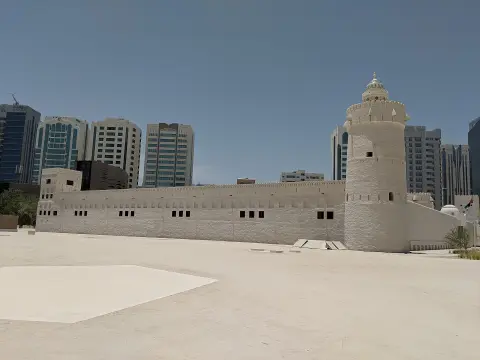
Welcome, everyone, to the heart of old Abu Dhabi. Look around and you will see glass towers and busy roads on every side. Then look at this. Low white walls, round towers and wooden doors, standing calmly in a green park as if the twentieth century never happened. This is Qasr Al Hosn, the fort, and it is the oldest stone building in the city. Before the oil, before the skyscrapers, before the Corniche, there was this place and a well of fresh water beside it. Everything you have seen in Abu Dhabi grew outward from here. So let us step back a couple of centuries together and see how it all started.
The story of Qasr Al Hosn
Long before the fort, there was the water. Abu Dhabi means father of the gazelle, and legend says hunters from the Bani Yas tribe followed a gazelle across the shallows to this island and found it drinking at a freshwater spring. Whatever the truth of the story, fresh water was precious on this coast, and it drew people to settle.
Around 1761 a round watchtower was built to guard the island's only well. Then, in 1793, Sheikh Shakhbut bin Dhiyab Al Nahyan expanded the tower into a small fort, and it became the permanent home of the ruling sheikhs. In the late 1930s, money from Abu Dhabi's first oil concession helped extend it into the larger palace you see today, with an outer wall and corner towers.
For almost two centuries, Qasr Al Hosn was the seat of government, where the rulers lived, received guests and settled disputes. It kept that role until 1966. Afterwards it became a national archive and centre for documents and culture. Then came a long conservation project lasting about a decade, and in December 2018 the fort reopened as a museum, together with the Cultural Foundation building and a House of Artisans in the same complex.
The setting
The fort stands on its own in a wide, landscaped park in the middle of downtown. Two buildings make up the whole. The inner fort, around the original watchtower, is the oldest part. The outer palace wraps around it with high walls and towers. Both are built from coral stone and sea stone, cut from the shore and the reefs, held together with lime mortar and then whitewashed. Inside the walls you find shaded courtyards, cool rooms with thick walls, narrow stairs and wooden beams of mangrove and palm. Around the fort, the Cultural Foundation, a 1980s modernist building, and the House of Artisans complete the cultural site.
Why it matters
Qasr Al Hosn is the place where Abu Dhabi keeps its memory. It holds the city's origin story, the story of its ruling family and the story of how ordinary life changed with oil. Each year the Al Hosn Festival fills the grounds with traditional crafts, music and food. For visitors, it is the best place to understand that Abu Dhabi is not a new city at all, just one that changed very fast. Standing inside these walls, you feel how small and close-knit the community once was, and how much the people of this city have built since.
Your walk-through
The stops a guide would take you to, in order.
-
1
The approach across the park
We start out in the park, looking at the fort from a distance. Notice how small it seems against the towers around it. That contrast is the whole story of Abu Dhabi in one view. The low walls and rounded towers once looked out over open sand and sea. Now they are surrounded by the city they helped create. Take a photograph from here before we go in.
-
2
The walls and the building stones
Come close to the wall and look at the surface. Where the plaster has been opened for display, you can see the building blocks. They are coral stone and beach rock, pulled from the sea, and you can still see shell and coral textures in them. The thick walls kept the rooms cooler in summer. Whitewash protected them and reflected the sun. Run your hand gently along the plaster and feel how uneven it is.
-
3
The inner fort and the watchtower
Now we pass into the inner fort. This is the oldest part, built around the original watchtower of the 1760s. Look up at the tower and imagine a lookout at the top, watching the island's only freshwater well and the sea beyond. It was this single source of water that made the island worth guarding at all. Look for the narrow doorway linking it to the later palace.
-
4
The palace rooms
Walk through the rooms of the outer palace. Here the ruling family lived and the business of government was done. Exhibits show furniture, clothing and everyday objects, with photographs of life in the mid-twentieth century. Look at the ceilings, made of mangrove poles and woven palm mats. Simple materials, but they lasted. Imagine the long evenings of conversation held in these rooms.
-
5
The archive and photographs
In the exhibition rooms you will find historic photographs and documents. Take time over the pictures of Abu Dhabi in the 1950s and 1960s. Palm-frond houses, sand streets, the fort standing alone. Then remember the view outside. Very few cities in the world have changed so completely in a single lifetime. Many of the people in those pictures are still alive today.
-
6
The House of Artisans
We finish next door at the House of Artisans. Here Emirati craftspeople demonstrate traditional skills such as Al Sadu weaving, Khoos palm-leaf weaving and Talli braiding. Watch their hands for a few minutes. These crafts were once part of everyday life in every household. Today they are taught and practised here so that they are not lost. Some pieces are for sale, and buying one supports the artisans directly.
Things you might not know
- The first watchtower was built around 1761 to guard the island's only freshwater well.
- The fort was the seat of Abu Dhabi's government until 1966.
- It is built from coral stone and sea stone, then finished with whitewash.
Researched November 2026 from: en.wikipedia.org, qasralhosn.ae, abu-dhabi.platinumlist.net. Fees and hours change, so check on the day.