🚗 Day trip · Portage Valley, Chugach National Forest, 85 km from central Alaska (Anchorage)
Portage Glacier and Begich, Boggs Visitor Center
Blue ice, icebergs and a valley shaped by glaciers
🎧 Listen to this guide · about 6 min
Pop your earphones in and we'll walk you round.
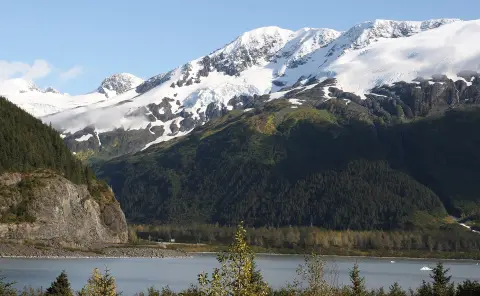
Past the wildlife center, the road turns away from Turnagain Arm and runs up Portage Valley. The mountains rise steeply on both sides, streaked with waterfalls in summer and hung with glaciers all year. At the end of the road lies Portage Lake, and beyond it, Portage Glacier. In summer, you can take a boat across the lake to the glacier's face, where blue ice rises from the water and icebergs drift past. In winter, the visitor center is closed and the lake may freeze, but the valley is quiet and dramatic. This is a place where you can see, very clearly, how glaciers shape the land and how fast they are changing.
The story of Portage Glacier and Begich, Boggs Visitor Center
The name Portage comes from an old travel route. People crossed the mountains here between Prince William Sound and Turnagain Arm, carrying boats and goods over the pass. The name was first recorded in 1898 by Thomas Corwin Mendenhall of the U.S. Coast and Geodetic Survey.
Portage Glacier once filled the whole valley. Over the past century and more it has retreated a long way. In 1986 the U.S. Forest Service built the Begich, Boggs Visitor Center on the lakeshore, facing the glacier. It was named for two members of the U.S. House of Representatives, Nick Begich of Alaska and Hale Boggs of Louisiana, whose small plane disappeared in October 1972 on a flight from Anchorage to Juneau. They were never found. When the center opened, the glacier could be seen from its windows. Since then it has retreated around a bend in the lake, and today it can no longer be seen from the center.
The 1964 earthquake also changed this area. The ground at the old town of Portage sank, and salt water flooded it. The town was abandoned. Today, a ghost forest of dead trees still stands on the nearby flats.
The setting
Portage Valley lies in the Chugach National Forest, about 50 miles southeast of Anchorage. The Portage Glacier Road runs about six miles from the Seward Highway up the valley to Portage Lake. The lake is deep and cold, often dotted with icebergs in summer. The glacier sits at its far end, about four miles west of Whittier. Around it, steep mountains rise with smaller glaciers clinging to their slopes. The visitor center stands on the lakeshore, a modern building with large windows. Nearby trails lead to Byron Glacier and along the valley. Beyond the lake, a tunnel through the mountain connects the road to the port town of Whittier.
Why it matters
Portage Glacier is one of the clearest examples in Alaska of how fast glaciers can change. In a single lifetime, it has retreated out of sight of a visitor center that was built to view it. For visitors, it offers a chance to get close to glacier ice and icebergs without a long boat trip or flight. The valley also tells the story of the 1964 earthquake, in the ghost forest and the lost town of Portage. And it is the gateway to Whittier and Prince William Sound, where many glacier cruises begin in summer.
Your walk-through
The stops a guide would take you to, in order.
-
1
The ghost forest at Portage flats
On the Seward Highway near the turnoff, look out over the flats. You will see dead, gray tree trunks standing in the marsh. These spruce trees died after the 1964 earthquake caused the land to sink and salt water to flood their roots. The old town of Portage stood nearby. It was abandoned after the disaster.
-
2
Portage Valley road
As you drive up the valley, watch the mountainsides. In summer, waterfalls pour down the cliffs, and small hanging glaciers cling to the peaks. The valley floor is the shape of a giant U, carved by the glacier when it filled this whole space. Slow down and enjoy it; this road is only about six miles long.
-
3
Begich, Boggs Visitor Center
At the lake, you reach the visitor center, built in 1986 and named for Congressmen Nick Begich and Hale Boggs, who vanished in a plane in 1972. In summer, step inside for exhibits on glaciers and the Chugach National Forest. Look out the big windows. When the center opened, Portage Glacier was visible from here. Now it has retreated out of sight.
-
4
Portage Lake shore
Walk down to the lakeshore. In summer, look for icebergs drifting in the gray-blue water, broken off from the glacier. Some have a deep blue color, from dense old ice. In winter, the lake may freeze. Do not walk on the ice unless you know conditions are safe; ice thickness can vary and can be dangerous.
-
5
Glacier cruise to the face of Portage Glacier
From late spring to mid-September, a tour boat crosses the lake to the face of Portage Glacier. As you round the bend, the glacier appears, a wall of blue and white ice rising from the water. Listen for cracking and watch for ice falling into the lake. It is one of the easiest glacier cruises in Alaska.
-
6
Byron Glacier Trail viewpoint
If you have time, walk the short Byron Glacier Trail nearby, which leads toward a small glacier in a steep valley. It is an easy walk in summer. In winter and spring, this valley is exposed to serious avalanche danger, so check conditions and stay well back from snow slopes and ice caves.
Things you might not know
- The Begich, Boggs Visitor Center was built in 1986, when the glacier could still be seen from it.
- The center is named for two congressmen whose plane disappeared in 1972 and was never found.
- The name Portage was first recorded in 1898 and refers to an old route between Prince William Sound and Turnagain Arm.
Researched November 2026 from: en.wikipedia.org, fs.usda.gov, princesslodges.com. Fees and hours change, so check on the day.