⭐ Must-see · Northeast of AlUla, off Highway 70, 15 km from central AlUla
Elephant Rock (Jabal AlFil)
A stone giant drinking from the desert at dusk
🎧 Listen to this guide · about 6 min
Pop your earphones in and we'll walk you round.
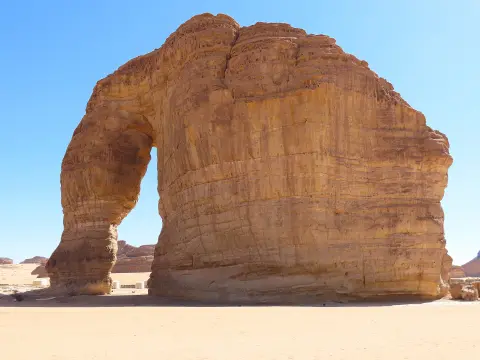
Come and meet the gentlest giant in Arabia. As you walk along the wooden path from the car park, you will see it rising ahead of you: a great domed head, a heavy body, and a long trunk curving down to touch the sand. Nobody carved it. Wind, rain and blowing sand did all the work, over a very long time. Arrive late in the afternoon and find a seat. As the sun drops, the rock turns from gold to copper to deep red, and the sky behind it goes violet. Then the stars come out, one by one. Bring a jacket. Desert evenings are cool, and you will want to stay longer than you planned.
The story of Elephant Rock (Jabal AlFil)
The story of Elephant Rock is mostly a story of geology. The sandstones around AlUla were laid down as layers of sand and gravel by ancient rivers and seas, roughly 540 to 485 million years ago. For an unimaginable stretch of time they lay buried. Then, around 30 million years ago, as the Earth's crust began to pull apart to open the Red Sea, this part of Arabia was lifted up, and the old layers met the weather.
What followed was slow sculpture. Rain, wind and sand-laden gusts wore away the softer parts of the rock faster than the harder parts. Cracks widened into gaps. One gap, near the base, grew into the opening that now separates the trunk from the body. The result is a formation about 52 metres high at its tallest point, and from the right angle it looks remarkably like an elephant.
Local people have long known it by its Arabic name, Jabal AlFil, the Elephant Mountain. In recent years the Royal Commission for AlUla, set up in 2017, has turned the spot into an evening gathering place, with a wooden walkway, seating, fire pits, food trucks and a café, while keeping the rock itself untouched. Climbing is not allowed, and that is part of why it still looks the way it does.
The setting
The rock stands on a wide, flat plain of soft orange sand, surrounded by other wind-carved outcrops that look like towers, mushrooms and walls. That open space is what makes the elephant so clear: there is nothing in front of it to break the silhouette. A wooden path leads from the free car park toward the rock, and low seating and fire pits are set out at a respectful distance. The best view of the trunk is from the side facing the seating area, where the arch beneath it frames the sky. At night, with little light pollution, the stars feel very close.
Why it matters
Elephant Rock has become a symbol of AlUla, the image many people see first when they hear the name. It shows that this landscape is not only about ancient kingdoms but also about natural forms of real beauty, shaped over geological time. It is also one of the few sights in AlUla you can visit freely without a timed tour, so it is where locals and visitors mix in the evening, sharing coffee by the fire. That easy, open feeling is part of its charm.
Your walk-through
The stops a guide would take you to, in order.
-
1
The car park and wooden path
Start here and walk slowly. From the path, the elephant reveals itself in stages. First you see a big rounded mass, then the head, then the trunk dropping down. Notice how fine the sand is underfoot, almost like powder. This is the same material, broken down over ages, that once made up rocks like the one in front of you.
-
2
Facing the trunk
Stop where you can see the gap under the trunk clearly. That opening was made by erosion, the softer stone wearing away while the harder layers above held firm. Look at the bands running horizontally through the rock. Each one is a layer of ancient sediment. You are reading a page of Earth's history, written long before any animal like an elephant existed.
-
3
The seating and fire pits
Find a seat here as the sun gets low. This is the moment people come for. Watch how quickly the colour changes on the rock face, from yellow to orange to red. Photographers like the time just after sunset, when the sky still holds light but the rock becomes a dark silhouette. Order a coffee, sit back, and give it twenty minutes.
-
4
Around the base, at a distance
If you walk along the edge of the area, you will see the rock change shape. From some angles it looks less like an elephant and more like a castle or a ship. Please do not climb or touch the rock, and stay on the open ground. The sandstone is soft, and every hand and foot speeds up the erosion.
-
5
The neighbouring outcrops
Turn around and look at the other formations on the plain. They were shaped by the same forces, and each has its own character. Some look like mushrooms, with a narrow stem and a wide cap. That happens when blowing sand wears away the base faster than the top, because most windblown sand travels close to the ground.
-
6
Under the stars
Once it is fully dark, step away from the lights and let your eyes adjust for a few minutes. On a clear night the sky above AlUla fills with stars, and the elephant becomes a black shape against them. Listen to how quiet it is. This is a good moment to simply be still before you head back to town.
Things you might not know
- Elephant Rock is about 52 metres high at its tallest point.
- Its sandstone is roughly 540 to 485 million years old, far older than any elephant species.
- Climbing the rock is forbidden to protect the soft sandstone from erosion.
Researched November 2026 from: experiencealula.com, en.wikipedia.org, visitsaudi.com. Fees and hours change, so check on the day.