🚗 Day trip · Laxmanpur Beach No. 2, Neil Island (Shaheed Dweep), 37 km from central Andaman Islands (Havelock)
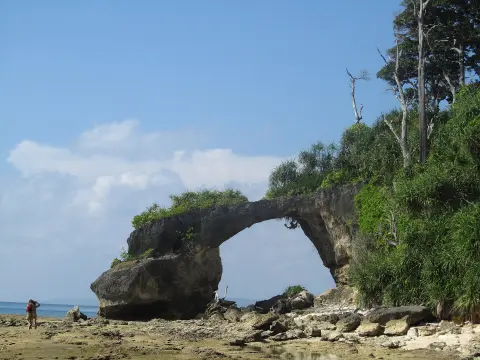
Natural Bridge, Neil Island
An ancient coral arch revealed by the falling tide
🎧 Listen to this guide · about 6 min
Pop your earphones in and we'll walk you round.
Welcome to one of the islands' most photographed shapes, the Natural Bridge of Neil Island. You can only see it properly when the sea lets you. At low tide the water draws back from Laxmanpur Beach No. 2, and a path opens across the rocks and reef flats. You pick your way past pools full of tiny fish and sea stars, and then there it is, a great arch of weathered rock standing at the edge of the sea. People here sometimes call it Howrah Bridge, after the famous bridge in Kolkata. Bring good shoes, check the tide chart, and come with a local guide if you can. The guides know where the creatures hide, and they know when the sea is coming back.
The story of Natural Bridge, Neil Island
The Natural Bridge was made by the sea, not by people. Long ago, the rock here was part of a coral reef. Over a very long time, the land rose and the reef was lifted above the water. Waves then went to work on it, carving away the softer parts and leaving a harder arch standing. The process is still going on, very slowly, with every tide.
Neil Island itself was named by the British after James Neill, an officer of the East India Company in the 1857 uprising. It was settled from the late 1960s by refugee families from East Pakistan, who named their villages after figures from the Ramayana. The bridge lies on the shore of Laxmanpur, named after Lakshman, Rama's loyal brother.
As Neil opened up to tourism in the 2000s, the arch became the island's best-known sight. Many visitors from West Bengal nicknamed it Howrah Bridge, after the great steel bridge in Kolkata, and the name stuck. In December 2018 Neil was renamed Shaheed Dweep in honour of Subhas Chandra Bose. Today the walk to the bridge is often led by local guides who point out the reef life along the way, and visitors are asked not to climb on the arch.
The setting
The Natural Bridge stands on the north-western shore of Neil Island, about two kilometres from the jetty, beside Laxmanpur Beach No. 2. From the end of the road a short path leads down to the shore. At low tide the sea pulls back to reveal a wide stretch of rocky reef flats, with pools of seawater and patches of living coral. You walk across these flats to the arch, which rises from the shore in grey and brown rock, wide enough to frame the sea behind it. At high tide the flats disappear under water, and the arch can only be seen from a distance.
Why it matters
The Natural Bridge is a reminder that the Andaman Islands are built from the sea itself. Much of the rock here began as living coral. The walk across the flats is also a lesson in how much life a reef holds, even in a few centimetres of water. It is fragile, though. Large numbers of visitors walking on the flats can damage coral and disturb animals, so stepping carefully and following your guide really matters. For Neil Island, the bridge is its signature, the sight that draws many day-trippers across from Havelock.
Your walk-through
The stops a guide would take you to, in order.
-
1
The path from the road
We start at the end of the road near Laxmanpur Beach No. 2. Before you go down, check the tide time. The best window is around low tide, and you want to arrive about an hour before it. Put on shoes with good grip. The path leads down through the trees to the shore. Look ahead and you will see the rocks spreading out where the sea has drawn back.
-
2
The reef flats
Now step out onto the flats. Walk slowly, and step only on bare rock and sand. Look into the pools around you. There are small fish, crabs, sea urchins and sea cucumbers. Your guide may show you a starfish or a moray eel hiding in a crack. Do not lift anything out of the water. These animals are stranded only until the tide returns.
-
3
Living coral pools
In some pools you will see living coral, in shades of brown, green and purple. Some may even have clownfish living among anemones. Look but do not touch. Coral is made of tiny animals, and a single footstep can break years of growth. This is a good moment to stop and look closely. The reef is at your feet.
-
4
The arch
Here it is, the Natural Bridge. Stand back and look at its shape. It is solid rock, but look closely and you can see the remains of ancient coral in it. The sea has carved the opening, and it keeps carving it with every tide. Take your photographs from the front, with the sea framed behind the arch. Do not climb on it.
-
5
The walk back
Before the tide turns, head back across the flats. Watch the water. Once it starts to rise, it can cover the flats faster than you expect. Follow the same safe route you came on. When you reach the shore, look back at the arch one more time, with the sea creeping in around it. In a few hours it will be standing in the water again.
Things you might not know
- The arch is formed from ancient coral rock lifted above the sea and shaped by waves.
- Many visitors call it Howrah Bridge, after the famous bridge in Kolkata.
- It can only be reached on foot around low tide.
Researched November 2026 from: en.wikipedia.org, go2andaman.com, traveltriangle.com. Fees and hours change, so check on the day.