💎 Hidden gem · Mengwi, Badung, 15 km from central Bali
Pura Taman Ayun
A royal water temple floating in its own moat
🎧 Listen to this guide · about 6 min
Pop your earphones in and we'll walk you round.
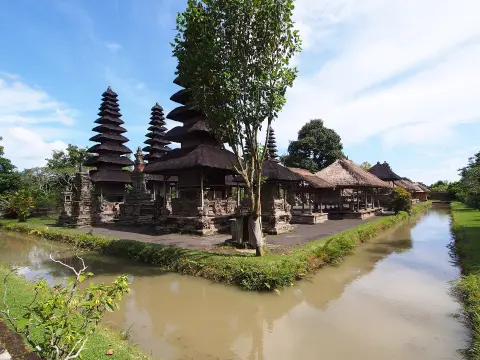
Welcome to Pura Taman Ayun. The name means the beautiful garden temple, and as we cross this bridge over the moat, you will see why. Water surrounds the temple on three sides, still and green, with lotus leaves floating near the edges. Ahead, lawns and frangipani trees lead towards a line of tall, dark shrine towers. Their thatched roofs rise in layers, one above the other, like stacked umbrellas against the sky. This was the family temple of the kings of Mengwi, built almost four hundred years ago. It is quiet here, even in high season. Walk slowly, listen for the birds and the fountains, and imagine the royal processions that once passed this way.
The story of Pura Taman Ayun
Taman Ayun was built in 1634 by Gusti Agung Putu, the king of Mengwi, a powerful kingdom in the west of Bali. He built it as a family temple, a place to honour his royal ancestors and the gods who protected his realm. The site was chosen for its water, and the moat and ponds were part of the design from the start.
Over the following centuries, the temple was repaired and changed several times. A renovation is recorded in 1750. The kingdom of Mengwi itself fell in 1891, conquered by its neighbours, but the temple remained in use, cared for by the descendants of the royal family and the local community. Its last major restoration took place in 1937.
In 2012, UNESCO included Pura Taman Ayun in its World Heritage listing for Bali's subak system. It is listed as a royal water temple, because it played a role in managing irrigation for the farmland of the old kingdom. That makes it one of only five places named in the Bali World Heritage site.
The setting
The temple covers about seven hectares on a long, rectangular plot that runs north to south. A broad moat wraps around it on the west, south and east, and you enter by a bridge on the south side. Inside, the temple is divided into three courtyards, each a little higher and more sacred than the last. Split gates, called candi bentar, separate them. In the outer courtyard stands a wantilan, an open pavilion with a tiered roof, once used for gatherings and cockfights. The innermost courtyard is enclosed by a low wall and a smaller moat. Inside it stand the meru, the shrine towers, with roofs of black palm fibre in odd numbers of tiers, up to eleven.
Why it matters
Taman Ayun shows you the link between royal power, religion and water in old Bali. Kings did not only rule land. They also helped manage the water that made rice farming possible, and temples like this one were at the centre of that system. Today, the temple is still active, with ceremonies throughout the year. It is also one of the best places to see classic Balinese temple design laid out clearly, in a peaceful garden setting. For a visitor, it offers a gentle introduction to how a Balinese temple is organised, from the outer world to the inner sanctum.
Your walk-through
The stops a guide would take you to, in order.
-
1
The bridge over the moat
Pause on the bridge and look along the moat. This water is fed by the irrigation channels of the surrounding farmland. In the morning, the moat reflects the trees and the sky like a mirror. The moat also had a symbolic meaning. In Balinese belief, the temple represents the sacred mountain floating on the cosmic ocean, so the water around it is part of the story.
-
2
The outer courtyard and wantilan
This first courtyard is the most open and public. On your left stands the wantilan, a large open pavilion with a layered roof. Villagers once gathered here for meetings and for cockfights, which were part of temple rituals. Today it is often quiet, a shady place to rest. Look at the neat lawns and the fountain. Everything here is designed to slow you down.
-
3
The split gate
Now walk to the candi bentar, the split gate. It looks like a single tower cut in half, with the two halves pulled apart. Balinese explain that you pass between the two halves of the world as you enter. Notice the fine brickwork and carved stone. Beyond the gate, the middle courtyard has a small bale, or pavilion, decorated with carved reliefs.
-
4
The inner wall and the meru
Here you reach the low wall around the inner courtyard. Visitors walk around the outside, which gives you a full view of the shrines within. Count the tiers on the meru roofs. They always come in odd numbers, and the tallest have eleven. More tiers mean a higher god or a more important ancestor. The roofs are made of black fibre from the sugar palm.
-
5
The inner moat path
Follow the path around the inner wall. You will see the narrow inner moat on your side, and beyond the wall the different shrines dedicated to gods, mountains and royal ancestors. Some shrines face towards Mount Batukaru and others towards Mount Batur and Mount Agung. Walk all the way around for the best angles, especially in the soft afternoon light.
-
6
The gardens and ponds
Finish in the gardens near the entrance. Here you will find lotus ponds and old trees offering shade. Sit on a bench for a while. In the late afternoon, local families sometimes come to stroll. If you are lucky, you may see villagers arriving in white and gold for a ceremony, carrying offerings and the sound of gamelan.
Things you might not know
- Taman Ayun was built in 1634 by Gusti Agung Putu, king of Mengwi.
- It is one of five places named in Bali's 2012 UNESCO World Heritage listing.
- The temple compound covers about 6.9 hectares and is ringed by a moat on three sides.
Researched November 2026 from: en.wikipedia.org, en.wikipedia.org, heybali.info. Fees and hours change, so check on the day.