⭐ Must-see · Rattanakosin (Old Town), 2 km from central Bangkok
Wat Pho (Temple of the Reclining Buddha)
A golden Buddha at rest, and the cradle of Thai massage
🎧 Listen to this guide · about 6 min
Pop your earphones in and we'll walk you round.
Welcome to Wat Pho, just south of the Grand Palace walls. Many people come for one thing, the great reclining Buddha, and it will not disappoint you. But stay a while longer. This temple is a maze of cloisters, tiled chedis and little gardens, and it is far calmer than its royal neighbour. You will hear monks chanting, coins ringing in bronze bowls, and the soft slap of massage in the pavilions. Kings turned this place into a school in stone, with lessons carved on its walls for anyone who walked in. So slow down, take off your shoes when asked, and let this old temple teach you a few things.
The story of Wat Pho (Temple of the Reclining Buddha)
A temple stood here before Bangkok was a capital. It was known as Wat Photaram, and it dates from the Ayutthaya period. When King Rama I founded his new city in 1782, he chose this old temple, right next to his palace, for a great rebuilding. Work began in 1788, and he brought in damaged Buddha images from old capitals to be restored and placed in the cloisters.
The temple took the shape you see mostly under King Rama III, in the 1830s and 1840s. He enlarged the grounds and built the hall for the reclining Buddha, which was completed in 1832. He also had hundreds of stone tablets set into the walls, covering medicine, massage, history, literature and religion. Thais often call Wat Pho the country's first public university for this reason. In 2011 these inscriptions were added to UNESCO's Memory of the World register.
The massage knowledge kept here grew into a school that still trains therapists today. In 2019 UNESCO recognised Nuad Thai, traditional Thai massage, as intangible cultural heritage. The temple's full name is long, but locals simply say Wat Pho, a short form of its old name. Kings and princes studied here, but so did ordinary people. The doors were open to anyone who wanted to read the walls.
The setting
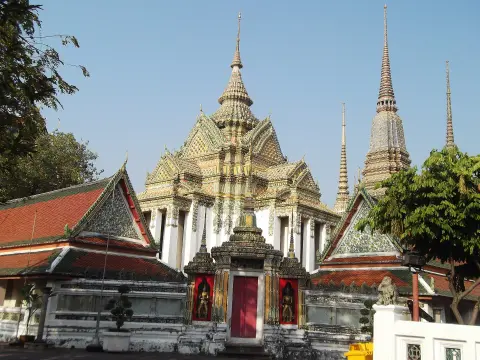
Wat Pho is split in two by a lane. The northern half holds the main temple, and the southern half houses monks' quarters and the school. In the north, the reclining Buddha's hall sits near the west side. East of it, four tall chedis covered in coloured porcelain honour the first four Chakri kings. Beyond them is the ordination hall, the ubosot, ringed by a double cloister lined with gilded seated Buddhas. Little rock gardens, bonsai trees and many smaller chedis fill the spaces in between. Large Chinese stone figures stand at the gates. Many came from China as trade goods in the early nineteenth century.
Why it matters
Wat Pho is a first-class royal temple and a working monastery. Thais come here to make merit, study and pray. It also keeps alive the tradition of Thai massage, which has spread to spas around the world from schools like this one. For visitors, it offers something rare in Bangkok, a famous sight where you can still find a quiet bench and a little shade. The carved tablets remind us that temples in Thailand were long the main places of learning for ordinary people. Many visitors leave with sore feet and a loose back, which seems only fair.
Your walk-through
The stops a guide would take you to, in order.
-
1
The Reclining Buddha hall
Slip off your shoes and step inside. The Buddha lies on his right side, head resting on his hand, and stretches about 46 metres from end to end. He is covered in gold leaf over brick and plaster. This pose shows the Buddha at the moment of passing into final nirvana. Walk slowly along his length. The hall is narrow, so you only ever see part of him at once, which makes him feel even larger.
-
2
The soles of the feet
At the far end, stop and look at the soles of his feet. Each one is inlaid with mother-of-pearl in a grid of 108 small panels. They show the auspicious signs by which a Buddha can be recognised, such as lotus flowers, elephants and tigers. Behind you along the wall are 108 bronze bowls. Buy a cup of small coins and drop one in each. Thais believe this brings good fortune, and the money helps the temple.
-
3
The four great chedis
Out in the sun you will find four tall chedis, each faced with tiny pieces of glazed porcelain. Green, white, yellow and blue, they honour the first four kings of the Chakri dynasty. Rama I built the first, Rama III added two more, and Rama IV built the fourth. Get close and look at the flowers made from broken china. From a distance they shimmer like embroidered cloth.
-
4
The cloisters of seated Buddhas
Now walk into the long galleries around the ordination hall. Row after row of gilded Buddhas sit in meditation, all different. Many were brought here by Rama I from ruined temples in Ayutthaya and Sukhothai, then repaired. Look closely and you will see changes in face shape, hand position and style. This is a quiet place, and a lovely spot to sit and let the heat ease for a few minutes.
-
5
Phra Ubosot, the ordination hall
This is the holiest building at Wat Pho, where monks are ordained. Look at the doors, inlaid with mother-of-pearl scenes from the Ramakien. Around the base you will see carved stone panels from the same epic. Inside, the main Buddha sits on a three-tiered pedestal, and Rama I's ashes are said to be kept beneath it. Keep your voice low and your feet tucked away from the image.
-
6
The massage pavilions
End your visit where so many people end it, with a massage. In the eastern part of the grounds, trained therapists from the temple school work in open pavilions. A traditional Thai massage involves stretching and firm pressure, so tell them if it is too strong. On the walls nearby you can still find old diagrams of the body showing energy lines. Lie back and enjoy a lesson that has been taught here for nearly two centuries.
Things you might not know
- The reclining Buddha is about 46 metres long and 15 metres high.
- Wat Pho's stone inscriptions were added to UNESCO's Memory of the World register in 2011.
- Traditional Thai massage, taught here for generations, was listed by UNESCO as intangible heritage in 2019.
Researched November 2026 from: watpho.com, en.wikipedia.org, unesco.org, ich.unesco.org. Fees and hours change, so check on the day.