🚗 Day trip · Cherry Tree Hill, St Peter, 25 km from central Barbados
St Nicholas Abbey
A plantation house, and the history it holds
🎧 Listen to this guide · about 6 min
Pop your earphones in and we'll walk you round.
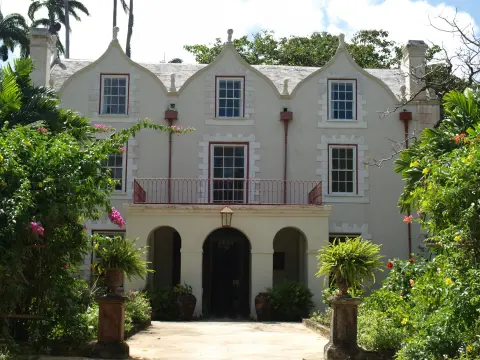
Welcome to St Nicholas Abbey. We have come to the north of the island, near Cherry Tree Hill. Ahead of you stands a three-storey house with curved gables and tall chimneys. It was built in 1658 and is one of only three Jacobean-style mansions surviving in the Western Hemisphere. Despite its name, it was never an abbey. It was the great house of a sugar plantation. Around it you will see the boiling house, the steam mill and the fields. As we walk, I will show you the architecture and how sugar and rum were made. I will also ask you to remember the enslaved African men, women and children whose forced labour created this estate.
The story of St Nicholas Abbey
The house was built in 1658 by Colonel Benjamin Berringer, one of the early English planters on the island. According to the estate's history, his neighbour Sir John Yeamans was accused of poisoning him, and Yeamans later married Berringer's widow. Yeamans went on to help lead colonists from Barbados to settle the Carolina colony in North America, taking the Barbadian plantation system with him. The poisoning story cannot be proven.
Like every sugar estate in Barbados, St Nicholas Abbey depended on enslaved Africans. They cleared the land, planted and cut the cane, worked in the mill and the boiling house, and lived in harsh conditions under the threat of violence. Slavery was abolished in 1834, followed by an apprenticeship system that ended in 1838. Afterward, many of the freed people and their descendants continued to labour on estates like this one for low wages.
The estate passed through several families, including the Cave family, who owned it from the nineteenth century. Around 1890 a steam-powered mill was installed, which still grinds cane in season. In 2006 the estate was bought by Larry and Anna Warren, who restored the house and gardens and revived rum making, using sugar cane grown on the estate.
The setting
The estate sits in the rolling hills of St Peter, near Cherry Tree Hill, in the north of Barbados. The great house is built of coral stone and plaster, with three Dutch-style curved gables, corner chimneys and a covered porch. Inside are polished wooden floors, antique furniture and a fine Chippendale staircase. Around the house are formal gardens, an avenue of mahogany trees and a gully. Nearby stand the boiling house and the steam mill, and a distillery where the estate's rum is aged in barrels. A heritage steam railway runs on part of the land. Cane fields still surround the house today.
Why it matters
St Nicholas Abbey is a rare survivor of seventeenth-century Caribbean architecture, and it shows how wealth from sugar shaped Barbados and the wider Atlantic world. It is also a place to reflect. The beauty of the house cannot be separated from the suffering of the enslaved people who worked here, whose names are mostly lost. Barbados was among the first English colonies to build its economy on enslaved labour, and planters like Yeamans carried that system to North America. Visiting here asks you to hold both the history of the building and the history of the people together.
Your walk-through
The stops a guide would take you to, in order.
-
1
The avenue and front of the house
Start as you approach along the avenue of mahogany trees. Look at the front of the house. Notice the three curved gables, the corner chimneys and the symmetry. This is Jacobean style, brought from England in the seventeenth century. Chimneys like these served little purpose in the tropics, which shows how closely the builders copied English fashion. Only three such houses survive in the Americas, and this is one of them.
-
2
Inside the great house
Step inside. The rooms are furnished with antiques and family portraits. Look at the staircase, made of fine wood, and the polished floors. This was where the planter family lived, entertained guests and managed the estate. As you look at the comfortable rooms, remember that their comfort was paid for by the labour of enslaved people who lived in small, crowded dwellings out of sight of this house.
-
3
The film room
In one room, an old film from the 1930s shows life on the estate and on the island at that time. Watch carefully. You will see Barbadian workers cutting cane, loading carts and working in the mill, almost a century after emancipation. Their labour was still hard and poorly paid. The film is a rare record of how little had changed for many workers long after slavery ended.
-
4
The steam mill and boiling house
Now walk to the steam mill, installed around 1890. In the crop season, from about January to May, it still grinds cane. Watch how the cane is crushed and the juice runs off to be boiled into syrup. Before steam, this work was done by windmills or animals, and the hot, dangerous work in the boiling house was done by enslaved people. Many were injured or killed in the machinery and heat.
-
5
The distillery
Next, visit the distillery, where rum is made from the estate's own cane syrup. Look at the copper still and the barrels where the rum ages. Rum was born in the Caribbean as a by-product of sugar, and Barbados is among the earliest places it was made. If you choose to taste, take a moment to think about how much history is in that small glass.
-
6
Cherry Tree Hill
Finish at nearby Cherry Tree Hill, just up the road. From here you look east over the rugged Scotland District toward the Atlantic. The view is wide and green. It is a good place to pause after the visit, to think about what you have seen: the house, the machinery, and the lives of the people who worked this land. Then we head back down the hill.
Things you might not know
- The great house was built in 1658 and is one of three surviving Jacobean mansions in the Western Hemisphere.
- Sir John Yeamans, linked by tradition to the builder's death, later led Barbadian settlers to found the Carolina colony.
- The estate's steam mill, installed around 1890, still grinds cane in the crop season from January to May.
Researched November 2026 from: stnicholasabbey.com, visitbarbados.org, en.wikipedia.org. Fees and hours change, so check on the day.