⭐ Must-see · Recoleta, 3 km from central Buenos Aires
Recoleta Cemetery
A silent city of marble angels and family stories
🎧 Listen to this guide · about 6 min
Pop your earphones in and we'll walk you round.
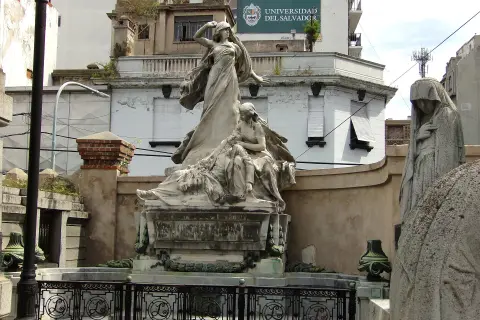
Step through the tall gate and the city noise falls away. In front of you lies a town in miniature, with its own streets, corners and little squares. But the houses here are tombs. There are thousands of them, built of marble, granite and bronze, some as small as a wardrobe and some as grand as chapels. Cats doze on the steps. Angels look down from the rooftops. Every vault holds a family name, and many of those names are also on the streets you walked to get here. Recoleta Cemetery is beautiful, a little eerie and full of stories. Take your time. Let me lead you to some of the people who rest here.
The story of Recoleta Cemetery
This ground was once the garden of a convent run by the Recollect friars, a branch of the Franciscans. Their church, Our Lady of the Pillar, still stands beside the gate and dates from 1732. The neighbourhood takes its name from those friars. In 1822 their order was dissolved, and the city turned the garden into its first public cemetery, opened that November as the Northern Cemetery. The French engineer Próspero Catelin drew its first layout.
Through the nineteenth century the city's leading families began building ever more elaborate vaults. After the yellow fever outbreak of 1871, many of those families moved to this northern part of town, and Recoleta became the most prestigious place to be buried in the country. Architects and sculptors, many from Europe, were hired to design tombs in every style, from Greek temple to Art Nouveau.
Today there are more than four thousand six hundred vaults on about five and a half hectares, and dozens of them are declared National Historic Monuments. Presidents, generals, writers and scientists lie here. So does Eva Perón, the most visited name of all.
The setting
The cemetery is laid out like a grid of streets, with wide main avenues and narrow lanes between rows of vaults. Trees shade the larger paths, and small plazas open where avenues cross. The entrance is a neoclassical gateway with Doric columns, facing a park and the old Pilar church. Inside, look at the materials: Italian marble, polished granite, bronze doors and stained glass. Many vaults have glass doors, so you can see coffins on shelves and little altars with flowers. Some tombs are well kept and gleaming. Others are cracked and overgrown, their families long gone. The contrast is part of the atmosphere. Maps are sold or shown near the entrance, and it is easy to get pleasantly lost.
Why it matters
Recoleta is a history lesson you can walk through. The names on the vaults include independence heroes, presidents such as Domingo Faustino Sarmiento, Nobel Prize winners and the founders of great fortunes. Their tombs show how Argentina saw itself in its richest years, looking to Paris and Rome for its art. It is also still a working cemetery, where families bring flowers and hold services. For many visitors, Eva Perón's simple family tomb, always covered in flowers and notes, is a moving reminder of how deeply she is still loved and argued about.
Your walk-through
The stops a guide would take you to, in order.
-
1
The entrance gate
Pause under the columns before you go in. Above you, carved in stone, are words in Latin about rest and peace. Behind you stands the white church of Our Lady of the Pillar, built in 1732 by the Recollect friars whose garden this once was. In 1822, when their order was dissolved, the garden became the city's first public cemetery. Pick up a map here, and agree on a meeting point with your group, because the lanes look alike.
-
2
The main avenue
Walk straight ahead along the central avenue and look at the variety of styles. You will see miniature Greek temples, Gothic chapels and sleek Art Deco shapes. Each family tried to outdo the next. Notice the bronze sculptures of grieving women and angels, many made by European artists. Several of these vaults are National Historic Monuments. Look for the family names, then think of the streets and avenues across the city that carry the same names.
-
3
The Duarte family vault
Follow the signs and the crowd to a narrow lane and a dark granite vault marked Familia Duarte. This is where Eva Perón rests. She died in 1952, and her body went on a long and troubled journey before it was finally placed here. The tomb is modest compared with its neighbours, yet it always has fresh flowers tucked into the door. Please keep your voice low here. People come to pay respects as well as to look.
-
4
Tomb of Rufina Cambaceres
Now find a white Art Nouveau tomb with a young woman carved in marble, her hand on the door. This is Rufina Cambaceres, who died very young in the early 1900s. Legend says she was buried alive, that she was only in a deep faint, and that scratches were later found inside her coffin. Historians are not sure the story is true. Still, it has made her one of the most visited people in Recoleta.
-
5
Tomb of Liliana Crociati
Look next for a neo-Gothic tomb with a bronze statue of a young woman in a wedding dress, her dog at her side. Liliana Crociati de Szaszak died in 1970, on her honeymoon, in an avalanche in the Austrian Alps. So the story goes, her dog Sabú died at home in Buenos Aires at almost the same time. Her family placed them together in bronze. Visitors rub the dog's nose for luck, which is why it shines.
-
6
Sarmiento's tomb
End at the tomb of Domingo Faustino Sarmiento, president of Argentina from 1868 to 1874 and a champion of public schools. A tall monument with a condor on top marks his grave. Sarmiento believed education would build the nation, and Argentina marks Teachers' Day on the anniversary of his death in September. It is a fitting last stop, a reminder that this is a place of ideas as well as wealth.
Things you might not know
- The cemetery has more than 4,600 above-ground vaults on about 5.5 hectares.
- It opened in 1822 in the former garden of the Recollect friars, whose church of 1732 still stands at the gate.
- Dozens of its tombs, more than ninety, are declared National Historic Monuments.
Researched November 2026 from: buenosaires.gob.ar, en.wikipedia.org, batimes.com.ar. Fees and hours change, so check on the day.