🚗 Day trip · Saqqara, Giza Governorate, 30 km from central Cairo
Saqqara and the Step Pyramid of Djoser
Where Egypt first learned to build in stone
🎧 Listen to this guide · about 6 min
Pop your earphones in and we'll walk you round.
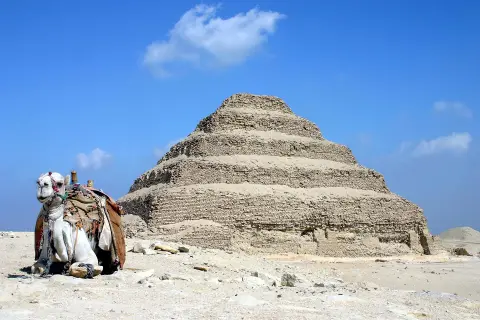
Welcome to Saqqara, the great cemetery of ancient Memphis. Look across the desert and you see a pyramid unlike the ones at Giza. It rises in six great steps, like a stairway to the sky. This is the Step Pyramid of King Djoser, and it is where the whole story of pyramids begins. Around it, the sand hides thousands of years of burials, from early kings to sacred bulls. Here we will walk through a stone colonnade older than Giza, visit the tomb of a royal official whose walls teem with daily life, and stop at the museum named after the man often called the world's first architect. Wear good shoes and bring water. The sun is strong.
The story of Saqqara and the Step Pyramid of Djoser
Saqqara was the main burial ground for Memphis, ancient Egypt's first capital, for around three thousand years. Kings and nobles of the first two dynasties were buried here in mud-brick tombs. Then, around 2670 BC, King Djoser of the Third Dynasty did something new. With his architect Imhotep, he built a tomb of cut stone, stacking six layers, each smaller than the one below. It became the first large pyramid in Egypt.
Imhotep was later honoured as a sage, and much later, Egyptians worshipped him as a god of healing. Pharaohs after Djoser built their own pyramids here. The pyramid of Unas, from the Fifth Dynasty, holds the oldest Pyramid Texts, carved spells to protect the king in the afterlife. Nobles built richly decorated tombs, like that of Mereruka, a vizier under King Teti.
Later, from the New Kingdom to the Ptolemies, the Apis bulls, sacred to the god Ptah, were buried in huge granite coffins in underground galleries known as the Serapeum. Saqqara is still giving up secrets. In recent years, archaeologists have found sealed coffins, mummified animals and new tombs. The Step Pyramid itself reopened in 2020 after a long restoration. Every season, new finds remind us how much still lies beneath the sand.
The setting
Saqqara stretches about seven kilometres along a desert ridge on the west bank of the Nile, above palm groves and fields. The Step Pyramid stands at the centre of a large walled complex, with a single real entrance leading into a stone colonnade. Inside the enclosure lies a vast open court and buildings that copy in stone the reed and wood structures of the time. Around the complex are other pyramids, many now ruined mounds, and hundreds of tombs. The Imhotep Museum sits near the entrance. To the northwest is the Serapeum, cut deep into the rock, and nearby are the tombs of Mereruka and other officials.
Why it matters
Saqqara is where monumental stone architecture began in Egypt. Without Djoser's pyramid, there would be no Great Pyramid at Giza. The tombs here also give some of the best pictures of daily life in ancient Egypt, from farming to fishing. It is part of the UNESCO site Memphis and its Necropolis, and it remains one of Egypt's most active areas for new discoveries. Because it sees fewer visitors than Giza, you can often walk its paths in near silence. That quiet makes it easier to imagine the priests, builders and mourners who came here over three thousand years.
Your walk-through
The stops a guide would take you to, in order.
-
1
The Imhotep Museum
Start in the museum near the entrance. It honours Imhotep, Djoser's architect and one of the few non-royal people from early Egypt whose names we know. Look for finds from across Saqqara, including fine statues and decorated blocks. It helps you understand what you are about to see outside. Give yourself twenty minutes here.
-
2
The Entrance Colonnade
Now walk through the only real gate into Djoser's complex and into the colonnade. Look at the stone columns, carved to look like bundles of reeds. They are some of the oldest stone columns in the world. The builders were copying older buildings of plant materials, in a new and lasting stone. Run your hand along the ribbed stone.
-
3
The Great Court and Step Pyramid
Step out into the great open court and face the Step Pyramid. Count the six levels, rising to about 60 metres. Look closely and you can see the builders changed their plan more than once as they went. They began with a flat tomb and kept adding layers. This is where the dream of the pyramid began. Walk around the court and take it in from different sides.
-
4
Pyramid of Unas
Walk southwest to the pyramid of Unas. From outside it looks like a pile of rubble. But inside, when open, the walls are covered with carved hieroglyphs filled with blue pigment. These are the Pyramid Texts, the oldest known religious writings in a royal tomb. Spells to help the king rise to the stars. The blue against the stone is unforgettable.
-
5
Tomb of Mereruka
Head north to the tomb of Mereruka, vizier of King Teti in the Sixth Dynasty. It has more than thirty rooms. Look at the carved scenes of daily life. Fishermen, dancers, animals, workers. In one room, Mereruka's statue steps out of a false door, as if walking out to meet his visitors. Look for the hippos and crocodiles in the river scenes.
-
6
The Serapeum
End deep underground in the Serapeum. Walk along the long, cool galleries cut in the rock. Here, sacred Apis bulls were buried in enormous stone coffins, some made of a single block of granite. The scale is astonishing. Imagine the priests moving these giant boxes by lamplight. Take your time, and let your eyes adjust to the dim light.
Things you might not know
- Djoser's Step Pyramid, built around 2670 BC, is Egypt's oldest large stone monument.
- The pyramid of Unas holds the oldest Pyramid Texts.
- The Serapeum's coffins were made for sacred Apis bulls.
Researched November 2026 from: egymonuments.gov.eg, whc.unesco.org, en.wikipedia.org, en.wikipedia.org. Fees and hours change, so check on the day.