⭐ Must-see · San Marco, 1 km from central Florence
Galleria dell'Accademia (Michelangelo's David)
Meet the giant face to face, carved from a forgotten block
🎧 Listen to this guide · about 6 min
Pop your earphones in and we'll walk you round.
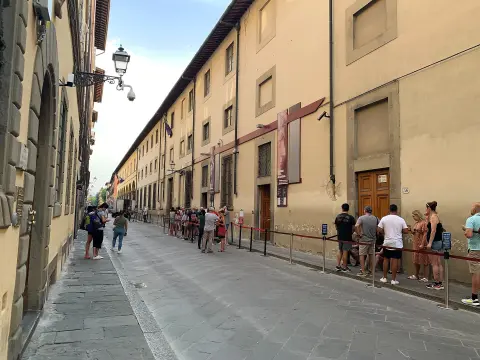
Welcome to the Accademia. From the outside it looks modest, just a doorway on a narrow street. But inside waits one of the most famous statues on earth. You will walk down a long hall, and at the far end, under a bright dome, he stands. David. Over five metres of white marble, calm and alert, the stone in his hand. Many people say a photograph never prepared them for this moment. Before you reach him, you will pass Michelangelo's Prisoners, figures still struggling to break out of their blocks. Take your time with them. They show you how the master worked. Then walk on, step into the light, and say hello to the giant.
The story of Galleria dell'Accademia (Michelangelo's David)
The story starts with a failure. In 1464 the cathedral works office commissioned the sculptor Agostino di Duccio to carve a huge figure from a tall block of Carrara marble. He began, then stopped. Another sculptor, Antonio Rossellino, also gave up. For years the damaged block lay in the cathedral yard. People called it the Giant.
In 1501 the job went to a twenty-six-year-old Michelangelo Buonarroti. He worked on it for about three years. When it was finished in 1504, the city decided it was too fine to sit high on the cathedral as planned. Instead, David was placed beside the door of Palazzo Vecchio, a symbol of the young republic standing up to stronger enemies. He stayed there, in wind and rain, for more than three and a half centuries.
In 1873 the statue was moved indoors to protect it, to this gallery, which had been founded in 1784 by Grand Duke Pietro Leopoldo as part of the Academy of Fine Arts. A special domed tribune was built for him, finished in 1882. A marble copy took his old place in the square in 1910. In 1991 a man attacked the statue with a hammer and damaged a toe, which was carefully restored. Today the gallery is run together with the Bargello museums.
The setting
The Accademia is compact and easy to follow. You enter through the Hall of the Colossus, with paintings from the late 1400s and early 1500s and a plaster model by Giambologna. From there the long Hall of the Prisoners leads straight toward the tribune. On both sides stand Michelangelo's unfinished sculptures. At the end is the tribune itself, a nineteenth-century apse with a glass skylight, designed by Emilio De Fabris, so that natural light falls on David from above. Off to the side is the Gipsoteca, a former hospital ward lined with nineteenth-century plaster models. Upstairs and in the side rooms you will find gold-ground religious paintings and a collection of historic musical instruments.
Why it matters
David is perhaps the most recognised sculpture in the world, and he has become a symbol of Florence itself. For Florentines in 1504 he meant liberty, a small republic facing giants. For artists he showed what the human body could be in stone: balanced, tense, alive. Michelangelo's Prisoners here are just as important in their own way. Because they were never finished, they reveal his method, cutting into the block from one side, as if freeing the figure inside. Together they make this little gallery one of the most visited museums in Italy, and a place where you can stand close to genius at work.
Your walk-through
The stops a guide would take you to, in order.
-
1
Hall of the Colossus
You begin in a room named after the colossal statues of Monte Cavallo in Rome, whose plaster cast once stood here. Today look at the plaster model in the centre, by Giambologna, for his Rape of the Sabine Women, the marble of which stands under the Loggia dei Lanzi. Around you hang paintings from Michelangelo's lifetime, by artists such as Perugino and Filippino Lippi. This is the world the young sculptor grew up in.
-
2
The Prisoners
Now walk slowly down the long hall. On each side stand rough marble figures, half carved, still caught in the stone. They are known as the Prisoners or Slaves, and were made for the tomb of Pope Julius II, a project that dragged on for decades. Look at the chisel marks. Look at a shoulder pushing out of the block while the head is still buried. Many visitors say these are as moving as David himself.
-
3
St Matthew
On your path you will also find St Matthew, another unfinished figure. Michelangelo began it for the cathedral in the early 1500s, as part of a series of twelve apostles, then left for Rome. The saint twists inside the block, one knee raised. You can see how the sculptor worked from the front inward. It feels as if he could walk back in tomorrow and pick up his chisel.
-
4
David, from the front
And here he is. Step back first and take in the whole figure, 5.17 metres tall. He stands with his weight on one leg, the other relaxed, in the classical pose called contrapposto. In his left hand, over his shoulder, is the sling. Notice that his head and hands are a little large for his body. One reason often given is that the statue was meant to be seen from below, high on the cathedral.
-
5
David, walking around
Now walk slowly round him. Look at his face from the side, the frown, the tense brow. He is not celebrating a victory. He is in the moment before the fight, sizing up Goliath. Look at the veins on his right hand, and the stone hidden in it. From behind you can see the tree stump that supports his leg. Michelangelo shaped every muscle from a block other sculptors had given up on.
-
6
The Gipsoteca Bartolini
Before you leave, step into this long hall full of white plaster figures. It was once part of a hospital ward. The models were made in the 1800s by the sculptor Lorenzo Bartolini and his school. Look for the small black dots on many of them. Those are pointing marks, used to copy the plaster into marble. It is a working sculptor's studio, frozen in time.
Things you might not know
- The marble block for David had been started and abandoned by other sculptors decades before Michelangelo took it on in 1501.
- David stood outdoors in Piazza della Signoria from 1504 until 1873.
- The statue is 5.17 metres tall, without its base.
Researched November 2026 from: galleriaaccademiafirenze.it, finestresullarte.info, en.wikipedia.org, en.wikipedia.org. Fees and hours change, so check on the day.