⭐ Must-see · Morro-Cabaña, east side of Havana Bay, 4 km from central Havana
Morro Castle (Castillo de los Tres Reyes del Morro)
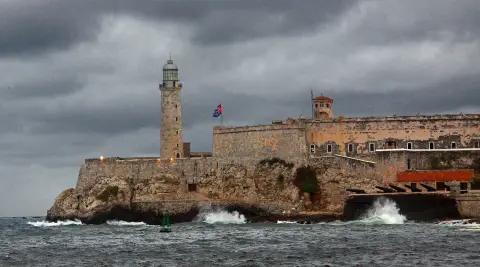
The stone sentinel at the mouth of Havana Bay
🎧 Listen to this guide · about 6 min
Pop your earphones in and we'll walk you round.
Welcome to El Morro. You have crossed under the bay, and now you stand on the rock that has guarded Havana for more than four hundred years. Walk to the edge of the wall and look out. The open sea is on one side. On the other, the whole city lies spread along the water, the Malecón curving away, the Capitol dome rising above the rooftops. Above you the lighthouse stands white against the sky. Feel the thickness of these walls under your hand. They were built to stop pirates and fleets. Today they shelter lizards and photographers, and in the late afternoon the stone turns warm gold.
The story of Morro Castle (Castillo de los Tres Reyes del Morro)
In the sixteenth century Havana was the gathering point for Spain's treasure fleets on their way home, and that made it a target. After raids by French pirates, Spain decided to fortify the harbour entrance. The Italian military engineer Battista Antonelli designed the Castle of the Three Kings of the Morro, named for the three Magi. Work began in the 1580s, and the main fortress was largely complete by the end of the century, though building and improvements went on for decades.
The castle's great test came in 1762, during the Seven Years' War. A British force landed east of the city and placed its guns on the higher ridge of La Cabaña, which Spain had left unfortified. For weeks they bombarded the Morro. Its commander, Captain Luis Vicente de Velasco, defended it until British miners blew a breach in a bastion. He was mortally wounded in the final assault, and the castle fell at the end of July. Britain held Havana for less than a year before returning it to Spain under the Treaty of Paris in 1763.
Spain had learned its lesson and built the huge fortress of La Cabaña on the ridge, finished in 1774. The lighthouse on the Morro was added in the 1840s. In 1982 the castle became part of the Old Havana World Heritage Site.
The setting
The fortress sits on a rocky headland on the eastern side of the narrow channel into Havana Bay. Antonelli shaped it to fit the rock, an irregular polygon of bastions stepping down toward the water. Deep dry moats cut into the stone separate the castle from the land behind it. Inside are ramparts, gun platforms, vaulted rooms and ramps for moving cannon. The lighthouse rises from the seaward corner. Behind and above, along the ridge, stretches the long fortress of La Cabaña, and the two together form the Morro-Cabaña historic park.
Why it matters
El Morro is the face of Havana from the sea. For centuries sailors knew they had arrived when they saw it, and its lighthouse still guides ships into the bay. It is one of the earliest major Spanish forts in the Americas and shows how the empire protected its sea routes. The 1762 siege is a turning point in Cuban history, because the brief British occupation opened the island to wider trade. For you, it is the best place to understand why Havana was built where it is, and to see the city whole.
Your walk-through
The stops a guide would take you to, in order.
-
1
The moat and drawbridge
As you approach, stop on the bridge and look down into the moat. It was cut straight out of the rock. Anyone attacking from the land side had to cross this gap under fire from the walls above. The British in 1762 had to dig mines under these defences to break in. Notice how the walls lean slightly back. That slope helped them absorb cannon shot.
-
2
The inner ramparts
Walk through the gate and climb to the ramparts. Look at the old cannon still lined up toward the sea. From here gunners could fire straight down into the channel, so any ship entering the harbour had to pass right beneath them. Look across the water to the little fort of La Punta. Together the two forts closed the harbour mouth like a pair of jaws.
-
3
The lighthouse
Now head to the lighthouse at the seaward corner. It was added in the 1840s and still works today. When it is open, a small extra fee lets you climb the narrow stairs to the top. The view from up there reaches far out to sea and right across the city. On a clear day you can follow the Malecón almost to its western end.
-
4
The view of the city
Walk along the wall facing the bay. This is the classic picture of Havana. The Malecón curves away to the west, the fortress of La Punta at its tip, the dome of the Capitol behind, and the towers of Vedado beyond. Take your time here. This is where you understand the city's shape, a port that grew up around one deep, protected bay.
-
5
Toward La Cabaña
Finally, look up the ridge behind you to the long walls of La Cabaña. This is the high ground the British seized in 1762 to pound the Morro. Spain built La Cabaña afterward so it could never happen again. If you stay into the evening, you can walk over there for the cañonazo, the firing of a cannon at nine o'clock, a colonial custom that once signalled the closing of the city gates.
Things you might not know
- The castle is named after the Three Kings, the Magi of the Christmas story.
- British forces captured it in 1762 after placing guns on the higher Cabaña ridge.
- A cannon is still fired each night at 9 pm from neighbouring La Cabaña.
Researched November 2026 from: en.wikipedia.org, en.wikipedia.org, whc.unesco.org. Fees and hours change, so check on the day.