⭐ Must-see · Xuan Hoa ward (former District 3), 6 km from central Ho Chi Minh City
War Remnants Museum
Where Saigon remembers the war, plainly and without looking away
🎧 Listen to this guide · about 6 min
Pop your earphones in and we'll walk you round.
Welcome, everyone. Before we go in, take a breath with me here under the trees. This is not an easy museum, and I won't pretend it is. But it may be the most important hour you spend in this city. Inside you will meet the war that Americans call the Vietnam War, and that people here call the American War. You will see it mostly through photographs. Faces, villages, children, soldiers. Some rooms are hard. If you need a moment, step outside, sit in the yard, and come back when you are ready. Nobody here will judge you. Out in the courtyard the machines wait first, silent and heavy. Then we climb the stairs, floor by floor, into the stories.
The story of War Remnants Museum
The museum opened on 4 September 1975, barely four months after the war ended on 30 April that year. It moved into the former United States Information Agency building, a place that had also served American military intelligence during the war. Its first name was blunt: the Exhibition House for US and Puppet Crimes. Puppet meant the government of South Vietnam.
As the years passed, the name softened with the times. In 1990 it became the Exhibition House for Crimes of War and Aggression. In 1995, the year Vietnam and the United States restored diplomatic relations, it took the name you see today, the War Remnants Museum.
The collection grew with gifts and loans. Photographers from many countries contributed images, among them the Japanese photographer Bunyo Ishikawa, who donated work in 1998. Galleries were added on Agent Orange, on napalm and white phosphorus, and on the massacre at My Lai. Today the museum is run by the city and draws visitors from all over the world, and by the museum's own estimate, most of them are foreigners. In February 2026 the museum began selling tickets online as well, to ease the long queues that form on busy days. Its address, 28 Vo Van Tan Street, lies in the ward now called Xuan Hoa.
The setting
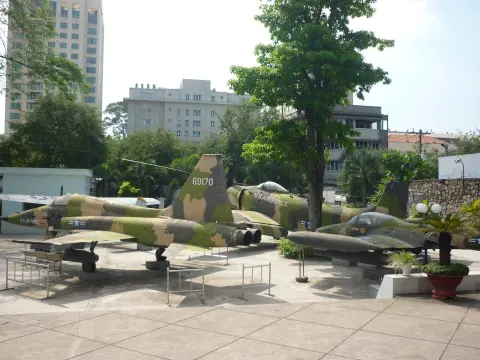
The museum sits on Vo Van Tan Street, a short walk from the Independence Palace. A walled courtyard comes first. It is packed with the hardware of the war: helicopters, fighter planes, a tank, artillery and a huge bomb casing. Shade trees and benches make it a good place to pause. The main building rises behind it over three floors, modern and plain, with wide galleries arranged around a central stair. Each floor carries a theme. Photographs dominate, many in black and white, with captions in Vietnamese and English. In one corner of the grounds stands a separate low building given to the prison system, with reconstructed cells. The whole site is compact. You can walk it end to end in minutes, but you will not want to rush.
Why it matters
For many Vietnamese families, the war is not distant history. It is a grandparent's story, a missing uncle, a village that moved. This museum keeps that memory in public view. It is openly one-sided, and it says so in its tone. That is part of what makes it worth seeing. You hear the official Vietnamese account in its own voice. The galleries on Agent Orange matter most of all, because the effects of the chemical are still felt by families today. Visitors often leave quiet. Many say it changed how they understand the war, and the country around them.
Your walk-through
The stops a guide would take you to, in order.
-
1
The aircraft courtyard
Start among the machines. Here is a Huey helicopter, the sound of the war for so many. There is an F-5A fighter, an A-37 Dragonfly and an old Skyraider. Look at the M48 Patton tank, and the giant BLU-82 bomb casing, nicknamed the Daisy Cutter. One small surprise. Several planes carry United States Air Force markings, yet many of them actually flew for the South Vietnamese air force. Read the plaques closely as you go.
-
2
The tiger cages
Now walk to the low building in the corner. Inside are reconstructions of the so-called tiger cages, the cramped cells used by the South Vietnamese government to hold political prisoners, most famously on Con Dao island. Stand by one for a moment and imagine the heat. Nearby you will see a French guillotine, used by both the French and the South Vietnamese governments. It was last used in 1960. It is a cold, quiet object, and people often fall silent here.
-
3
Historical truths gallery
Back in the main building, the ground floor sets the scene. Posters, newspapers and messages from around the world show how the war looked from abroad. Look for the photos of the protests that filled streets far from Vietnam. There are letters and badges too. This floor gives you the politics. The floors above give you the people. Take your time with the timeline, because it helps the rest of the museum make sense.
-
4
Agent Orange gallery
This is the room people remember. Between the early 1960s and 1971, American forces sprayed millions of litres of defoliant over forests and fields. The worst of these contained dioxin. The photographs show the people born afterwards, many with serious disabilities. Some are portraits of children growing up, smiling, studying, painting. You will also see preserved specimens in jars. If that is too much for you, there is no shame in walking past. Read the stories of the families.
-
5
War photography galleries
Upstairs the photographs grow larger and more personal. Look for the images of My Lai, where hundreds of villagers were killed by American troops in March 1968. Look for the work of Bunyo Ishikawa, a Japanese photographer who covered the war and gave his pictures to the museum. Notice the faces of soldiers on every side. Many images were taken by photographers who never came home. Walk slowly. Let the silence do its work.
Things you might not know
- The museum opened on 4 September 1975, just over four months after the war ended.
- It occupies the former United States Information Agency building.
- It took its current name, War Remnants Museum, in 1995, the year Vietnam and the United States restored diplomatic ties.
Researched November 2026 from: en.wikipedia.org, news.tuoitre.vn, baovanhoa.vn, en.sggp.org.vn. Fees and hours change, so check on the day.