💎 Hidden gem · Sant Josep de sa Talaia (south coast), 12 km from central Ibiza
Sa Caleta Phoenician Settlement
Where Ibiza's first town rose on a red rock headland
🎧 Listen to this guide · about 5 min
Pop your earphones in and we'll walk you round.
Welcome to Sa Caleta, on the south coast. This is a quiet place. You will see low stone walls on a rocky headland, a few signs, the sea on three sides and a little cove with red cliffs. It may not look like much at first glance. But stand here for a moment and imagine: nearly three thousand years ago, Phoenician sailors pulled their boats up on this shore and built a village. It was the first town on Ibiza that we know of. Later its people moved to the bay of Ibiza and founded the city we know today. So this is where it all started. Take your time, read the panels, and let the sea breeze tell you the rest.
The story of Sa Caleta Phoenician Settlement
The settlement at Sa Caleta was founded by Phoenicians who came from the eastern Mediterranean. Archaeologists still debate the exact date, with estimates ranging from the late eighth to the mid seventh century BC. They chose this low headland because it had a sheltered cove for boats, fertile land behind it, and the nearby salt flats.
The village grew to cover several hectares. Its people fished, farmed, raised animals and worked metal, and they traded with other Phoenician colonies across the western Mediterranean. Archaeologists have found the remains of houses, streets, ovens and workshops. Much of what we know comes from those excavations, which uncovered the plans of houses, streets and courtyards you can still trace today.
Then, around 600 BC, the settlement was abandoned. It seems to have been a planned move rather than a disaster. The inhabitants probably relocated to the bay of Ibiza, where the hill of Dalt Vila offered a better harbour and a stronger position. That new town grew into Ibosim, the ancestor of Ibiza Town. Sa Caleta was left to the wind and the sea, and its walls slowly crumbled. It was excavated in the late twentieth century and in 1999 became part of the UNESCO World Heritage Site.
The setting
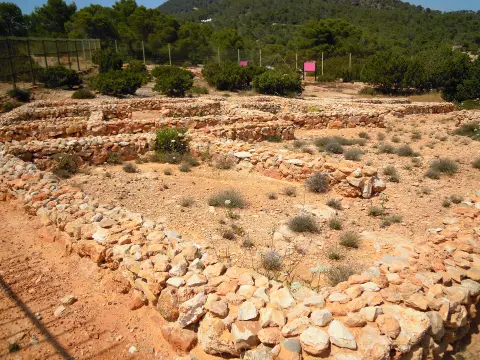
Sa Caleta sits on a low headland of reddish rock, between the beaches of Es Codolar and the cove of Sa Caleta itself. The ruins are fenced but visible, with low walls marking out houses and streets. A path with information panels runs around the site. On one side is the open sea, on the other the small cove with its red sandstone cliffs and fishermen's boathouses. Behind the site lies flat land and, a little further, the salt pans and the airport. The landscape is dry and open, with scrub and a few pines. Information panels along the way explain what each group of walls once was.
Why it matters
Sa Caleta is the birthplace of Ibiza Town and one of the best examples of an early Phoenician settlement in the western Mediterranean. Because it was abandoned so early, it gives archaeologists a rare snapshot of a Phoenician village from that time, without later buildings on top. For visitors, it is a chance to stand at the very beginning of the island's urban story, in a peaceful spot most tourists pass by.
Your walk-through
The stops a guide would take you to, in order.
-
1
The entrance panels
Start at the information panels near the entrance. They show a plan of the settlement and drawings of how it may have looked. Take a minute to orient yourself. Notice how the village filled the headland, with the sea all around. The boats would have come into the cove just beside us.
-
2
House remains
Walk along the fence and look at the low stone walls. These are the foundations of houses. Most had several small rooms around a courtyard, with walls of stone at the bottom and mud brick above. Try to picture the roofs of reeds and clay, smoke rising from cooking fires, and the sound of people working.
-
3
Streets and workshops
Look for the narrow gaps between the buildings. These were the streets. Archaeologists found ovens here, and traces of metalworking. The people of Sa Caleta made what they needed, but they also traded, bringing in goods from across the Mediterranean.
-
4
The seaward edge
Walk to the seaward edge of the site. From here you can see the coast to the east, toward the bay of Ibiza. That is where the people of Sa Caleta eventually moved. On a clear day, you can just make out the hill of Dalt Vila. It is a beautiful line to draw in your mind, from this first village to the old town.
-
5
Sa Caleta cove
Finish at the little cove beside the site. Look at the red cliffs and the boathouses. The colour comes from iron in the rock. This cove is probably why the Phoenicians chose this place. It is small but sheltered, perfect for their boats. Today it is a lovely spot for a swim. Sit on the rocks and enjoy the quiet.
Things you might not know
- Sa Caleta is the oldest known Phoenician settlement on Ibiza.
- It was abandoned around 600 BC, probably when its people moved to the bay of Ibiza.
- It is one of four parts of the UNESCO World Heritage Site Ibiza, Biodiversity and Culture.
Researched November 2026 from: en.wikipedia.org, illesbalears.travel, whc.unesco.org. Fees and hours change, so check on the day.