💎 Hidden gem · Tahtakale, Eminönü, 1 km from central Istanbul
Rüstem Pasha Mosque
A secret garden of tiles above the market
🎧 Listen to this guide · about 5 min
Pop your earphones in and we'll walk you round.
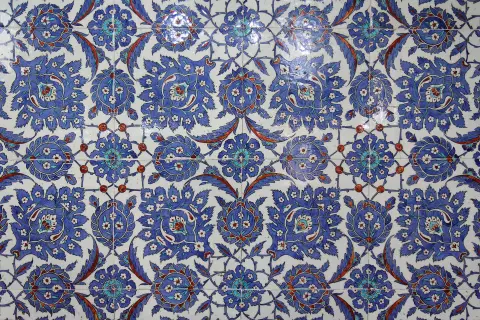
This one is easy to miss, and that is half its charm. You are in Tahtakale, a crowded market street just west of the Spice Bazaar. Porters push carts, sellers shout prices, and there seems to be no room for anything quiet. Then you find a narrow stone stairway between the shops, climb it, and arrive on a terrace in front of a small mosque. Step inside and you are surrounded by tiles: tulips, carnations, hyacinths and pomegranate blossoms in blue, turquoise and a deep tomato red. This is the Rüstem Pasha Mosque, built by Sinan, the greatest Ottoman architect. Many people say its tiles are the most beautiful in Istanbul. Come and decide for yourself.
The story of Rüstem Pasha Mosque
Rüstem Pasha was one of the most powerful men of the sixteenth century. He served twice as grand vizier to Suleiman the Magnificent and was married to the sultan's daughter, Mihrimah Sultan. He was known as a sharp manager of the treasury and was also accused of greed by his enemies. He was very rich, and he spent part of that wealth on charity and building.
He asked the imperial architect Mimar Sinan to design this mosque. Rüstem Pasha died in 1561, before it was finished, and the work was completed around 1563, probably under Mihrimah's care. Sinan had a crowded site in a busy commercial district. His clever solution was to raise the mosque up on a platform, with vaulted shops underneath. The rents from those shops helped pay for the mosque.
The tiles came from the workshops of İznik at their very best, just as potters had perfected a brilliant raised red. No other mosque uses them so lavishly. Some tiles were replaced over the centuries, but most of what you see dates from the 1560s. Today it remains a neighbourhood mosque, quietly serving the traders of the market below, as it has for more than four and a half centuries.
The setting
The mosque stands on a raised terrace above the Tahtakale market streets, close to the Golden Horn. You reach it by covered stairways from the street. In front is a double porch, and its outer walls are tiled too. The prayer hall is a compact octagonal space under a central dome, supported by four half domes at the corners and pillars set against the walls. Small galleries run along the sides. Every surface you can reach, the walls, the piers, the mihrab and the porch, is covered in tiles. Light comes through tiers of windows, so the colours change through the day.
Why it matters
This mosque shows İznik tile art at its peak, before Sinan and later architects began to use tiles more sparingly. Art historians come here to study the patterns and the famous red glaze. It is also a fine example of Sinan's skill at fitting a beautiful building into a difficult city site, and of the Ottoman system of supporting mosques with market rents. It is still a working neighbourhood mosque, used by the shopkeepers and porters below.
Your walk-through
The stops a guide would take you to, in order.
-
1
The market stairway
Look for the stairway on Hasırcılar Caddesi, the Street of the Mat Makers. It rises between shops into the gloom. You are climbing through the commercial foundations Sinan built. The vaulted rooms around you are still shops, still paying their way. At the top, pause and notice the change: sudden calm, fresh air and a view of the mosque front.
-
2
The porch tiles
Before you go in, look at the walls of the porch. They are already covered in tiles, with panels of flowering trees and vines. Notice the red. It is slightly raised, like a thin layer of coral on the surface. İznik potters mastered this colour only in the mid sixteenth century, and later it became harder to make. Look closely, but please do not touch.
-
3
The prayer hall
Step inside after removing your shoes. Let the room surround you. Tulips, carnations, hyacinths, roses and plum blossom climb every wall. Look for patterns that repeat across many tiles to form one large design, and for panels that tell their own small story. Find a quiet spot near the back and simply sit. Few rooms in the world are this richly coloured.
-
4
The mihrab and the piers
Walk toward the mihrab, the niche facing Mecca, which is framed in tiles of the finest quality. Then look at the piers holding up the dome. Each face carries a different pattern. Some visitors spend time looking for a small panel said to show the Kaaba in Mecca, a reminder that these tiles were not only decoration but part of the faith practised here.
-
5
The galleries
Look up to the side galleries. Some of the most beautiful tiles are up there, and the gallery is usually closed, so view them from below. From here you can also see how the dome rests on its octagon of arches. Before you leave, look back at the whole room from the doorway. Then descend into the noise of the market again, a little dazzled.
Things you might not know
- Rüstem Pasha died in 1561, about two years before his mosque was finished.
- The mosque stands on a platform above vaulted shops, whose rents helped pay for its upkeep.
- It is often said to have the most lavish use of İznik tiles of any Ottoman mosque.
Researched November 2026 from: en.wikipedia.org, cornucopia.net, archnet.org. Fees and hours change, so check on the day.