💎 Hidden gem · Falmouth, Trelawny, 35 km from central Jamaica (Montego Bay)
Falmouth Historic Town
A Georgian sugar port, still standing on its old streets
🎧 Listen to this guide · about 5 min
Pop your earphones in and we'll walk you round.
Welcome to Falmouth, the old capital of the parish of Trelawny. If you came by cruise ship, you have seen the big modern pier. Now let us walk away from it into the old town. Look at the buildings: two-storey houses with stone ground floors, timber upper floors and long verandas, shuttered windows, iron railings. Falmouth is often called one of the best preserved Georgian towns in the Caribbean. It is also a town built on sugar and slavery. Ships here loaded sugar and rum for Britain, and enslaved Africans were landed and sold. Walk with me, and look at both its beauty and its history honestly.
The story of Falmouth Historic Town
Falmouth was founded in 1769 on the coast of Trelawny, near the mouth of the Martha Brae River. It was named after Falmouth in Cornwall, England, the birthplace of Sir William Trelawny, then Governor of Jamaica. The town was laid out on a planned grid, like a small English town, and quickly grew rich.
In the late eighteenth and early nineteenth centuries, Trelawny had a great many sugar estates, and Falmouth was its port. Ships carried sugar and rum to Britain, and brought in goods and, until the slave trade was abolished in 1807, enslaved Africans. Merchants and planters built fine houses, churches and public buildings. Falmouth even had piped water earlier than New York City.
After emancipation in 1838 and the decline of sugar, the town's trade faded. That decline helped save its buildings, since there was little money to tear them down. In 2011 a large cruise port opened here, bringing new visitors. In October 2025 Hurricane Melissa caused serious damage, including the loss of the old courthouse, and restoration work is continuing. Local heritage groups have long argued that Falmouth's buildings are worth saving not only for their looks, but because they hold the memory of the people, free and enslaved, who lived and worked in them.
The setting
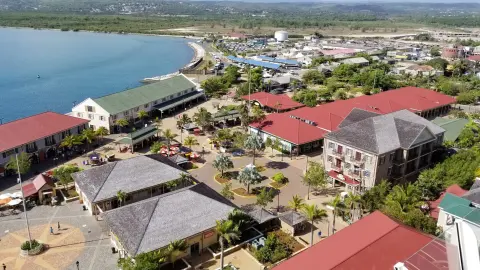
The old town sits on flat land at the edge of the sea, with the cruise pier on its northern side. Streets run in a neat grid around a central area known as Water Square. Many buildings are Georgian in style: symmetrical fronts, cut stone lower floors, wooden upper floors with jalousie windows, and deep verandas to give shade. Some are well restored, others worn or damaged. Main landmarks include St Peter's Anglican Church, built in 1795, the William Knibb Memorial Baptist Church, the Albert George building, dating from 1895, and old merchants' houses. To the east, the Martha Brae River meets the sea at the Luminous Lagoon.
Why it matters
Falmouth matters because so much of its old fabric survives. It lets you see, at street level, the scale and layout of a Caribbean sugar port in the age of slavery. That makes it a powerful place to learn about how wealth and suffering were bound together. Local groups and heritage bodies have worked for years to restore its buildings and to tell fuller stories, including those of enslaved and free Black Jamaicans. Supporting local guides and businesses here helps keep the town, and its history, alive.
Your walk-through
The stops a guide would take you to, in order.
-
1
Water Square
Start at Water Square, the heart of the old town. It is named after the water system that once supplied Falmouth, piped from the Martha Brae River. The town had piped water before New York City did. Look around the square at the old buildings, many with stone ground floors and wooden upper floors. This is a good place to imagine the market days of the early 1800s.
-
2
The Albert George building
Walk to the Albert George building, which dates from 1895, long after the peak of the sugar trade. It has served as a market and a shopping and heritage centre. Notice how its style differs from the older Georgian houses. By the 1890s, Falmouth's great years were over, but the town kept building, in a more modest way.
-
3
Merchants' houses on Market Street
Stroll along the streets near the square. Look up at the verandas and shutters. These were merchants' homes and businesses, with stores below and living rooms above. Many of the merchants dealt in sugar and rum. Some dealt in human beings: enslaved Africans were sold in Falmouth before the trade ended in 1807. The beauty of these buildings is inseparable from that history.
-
4
William Knibb Memorial Baptist Church
Now come to the William Knibb Memorial Baptist Church. William Knibb was an English Baptist missionary who campaigned hard against slavery. So the story goes, on the night before full freedom in 1838, he gathered his congregation, and they buried symbols of slavery, such as chains and a whip, in a coffin. The church you see was rebuilt in the twentieth century.
-
5
St Peter's Anglican Church
End at St Peter's Anglican Church, built in 1795, near the shore. It was the church of the planters and officials of Trelawny. Walk around the churchyard and look at the old graves. Then step back and look across at the modern cruise pier. Two centuries of history in one view: the sugar town, and the tourism that now brings new life to its streets.
Things you might not know
- Falmouth was founded in 1769 and named after Falmouth in Cornwall, birthplace of Governor Sir William Trelawny.
- The town had piped water earlier than New York City.
- St Peter's Anglican Church in Falmouth was built in 1795.
Researched November 2026 from: en.wikipedia.org, en.wikipedia.org, jnht.com. Fees and hours change, so check on the day.