🚗 Day trip · Namo Buddha, 45 km from central Kathmandu
Namo Buddha
Homage to the Buddha on a forested hill
🎧 Listen to this guide · about 5 min
Pop your earphones in and we'll walk you round.
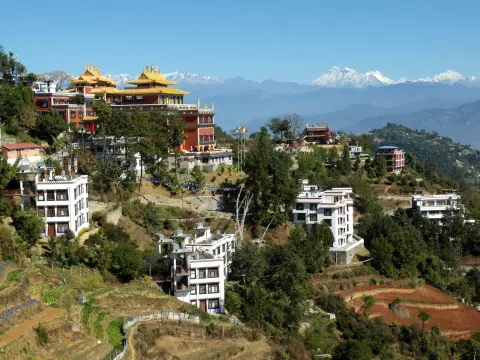
You stand on Gandha Malla Hill, 40 kilometres southeast of Kathmandu. Prayer flags flutter in the breeze above a white stupa that marks an act of supreme compassion. Forest paths lead upward to a monastery where monks chant and study. This is Namo Buddha, a place of pilgrimage for Buddhists from many traditions. The air feels still and clear. You have time to walk slowly, listen to the stories, and feel the quiet power of the site. The hill rises to about 1750 metres. On clear days the distant Himalayas appear on the horizon.
The story of Namo Buddha
According to Buddhist Jataka tales, Prince Mahasattva, an early incarnation of Shakyamuni Buddha, walked these forests with his brothers. He found a starving tigress unable to feed her cubs. Moved by compassion, he offered his own body so they might live. His bones and hair were later enshrined in a stupa built by his grieving family.
Centuries later, Gautama Buddha visited the site, recognised his past deed, circumambulated the stupa three times, and named the place Namo Buddha, meaning homage to the Buddha. In the fifth century the Licchavi king Mana Deva I expanded the sanctuary and established support for its care. The site remained a revered stupa for centuries.
In 1978 Khenchen Thrangu Rinpoche founded the Thrangu Tashi Yangtse Monastery here in the Karma Kagyu tradition. The main temple was consecrated in 2008. The monastery now houses more than 250 monks and serves as a centre for study, practice and community service.
The setting
The site occupies a pine-covered ridge on Gandha Malla Hill. A paved road reaches a small parking area near the main stupa. From there a stone stairway climbs through the forest to the monastery complex above. Prayer flags line the paths. The white stupa stands surrounded by smaller shrines and mani wheels. Nearby a carved stone panel depicts the prince offering himself to the tigress. Two caves on the hill are associated with the tigress in local tradition. The monastery buildings feature traditional Tibetan architecture with golden roofs, assembly halls and monks’ quarters. Terraced fields and villages lie below, with open views across the hills.
Why it matters
Namo Buddha ranks as one of the three most important Buddhist pilgrimage sites and stupas in the Kathmandu Valley, alongside Swayambhunath and Boudhanath. It embodies the Mahayana teachings of compassion and generosity. Pilgrims from Nepal, Tibet, Bhutan and beyond continue to visit. Monks from all four major Tibetan Buddhist schools have paid homage here over the centuries. Today the active monastery keeps the tradition alive through daily practice, education and retreats while welcoming visitors who seek quiet reflection amid the natural setting.
Your walk-through
The stops a guide would take you to, in order.
-
1
Main Stupa
Begin at the white stupa on the lower slope. Walk clockwise around it, as pilgrims do. This stupa enshrines the bone relics of Prince Mahasattva. The structure has stood here for centuries as a focal point of devotion. Notice the prayer wheels and small shrines that surround it. The site feels ancient and cared for. Many visitors pause here to absorb the stillness before continuing upward.
-
2
Carved Stone Panel
Near the stupa look for the carved stone slab that shows the prince cutting his flesh for the tigress. The scene is rendered in clear detail. It illustrates the moment of ultimate generosity described in the Jataka tale. The carving serves as a visual teaching of the Bodhisattva path. Pilgrims often stop to reflect on the story before moving on.
-
3
Forest Stairway
Follow the stairway that rises from the stupa into the pine forest. The path is lined with prayer flags. As you climb you pass through quiet woods that once formed the setting of the legend. The steps are steady and the air cooler under the trees. This short ascent connects the lower stupa with the upper monastery grounds.
-
4
Sacrifice Site Area
At the top of the stairway you reach the area traditionally identified as the place where the prince offered his body. A small sanctuary marks the spot beside the monastery. The location is sanctified and quiet. Many pilgrims spend time here in contemplation of the act of compassion that defines the site.
-
5
Tigress Cave Vicinity
A short distance from the main monastery area lies a small cave venerated as the tigress’s den. A stone sculpture nearby depicts the tigress and her cubs. Local tradition holds that this is where the starving animals were found. The cave adds a tangible element to the ancient story.
-
6
Thrangu Tashi Yangtse Monastery
Enter the monastery complex founded in 1978. The main assembly hall contains large Buddha images, butter lamps and elaborate murals. You may hear monks chanting during morning or afternoon puja. The buildings house study halls, a school and retreat facilities. Visitors are welcome to observe respectfully from designated areas.
Things you might not know
- The site is one of only three major stupas considered most sacred in the Kathmandu Valley.
- The modern monastery was established in 1978 and now educates more than 250 monks.
- Local people reportedly began calling the place Namo Buddha to avoid mentioning tigers out of fear of the animals that once lived in the area.
Researched November 2026 from: namobuddha.org, en.wikipedia.org, en.wikipedia.org, getawaynepal.com, atlasobscura.com. Fees and hours change, so check on the day.