💎 Hidden gem · Nowa Huta, 10 km from central Kraków
Nowa Huta Central Square
A workers' utopia, poured in concrete and tree-lined avenues
🎧 Listen to this guide · about 5 min
Pop your earphones in and we'll walk you round.
Welcome to Plac Centralny, the Central Square of Nowa Huta. It feels like another city. Wide streets fan out from where you stand, lined with stately apartment blocks, arcades and courtyards. This was meant to be the model town of communist Poland, built around a giant steelworks. Many people here still call the square by its old name, even though officially it now honours Ronald Reagan. That tells you a lot. Nowa Huta is full of these layers. It was built to celebrate the communist state, and later became a centre of resistance against it. Bring your curiosity. This is history that people here still remember first-hand.
The story of Nowa Huta Central Square
Nowa Huta, which means New Steelworks, was founded in 1949 on farmland and villages east of Kraków. The communist government wanted a model socialist city for industrial workers, and a huge steelworks to go with it. Some historians say it was also a political message to conservative, Catholic, intellectual Kraków. In 1951 Nowa Huta was joined to Kraków as a district.
The Lenin Steelworks opened in 1954. The town was planned in socialist-realist style, with a grand central square and avenues spreading out from it like a fan. The plan promised everything workers needed within walking distance: schools, shops, cinemas, parks and a theatre. One thing was left out: a church. Residents campaigned for years, and the Lord's Ark church, a striking modern building in the Bieńczyce estate, was finally consecrated in 1977 by Cardinal Karol Wojtyła, later Pope John Paul II.
In the 1980s Nowa Huta became a stronghold of the Solidarity movement, with strikes and street clashes with the police. In 1973 a statue of Lenin was put up on Aleja Róż; it was removed in December 1989 as communism ended. In 2004 the square was renamed Ronald Reagan Central Square. The steelworks is now owned by a private company, and Nowa Huta is an ordinary, green part of the city with a strong local identity.
The setting
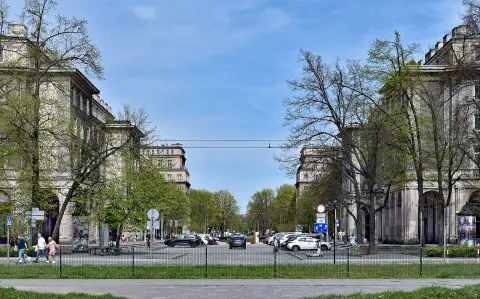
The Central Square is a broad, open space at the southern tip of the town plan. Five main avenues spread north from it, making a fan or half-star shape. The buildings around the square are solid and symmetrical, with arcades, decorative cornices and classical touches. Beyond them are courtyard housing blocks with plenty of trees and lawns. To the north, Aleja Róż, the Avenue of Roses, leads to residential districts. To the east lies the vast steelworks complex, behind its own monumental administrative buildings. To the south, the land drops toward the Nowa Huta meadows, a wide open grassland.
Why it matters
Nowa Huta matters as one of the largest planned socialist towns ever built, and one of the best preserved. Architects and historians come to study its layout. For Poles, it is a symbol of both the communist project and the resistance to it, from the fight for a church to the Solidarity strikes. For visitors, it offers a different, very real Kraków: everyday life, local bakeries, old milk bars and green courtyards, far from the crowds of the Old Town.
Your walk-through
The stops a guide would take you to, in order.
-
1
Plac Centralny
Stand in the middle of the square and look north. The avenues spread out in front of you, framed by symmetrical buildings with arcades. The original plan included a grand town hall and a theatre on the southern side, which were never built. Notice how the architecture borrows classical forms, columns and cornices, to give workers' homes the dignity of palaces.
-
2
Aleja Róż (Avenue of Roses)
Walk up Aleja Róż, the Avenue of Roses. In 1973 a statue of Lenin was put up here. It was taken down in December 1989, as communism fell in Poland. Today the avenue is a quiet place with benches and flowerbeds. Older residents may remember both the statue and the protests that gathered around it.
-
3
Residential courtyards
Step through an archway into one of the housing courtyards, the osiedla. They were designed as small self-contained neighbourhoods, with green spaces, play areas and shops nearby. Many still have old milk bars, simple canteens serving soups, pierogi and pancakes at low prices. Try one. They are a living piece of Polish everyday history.
-
4
Steelworks Administrative Centre
If you have time, take a tram east to the steelworks' administrative centre, two grand buildings that local people nicknamed the Doge's Palace for their Renaissance-style attics. Behind them lies the steelworks itself, once named after Lenin and still working. It is not open to casual visitors, but the scale of the entrance tells you how central it was to the whole idea of Nowa Huta.
-
5
Lord's Ark Church (Arka Pana)
Finally, head to the Bieńczyce estate to see the Lord's Ark church, built by residents over eight years and consecrated in 1977. Its shape recalls Noah's Ark, with a huge cross rising like a mast. Inside, look for the figure of Christ cast in metal. This church was a symbol of the community's determination to have a place of worship in a town planned without one.
Things you might not know
- Nowa Huta was founded in 1949 and became part of Kraków in 1951.
- The Lord's Ark church was consecrated in 1977 by Cardinal Karol Wojtyła, later Pope John Paul II.
- The Central Square was officially renamed after Ronald Reagan in 2004, but most locals still call it Plac Centralny.
Researched November 2026 from: en.wikipedia.org, britannica.com, culture.pl. Fees and hours change, so check on the day.