⭐ Must-see · Skukuza
Skukuza Rest Camp and the Sabie River
The old warden's river camp, where Kruger's story begins
🎧 Listen to this guide · about 7 min
Pop your earphones in and we'll walk you round.
Welcome to Skukuza. Stand here on the riverside path and listen for a moment. That low grunt from the reeds is a hippo. The splash downstream might be a fish eagle taking its breakfast. In front of you runs the Sabie River, one of the richest stretches of water in the whole of Kruger. Behind you is the park's biggest rest camp, with its thatched huts, shady trees and the smell of coffee from the restaurant deck. This is where most first-time visitors sleep, and it is where the park's own story began. Today we will walk the camp slowly, from the river to the old railway bridge and the memorial library. Keep your binoculars close. The river is always watching you back.
The story of Skukuza Rest Camp and the Sabie River
Long before there was a park, this stretch of the Sabie was home to Tsonga-speaking communities, and to the animals they lived beside. In 1898 the government of the South African Republic, under President Paul Kruger, proclaimed the Sabi Game Reserve between the Sabie and Crocodile rivers. After the Anglo-Boer War, in July 1902, a young Scottish officer named James Stevenson-Hamilton was appointed warden. He made an old blockhouse on the Sabie River his base, and the spot was known for years as Sabi Bridge, after the railway crossing.
The local staff gave Stevenson-Hamilton a nickname, Skukuza, usually translated as the one who sweeps clean, for the way he cleared the reserve of poachers. Some historians link the name also to resentment of the removals of people from the land. In time the name passed to the camp itself. In 1926 the reserve became the Kruger National Park, and in 1927 the first three tourist cars drove in.
The Selati railway once ran straight through here. After the park was proclaimed, it was seen as a disturbance to wildlife, and the line inside the park was closed by 1973. Its bridge over the Sabie still stands. In 1961 the Stevenson-Hamilton Memorial Library opened in the camp, keeping books and relics of the park's early years.
The setting
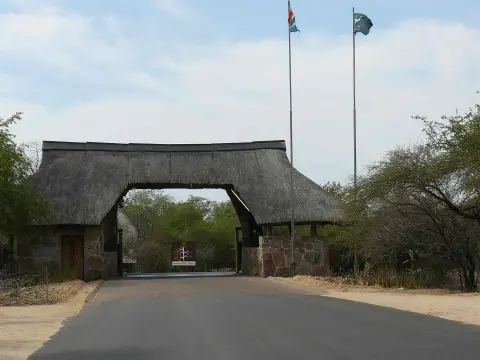
Skukuza sits low on the south bank of the Sabie, at about 260 metres above sea level, in rolling granite country. The river here is wide and sandy, braided with reed beds and pools, and lined with huge sycamore figs, jackalberries and Natal mahoganies. A fenced footpath follows the bank for much of the camp's length, with benches set under the trees. Inside the camp you will find a reception and shop, a restaurant deck over the water, a fuel station, a post office, the library and museum, and rows of thatched rondavels and cottages. The old Selati railway bridge spans the river on the eastern side, and the camp's small airport lies just to the north. Roads lead out in every direction, which is why so many people use Skukuza as their base.
Why it matters
Skukuza is still the working capital of Kruger. The park's management, scientists and many of its staff live and work here, and decisions made in these offices shape conservation across one of Africa's best-known parks. For visitors, it is the easiest place to understand how a hunting frontier became a protected wilderness. The library tells the story honestly, including the cost to people who were moved off the land. And the river reminds you why it all mattered. The Sabie is a perennial river, flowing even in the dry season, and it pulls elephants, buffalo, hippos and birds to its banks all year round.
Your walk-through
The stops a guide would take you to, in order.
-
1
The riverside path
Start at the reception and walk down to the fence along the water. Look along the far bank for elephants coming down to drink, and check the sandbanks for basking crocodiles. Bushbuck often browse just below the fence, so quiet that most people walk past them. In the tall fig trees, watch for green pigeons and the brilliant flash of a purple-crested turaco. Early morning and late afternoon are best, when the light is soft and the animals move.
-
2
The restaurant deck
The deck hangs over the riverbank and gives you a wide view upstream and down. It is a fine place to sit with a coffee and simply watch. Hippos rest in the deeper pools during the heat of the day, surfacing with a snort every few minutes. Grey herons and pied kingfishers hunt along the edge. Take your time here. Many visitors rush out to chase sightings, but some of the best moments in Kruger happen to people who sit still.
-
3
The Stevenson-Hamilton Memorial Library
This library and museum opened in 1961, a few years after Stevenson-Hamilton's death. Inside are books on ecology and history, old photographs and objects from the park's early days. Look for the knife that ranger Harry Wolhuter used to kill a lion that had dragged him from his horse in 1903. It is a reminder of how raw this country was for the first rangers. Read the panels on the people who lived here before the reserve, too.
-
4
The Founders frieze
Outside the reception building is a large frieze showing the three people traditionally honoured as the park's founders. Paul Kruger proclaimed the first reserve. James Stevenson-Hamilton guarded and grew it for more than forty years. Piet Grobler, the minister, carried the National Parks Act through parliament in 1926. Look closely, then think about who is missing from the picture, the rangers and local workers whose names the old histories rarely recorded.
-
5
The old Selati railway bridge
Walk east towards the old railway line. The bridge over the Sabie was part of the Selati railway, which once carried tourists through the park on the famous Round in Nine tours from 1923. The line inside the park was closed by 1973. Today the bridge carries a train-themed hotel built on the old tracks. Stand by the fence and look at the river from this height. You can often spot elephants or buffalo crossing the sand below.
-
6
The camp at dusk
End your walk back at the riverside as the gates close. The light turns gold, then pink, over the water. Fruit bats begin to chatter in the figs, and you may hear the first whooping call of a hyena out in the bush. Somewhere along the river, a lion might roar. This is the sound of Skukuza at night. It has been the same here for far longer than any camp has existed.
Things you might not know
- Skukuza was the nickname of the first warden, James Stevenson-Hamilton, before it became the camp's name.
- The first three tourist cars entered the park in 1927, and visitors made their own camps inside thorn-bush enclosures.
- The library displays the knife ranger Harry Wolhuter used to kill a lion that attacked him in 1903.
Researched November 2026 from: en.wikipedia.org, en.wikipedia.org, southafrica.co.za, atta.travel. Fees and hours change, so check on the day.