💎 Hidden gem · Tsemo Hill, Leh, 2 km from central Leh, Ladakh
Namgyal Tsemo Monastery
Prayer flags and a royal fort on Leh's highest ridge
🎧 Listen to this guide · about 6 min
Pop your earphones in and we'll walk you round.
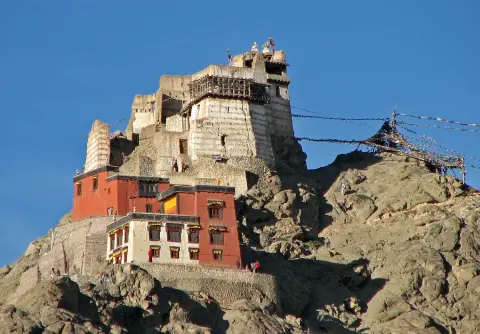
Welcome to Namgyal Tsemo. Most visitors stop at Leh Palace and look up at this ridge. Only some make the climb. You are one of them, and you will be glad. Up here, on the summit of Tsemo Hill, stand the red walls of a small monastery and the ruins of an old royal fort, strung together with countless prayer flags. The wind never really stops. Below you lies Leh Palace, and below that the whole town, like a map spread out on the table. The monastery is small and quiet, sometimes locked, with a caretaker monk who comes and goes. If the door is open, step inside to meet the great golden Maitreya. If not, the view alone is worth the climb.
The story of Namgyal Tsemo Monastery
Tsemo Hill was the first royal stronghold of Leh, long before the palace below was built. Its name means peak, and from here early rulers could watch the valley and the trade routes.
The monastery is linked with King Tashi Namgyal, who ruled Ladakh in the sixteenth century, during the rise of the Namgyal dynasty. He is remembered for building the fort and the temples on this summit. His successors later built the great palace lower down the slope, but Tsemo kept its sacred role.
The Namgyal Tsemo monastery is known for its three-storey statue of Maitreya, the Buddha of the future, along with old manuscripts and wall paintings. Close by is a temple for the protector deities, the guardians of the town. The fort, known as Tsemo Castle or the Victory Fort, is now mostly a ruin, but its walls still give the ridge its shape. Over the centuries, the summit has been patched and repaired, and prayer flags are renewed by local people. You may see the date 1430 given for the monastery, but that does not fit the reign of Tashi Namgyal. The sixteenth century matches the history of the dynasty far better.
The setting
Tsemo Hill rises steeply behind Leh Palace, a bare rocky ridge that is the highest point above the old town. On its summit are two main groups of buildings. One is the monastery, with its red-painted temples. The other is the ruined fort, a jumble of mud-brick and stone walls along the crest. Between and around them, ropes of prayer flags stretch in every direction, so dense in places that they form a canopy. A steep footpath climbs from the old town past the palace, and a narrow road reaches the top from the other side. From the summit you look south over the palace and town, and across to the Stok range and the Indus valley.
Why it matters
For the people of Leh, Tsemo is a protective presence above the town, and its temples are part of the city's sacred geography. The constant renewal of prayer flags on the ridge shows that this is a living place of devotion, not just a ruin. For travellers, it gives the best overall view of Leh and helps you understand how the town grew, from fort, to palace, to bazaar, to the modern spread toward the airport.
Your walk-through
The stops a guide would take you to, in order.
-
1
The path from the old town
We begin in the lanes behind the palace. The path climbs steeply in loose zigzags. Go slowly, and stop every few minutes. With every pause the view widens. You will see the roof terraces of the palace below you, and the old town falling away. If you are still getting used to the altitude, there is no hurry. A taxi can also take you to the top by road.
-
2
The prayer flag canopy
Near the top, the prayer flags thicken around you. Thousands of them, old and new, faded to pale shades or bright and fresh. Local people renew them, often at Losar, the Ladakhi new year, or for special prayers. Listen to the sound they make in the wind. It is the soundtrack of this hill, a steady rustle and snap.
-
3
The Maitreya temple
Here is the main temple. If the caretaker is present, you can step inside and meet Maitreya, the future Buddha, a gilded figure rising through three storeys. The space is cramped and dim, and you will find yourself looking up and up at his face. Around the walls are old paintings and shelves of manuscripts. Leave a small donation if you can. It helps keep the temple alive.
-
4
The protector temple
Next door is the temple of the protectors. These fierce deities guard the teachings and, so local people believe, the town below. It is often closed, and some parts may not be open to visitors. If you go in, be respectful and quiet. Even from outside, notice the dark entrance and the painted figures. This is one of the most sacred corners of the hill.
-
5
The ruined fort
Now walk along to the fort ruins. These broken walls of mud brick and stone are what remains of the early royal stronghold on Tsemo. Do not climb on them, as they are fragile. From here imagine the guards looking out along the valley for raiders and caravans. This was the strategic heart of Leh before the palace was built below.
-
6
The summit viewpoint
Finish at the highest point you can safely reach. Below you, the palace looks almost small. Beyond, the town, the green fields, the airport runway and the Indus valley. Across the river, the snow of the Stok range. At sunset the light here is wonderful, and the town lights begin to glow. Take your time on the way down, as the path is loose.
Things you might not know
- The monastery is linked with King Tashi Namgyal, who ruled Ladakh in the sixteenth century.
- Its Maitreya Buddha statue rises through three storeys of the temple.
- Tsemo Hill was a royal stronghold before Leh Palace was built lower down the slope.
Researched November 2026 from: en.wikipedia.org, holidify.com, waytoindia.com. Fees and hours change, so check on the day.