⭐ Must-see · Southwark, 3 km from central London
Borough Market
A thousand years of London appetite under iron and glass
🎧 Listen to this guide · about 5 min
Pop your earphones in and we'll walk you round.
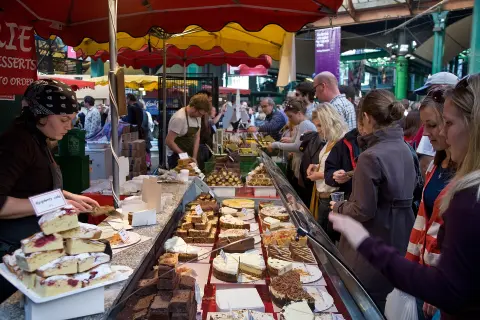
Welcome to Borough Market. Follow your nose. That is roasting coffee, warm bread and melting cheese, all mixed together. People have traded food near the south end of London Bridge for many hundreds of years, and the tradition carries on today. Above us, trains rumble across the viaducts, and under the green iron roofs you will find farmers, butchers, fishmongers and bakers. Come hungry. We will taste, we will look, and we will hear how a muddy street market became one of the most loved food halls in the world. Keep a little room for dessert.
The story of Borough Market
London Bridge was for centuries the only bridge across the Thames in London. Travellers, carts and cattle crowded into Southwark at its southern end, and traders followed. The market says it has served the area for around a thousand years. Records show a market here in medieval times, held right on Borough High Street, the road leading off the bridge.
By the 1700s the market was choking the traffic. In 1754 an Act of Parliament closed the street market, but local people raised money and, in 1756, a new market opened on its present site, away from the main road. It was run by trustees on behalf of the community, an arrangement that still guides the market today.
In the 1800s railway viaducts were built over the area, and the market grew into a major wholesale fruit and vegetable centre. Iron roofs went up in the 1850s, and an Art Deco entrance on Borough High Street followed in the 1930s. As wholesale trade declined, the market reinvented itself in the late 1990s with retail stalls selling fine produce. In 2004 a cast-iron portico from the old Floral Hall at Covent Garden was re-erected here, on Stoney Street. Southwark Cathedral, beside the market, has watched over all these changes.
The setting
The market sits in a tangle of lanes between London Bridge and Southwark Cathedral, just south of the Thames. Railway viaducts cross right over it, so trains pass above your head as you shop. The stalls are grouped under Victorian iron and glass roofs, painted green, with open sides that let in the weather. The Market Hall, the Green Market and the Three Crown Square area each have their own feel. On Stoney Street, the elegant Floral Hall portico frames the view. Around the edges are old pubs, cafés and warehouses turned into restaurants.
Why it matters
Borough Market is a working market, not a theme park. Many traders sell what they grow, rear or make themselves, and chefs from London restaurants shop here. It helped spark Britain's modern interest in good, seasonal food. It is still run by a charitable trust for the benefit of the community. For visitors, it is a place to taste British cheese, bread and fish, and to see how a neighbourhood market has survived for centuries by changing with the times.
Your walk-through
The stops a guide would take you to, in order.
-
1
Southwark Cathedral entrance
We begin by the cathedral gardens. Southwark Cathedral has Gothic parts dating back to the 1200s, and it has watched over this market for centuries. Inside is a memorial to William Shakespeare, who worked at the nearby Globe. Take a quiet moment here before the crowds. Then turn towards the smells of coffee and cooking, and step into the market.
-
2
The Green Market
This is the newer, open-air part of the market, full of street food stalls. You will find everything from toasted cheese sandwiches to curries to fresh oysters. The trick is to share: buy a few small things and pass them round. Look up between the stalls and you will see the railway viaduct carrying trains into London Bridge station.
-
3
The Market Hall cheesemongers
Under the iron roof, find the cheese stalls. Britain makes hundreds of cheeses, and many traders here offer a taste before you buy. Try a mature farmhouse Cheddar, a crumbly Lancashire or a soft blue Stilton. Ask the trader where it comes from. They usually know the farm and often the cows.
-
4
Stoney Street and the Floral Hall portico
Walk out onto Stoney Street. That graceful cast-iron front once stood at the Floral Hall in Covent Garden. It was taken down and rebuilt here in 2004. Film fans may know this street too. It appeared in the third Harry Potter film. Look at the old pubs nearby, with their worn wooden bars and hanging baskets.
-
5
Borough High Street entrance
Finish at the main entrance on Borough High Street, with its 1930s lettering. This busy road is the old route south from London Bridge, used by pilgrims heading to Canterbury in Chaucer's tales. Turn round and look back at the market under the arches. It has fed travellers at this river crossing for centuries, and it is still doing it.
Things you might not know
- In 1756 the market moved off Borough High Street to its present site after an Act of Parliament closed the old street market.
- The cast-iron portico on Stoney Street came from the Floral Hall at Covent Garden and was re-erected here in 2004.
- Trains into London Bridge station run on viaducts directly over the market stalls.
Researched November 2026 from: boroughmarket.org.uk, boroughmarket.org.uk, en.wikipedia.org. Fees and hours change, so check on the day.