🚗 Day trip · Toledo, 72 km from central Madrid
Historic City of Toledo
A city of three faiths, wrapped in a bend of the Tagus
🎧 Listen to this guide · about 6 min
Pop your earphones in and we'll walk you round.
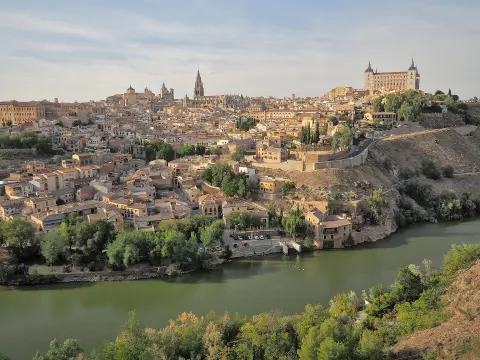
Welcome to Toledo. Look out from the hills and you see it: a whole city piled on a rock, almost surrounded by the deep green loop of the river Tagus. Towers, domes and rooftops crowd together, the cathedral spire above them all. For centuries, Christians, Muslims and Jews lived here side by side. They left churches, mosques and synagogues within a few streets of each other. El Greco made this city his home and painted it under a stormy sky. Today we will wander its narrow lanes, step into its great cathedral, and see why it was called the city of three cultures. Mind the cobbles. They are steep.
The story of Historic City of Toledo
Toledo has been a city since Roman times. In the sixth century it became the capital of the Visigothic kingdom of Hispania. In 711, Muslim armies arrived, and for more than three centuries Toledo was an important city of al-Andalus, famous for its learning and its steel.
In 1085, King Alfonso VI of Castile took the city. Toledo became a meeting place of cultures. Here, in the twelfth and thirteenth centuries, scholars translated Arabic and Hebrew texts into Latin and Castilian, passing ancient knowledge on to the rest of Europe. Jewish life flourished too, until the persecutions of the late fourteenth century and the expulsion of 1492.
The great Gothic cathedral was begun in 1226 and finished in 1493. Toledo remained the seat of the royal court until Philip II moved it to Madrid in 1561. A few years later, in 1577, the Greek-born painter Domenikos Theotokopoulos, known as El Greco, arrived. He lived and worked here until his death in 1614. In 1986, UNESCO listed the Historic City of Toledo as a World Heritage site.
The setting
Toledo sits on a granite hill wrapped on three sides by a deep gorge of the Tagus. Medieval bridges, the Alcántara and San Martín, cross the river on each side. Inside the old walls, the streets twist and climb in a tangle of lanes, many too narrow for cars. The cathedral stands near the centre. The square bulk of the Alcázar crowns the highest point. In the west lies the old Jewish quarter, with the synagogues and the monastery of San Juan de los Reyes. From the road on the far side of the river, the Mirador del Valle gives the classic view of the whole city.
Why it matters
Toledo is a symbol of a time when different faiths shaped one city. Its buildings mix Christian, Islamic and Jewish traditions, often in the same walls, in the style called Mudéjar. It is also the spiritual capital of Spain: its archbishop holds the title of Primate of Spain. And it is El Greco's city. Many of his greatest paintings are still here, in the places they were made for. In 2026 the cathedral is marking eight hundred years since its first stone.
Your walk-through
The stops a guide would take you to, in order.
-
1
Mirador del Valle
If you can, start across the river at the Mirador del Valle. From here the whole city spreads before you, ringed by the river. Find the cathedral spire, the square Alcázar with its four towers, and the bridges below. This is the view El Greco painted, though he moved buildings around to suit his picture. Take a photo, then let's head into town.
-
2
Toledo Cathedral
Now the Primate Cathedral of Saint Mary. Begun in 1226 and finished in 1493, it is one of the great Gothic churches of Spain. Inside, look at the carved choir stalls, the golden altarpiece, and behind the altar the Transparente, a Baroque marvel by Narciso Tomé from 1732, where light pours through a hole cut in the vault. Don't miss the sacristy, with paintings by El Greco, Goya and others.
-
3
Church of Santo Tomé
A short walk west brings you to Santo Tomé, with its Mudéjar brick tower. Inside, one painting fills a whole wall: The Burial of the Count of Orgaz, by El Greco, from the 1580s. Below, saints lay the count in his tomb among Toledo nobles in black. Above, heaven opens. Legend says the saints really did appear at his funeral. El Greco painted that story.
-
4
Synagogue of Santa María la Blanca
Now into the old Jewish quarter. This building looks plain outside, but inside is a forest of white horseshoe arches on octagonal pillars, with carved capitals like pine cones. It was built as a synagogue in the Middle Ages by Muslim craftsmen for the Jewish community, and later became a church. It is a perfect picture of Toledo's mixed past.
-
5
Monastery of San Juan de los Reyes
Nearby is San Juan de los Reyes, built by the Catholic Monarchs, Ferdinand and Isabella, in the late fifteenth century. Look up at the outside walls. Iron chains hang there. So the story goes, they belonged to Christian captives freed from Granada. Step into the two-storey cloister, with its delicate Gothic stonework and orange trees. It is one of the most peaceful places in the city.
-
6
San Martín Bridge
We finish at the San Martín Bridge, a medieval bridge with tall arches and fortified gates at each end. Walk out onto it and look down at the river far below, and back up at the city walls. It is a fine place to watch the late afternoon sun on the stone before you head back to Madrid.
Things you might not know
- Toledo was the capital of the Visigothic kingdom in the sixth century.
- The cathedral was begun in 1226 and took more than 260 years to finish.
- El Greco lived and worked in Toledo from 1577 until his death in 1614.
Researched November 2026 from: whc.unesco.org, catedralprimada.es, en.wikipedia.org, lamaletainquieta.com. Fees and hours change, so check on the day.