💎 Hidden gem · North of Talek, bordering the Maasai Mara National Reserve, 35 km from central Masai Mara
Olare Motorogi Conservancy
Big cats, few vehicles and the quiet of private land
🎧 Listen to this guide · about 5 min
Pop your earphones in and we'll walk you round.
Welcome to Olare Motorogi. Listen. Hear that? Almost nothing. No engines, no radios, just birds and wind in the grass. On this conservancy, the number of camps and vehicles is kept low on purpose, so when you find a lion or a leopard, you are likely to have it to yourself. The land is a beautiful mix of valleys, open plains and croton thickets, with two small rivers running through. The cats here are well known among guides. Leopards slip along the riverbanks, and lion prides patrol the plains. Settle back, take your time, and enjoy the feeling of having the Mara almost to yourself.
The story of Olare Motorogi Conservancy
This land belongs to Maasai families who, like their neighbours, saw their shared grazing land divided into individual plots in the late twentieth century. Instead of fencing or farming, many chose to work together for wildlife.
In the mid-2000s, two neighbouring conservancies were set up here, named after the Olare Orok and Motorogi rivers. They later joined to form the Olare Motorogi Conservancy. Landowners lease their plots to a small group of tourism partners, and in return receive regular payments. Grazing continues in managed areas and seasons, so families can keep their herds while wildlife has space.
Sources give its size at roughly 33,000 to 36,000 acres, and its landowners at a few hundred families. The conservancy became known for strict rules: limited bed numbers, limited vehicles at each sighting, and guides trained to give animals space. That approach helped turn it into one of the best places in East Africa to watch big cats without crowds, and it has shaped how other Mara conservancies are run. Its success helped persuade landowners elsewhere around the reserve to form conservancies of their own. Many of the guides working here today grew up in the surrounding villages.
The setting
Olare Motorogi lies just north of the reserve's boundary, near Talek, with the Naboisho Conservancy to the east. The land is a mix of open plains, shallow valleys, rocky outcrops and dense croton thickets. The Olare Orok and Motorogi rivers cut through it, lined with trees that leopards favour. Camps are small and set far apart. As with other conservancies, there is no public entry gate; visitors stay at member camps. Seasonal wetlands and small pools dot the valleys after rain. Rocky ridges give guides good lookout points, and quiet tracks link the camps without crossing busy reserve roads.
Why it matters
Olare Motorogi is part of a belt of conservancies that gives wildlife room to move outside the reserve, especially for predators like lions and cheetahs that roam widely. It shows that low-impact, high-value tourism can pay families more than intensive farming would. For you, it offers off-road access to sightings, walks and night drives, all with a calm, unhurried feel that is harder to find in the busy months inside the reserve. Each night you stay helps pay the lease that keeps this land open for wildlife.
Your walk-through
The stops a guide would take you to, in order.
-
1
Olare Orok riverbank
We begin along the Olare Orok river. Look into the big trees on the banks. Leopards often rest on wide branches here, their tails hanging down. If you see a carcass wedged in a fork, a leopard is not far away. Your guide may switch off the engine. In the silence you might hear a squirrel or a bird giving an alarm call.
-
2
Croton thickets
These dense, grey-green bushes are crotons. Lions and leopards use them for shade and cover, and lionesses hide young cubs here. Watch for movement low down. If cubs are present, your guide will keep a respectful distance. Conservancy rules limit how many vehicles can be at a sighting, which keeps the animals relaxed.
-
3
Open plains
Out on the plains, scan the horizon for cheetahs and for herds of zebra, wildebeest and gazelle. Eland and giraffe are common here too. Because off-road driving is allowed under rules, your guide can approach a sighting carefully, then stop and let the animals carry on as if you were not there.
-
4
Rocky outcrop viewpoint
Climb with your guide, if it is safe, onto a rocky outcrop for a view across the conservancy. From up here you can see how the valleys and thickets link together. You may also see cattle moving in the distance. That is part of the plan too, and a sign that people and wildlife are still sharing this land.
-
5
Evening sundowner spot
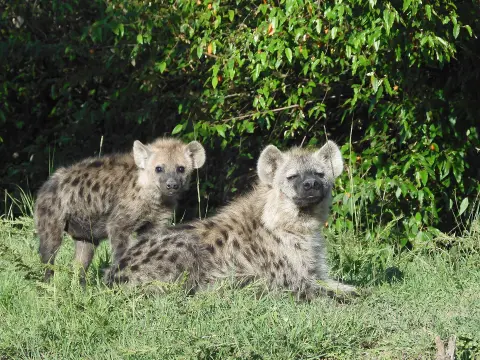
We finish at a quiet clearing as the sun sets. Many camps allow you to step out of the vehicle at a safe spot for a drink. Watch the sky turn orange and then purple. Listen as the night sounds begin: a lion's roar in the distance, a hyena's whoop, the first nightjars calling. Then it is back to camp.
Things you might not know
- The conservancy is named after the Olare Orok and Motorogi rivers.
- It was formed from two neighbouring conservancies that later joined.
- Its rules limit how many vehicles can gather at one sighting.
Researched November 2026 from: maraconservancies.org, en.wikipedia.org, discoverafrica.com. Fees and hours change, so check on the day.