⭐ Must-see · Chapultepec Park, 6 km from central Mexico City
National Museum of Anthropology
Three thousand years of Mexico, gathered around one great courtyard
🎧 Listen to this guide · about 7 min
Pop your earphones in and we'll walk you round.
Welcome to the house of Mexico's memory. Behind these walls sit the treasures of the Olmecs, the Maya, the Aztecs and dozens of other peoples who shaped this land long before Spain arrived. You could spend a week here and still find something new. So today we will be choosy. We will stand under a stone umbrella that rains water, look into the face of a rain god, and meet the great Sun Stone eye to eye. Take your time in the halls. Read the faces carved in jade and clay. These were people who watched the same stars and the same volcanoes you will see on this trip. Let's step inside and say hello to them.
The story of National Museum of Anthropology
Mexico has kept a national museum since the 1820s, soon after independence. For more than a century its collections lived in the old colonial building on Moneda Street, in the heart of the city. By the mid twentieth century the objects had simply outgrown the space. The government chose a new home in the woods of Chapultepec, and the architect Pedro Ramírez Vázquez led the design.
The new museum opened on 17 September 1964. It was built quickly, in about nineteen months, and it was meant to make a statement. Mexico wanted the world to see its ancient cultures as the root of a modern nation. Some of the greatest pieces arrived with real drama. The huge stone figure at the entrance, usually linked to the rain god Tlaloc, was hauled here in April 1964 from the town of Coatlinchan, and crowds lined the streets to watch it pass.
The star of the collection is older news. The Sun Stone was dug up in December 1790 during paving work in the main square, the Zócalo, a few months after workers found the great statue of the goddess Coatlicue. For years the Sun Stone stood against a wall of the cathedral. Today it hangs in the Mexica hall as the centrepiece of the whole building.
The setting
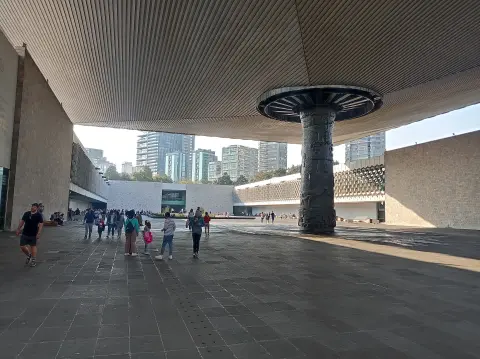
The museum sits on Paseo de la Reforma, at the edge of Chapultepec Park, one of the largest city parks in the Americas. The building is low and long, made of stone, wood and glass. At its heart lies a wide open courtyard with a pool. Around it run two floors. The ground floor holds archaeology, arranged region by region, from the first people of the Americas to the Aztecs, the Gulf Coast, Oaxaca, the Maya and the north and west. The upper floor is about living peoples, with clothes, crafts and homes of Mexico's Indigenous communities today. Several halls open onto small gardens with full size copies of temples and tombs, so you step from shade into sunlight and back again.
Why it matters
This is where Mexico tells its own story. Students come in school uniforms, families come on Sundays, and scholars come from all over the world. The museum was a bold idea in 1964: that the nation's deepest roots were Indigenous, and that those roots deserved pride of place. That idea still shapes how Mexicans see themselves. For you, it is the best possible first stop. Once you have seen the Sun Stone and the Maya halls here, every pyramid and ruin you visit later in Mexico will make more sense.
Your walk-through
The stops a guide would take you to, in order.
-
1
The Tlaloc monolith on Reforma
Before you even buy your ticket, look up at the giant stone figure by the road. It weighs well over a hundred tonnes and is usually linked to Tlaloc, the rain god, though some scholars think it may show his sister, the water goddess Chalchiuhtlicue. When it was moved here in 1964, a rare storm broke over the city. People still smile and say the rain god was announcing his arrival.
-
2
The umbrella in the courtyard
Now walk into the central patio. Above you is a vast concrete roof resting on one single column. Locals call it el paraguas, the umbrella. Water pours down from its rim like a curtain of rain. Look closely at the column. It is wrapped in bronze reliefs that tell the story of Mexico, with an eagle, a jaguar and the meeting of two worlds. Stand under it for a moment and listen to the water.
-
3
The Teotihuacan hall
Head into the hall of Teotihuacan, the great city of pyramids north of here. Look for the full size copy of part of the Temple of the Feathered Serpent, painted in the bright reds and greens it once wore. Those serpent heads with their feathered collars are the same ones you can see on the real temple. Notice the masks of green stone, too. Nobody knows what language the people of that city spoke.
-
4
The Sun Stone in the Mexica hall
This is the moment. In the centre of the Mexica hall hangs the Sun Stone, about three and a half metres across and around twenty four tonnes of basalt. In the middle is a face, most often read as the sun god or the earth, with a tongue shaped like a flint knife. Around it are the signs of the twenty days of the Aztec calendar. It is often called a calendar, but it was really a monument about the ages of the world.
-
5
Coatlicue
Close by stands Coatlicue, the mother of the gods. She has a head made of two serpents, a skirt of snakes and a necklace of hands and hearts. She was found in 1790, months before the Sun Stone, and she frightened the people of colonial Mexico so much that she was buried again for a while. Stand in front of her. Even now, she has real power.
-
6
The Maya hall and Pakal's tomb
Finish in the Maya hall. Go down the steps to the copy of the tomb of King Pakal of Palenque, who died in the seventh century. His real jade mask is shown here, made from hundreds of small pieces of green stone. It was stolen from this museum in 1985 and recovered a few years later. Then walk out to the garden behind the hall and see the bright copy of the murals of Bonampak.
Things you might not know
- The museum opened on 17 September 1964 and was built in roughly nineteen months.
- The Sun Stone was found in the Zócalo in December 1790 during paving work.
- The central courtyard roof rests on a single column, nicknamed the umbrella.
Researched November 2026 from: en.wikipedia.org, lugares.inah.gob.mx, chilango.com. Fees and hours change, so check on the day.