⭐ Must-see · Fort, 18 km from central Mumbai
Chhatrapati Shivaji Maharaj Terminus
Stone gargoyles, stained glass and the daily rush
🎧 Listen to this guide · about 6 min
Pop your earphones in and we'll walk you round.
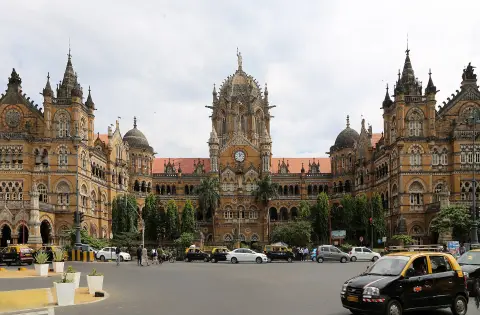
Here we are, at the station that many people still call VT. Stand across the road, near the traffic island, and take it all in. Pointed arches, turrets, carved stone, and a great ribbed dome crowned by a female figure holding a torch. It looks like a cathedral that someone filled with trains. And it is very much alive. Hundreds of thousands of commuters pass through here on a working day, so you will feel the pulse of the city in a way no museum can give you. Look for the carved animals, the peacocks, the monkeys and the lions. Then let yourself be carried inside for a moment with the crowd.
The story of Chhatrapati Shivaji Maharaj Terminus
Railways in India began right here. On 16 April 1853, the first passenger train in the country ran from Bori Bunder, on this site, to Thane. As traffic grew, the Great Indian Peninsula Railway needed a headquarters to match its ambition.
The architect was Frederick William Stevens, working from an early design by Axel Haig. Work began in 1878 and took ten years. The station opened on 20 May 1888 as Victoria Terminus, named for Queen Victoria. Indian craftsmen, many trained at the Sir J. J. School of Art, carved the stone and wood. It was the most expensive building in the city at the time it was built.
In 1996 the station was renamed Chhatrapati Shivaji Terminus, after the seventeenth-century Maratha ruler, and in 2017 the word Maharaj was added. UNESCO inscribed it as a World Heritage Site in 2004. The station also carries a hard memory. On the night of 26 November 2008, gunmen opened fire in the main passenger hall, killing fifty-eight people and injuring more than a hundred. A memorial in the concourse names those who died. For decades the building served as the headquarters of the Great Indian Peninsula Railway. After independence, that railway became part of the new Central Railway, formed in 1951, which still runs its offices from these rooms.
The setting
The building is shaped like a giant letter C, with the main block facing the road and two wings reaching forward. The style mixes Victorian Gothic Revival with Indian elements, which architects call Indo-Saracenic. The walls combine local basalt with fine limestone and sandstone. At the centre rises an octagonal ribbed dome, built without the usual wooden centring frame, a bold technical feat for its time. On top stands the statue of Progress, with a torch in one hand and a spoked wheel in the other. Lions and tigers flank the entrance. The station has eighteen platforms, split between long-distance trains and the suburban lines.
Why it matters
This is one of the finest railway buildings of the nineteenth century anywhere, and it is still doing the job it was built for. It is the headquarters of Central Railway and the southern end of lines that carry millions of Mumbaikars each day. It shows how European Gothic and Indian craft traditions blended into something new. And for the city, it is a place of pride and of grief, honoured both as heritage and as a site where people lost their lives in 2008.
Your walk-through
The stops a guide would take you to, in order.
-
1
The view from the traffic island
Start outside, facing the main facade. Count the layers: arched windows, stone balconies, turrets and then the dome. The figure on top is Progress, often mistaken for Queen Victoria. Victoria's own marble statue once stood under the clock but went missing after the 1950s. Early morning light is kind to the honey-coloured stone, and the road is calmer then.
-
2
The lion and tiger gateposts
Walk to the main gate. On the gateposts sit a lion and a tiger. They were meant to stand for Britain and India. Look closer at the walls nearby and you will find carved peacocks, monkeys, foliage and gargoyles. Much of this work came from Indian students and craftsmen of the J. J. School of Art, who brought local animals and plants into a European style.
-
3
The suburban concourse
Step inside the suburban hall. This is where you feel the city's heartbeat. Trains pull in every few minutes and the platforms fill and empty like a tide. Stay to the side, hold your bag in front of you, and simply watch. Look up at the iron roof and the high windows that let light fall across the crowds.
-
4
The 26/11 memorial
In the long-distance concourse, find the memorial to the victims of the November 2008 attack. Gunmen opened fire here, and fifty-eight people were killed. The plaque lists their names. Please pause quietly, and keep your camera down for a moment. Railway staff and passengers who helped others that night are remembered by the city with deep respect.
-
5
The Star Chamber and heritage gallery
If you have booked the official heritage tour, you will enter the old booking hall known as the Star Chamber. Its ribbed ceiling was once painted blue with gold stars, and stained glass fills the windows. The small heritage gallery displays old photographs and railway objects. Tours run on set slots, so book ahead.
-
6
Under the central dome
On the tour you also reach the inner space beneath the dome. Look up at the stone ribs rising to the lantern. Engineers of the time built it without a temporary wooden frame, which was unusual. From here you understand the plan of the whole building, with wings stretching out on either side like open arms.
Things you might not know
- India's first passenger train ran from Bori Bunder, the site of this station, to Thane on 16 April 1853.
- The statue on the dome represents Progress, not Queen Victoria, whose own statue vanished after the 1950s.
- UNESCO inscribed the station as a World Heritage Site in 2004.
Researched November 2026 from: en.wikipedia.org, whc.unesco.org, freepressjournal.in. Fees and hours change, so check on the day.