⭐ Must-see · Chinen, Nanjo, 25 km from central Okinawa
Sefa-utaki
The kingdom's holiest grove, where rock and forest meet the sea
🎧 Listen to this guide · about 5 min
Pop your earphones in and we'll walk you round.
Welcome to Sefa-utaki. The name means, roughly, the greatest of the sacred groves. In old Okinawa, an utaki was a holy place, often a patch of forest or rock where the gods were believed to visit. There are no temples here, no statues, no altars in the usual sense. Just stone, trees and silence. As we walk, the path climbs through thick green forest and between great slabs of limestone. Listen to the birds, feel the cooler air, and imagine the priestesses in white who walked here five centuries ago. Please treat it as the sacred place it still is. People come here to pray today.
The story of Sefa-utaki
Sefa-utaki has been sacred since the earliest period of Ryukyuan history. According to a kingdom chronicle, the Chuzan Seikan, this is where the creator goddess Amamikyu came ashore on Okinawa. That is legend, but it shows how central this place was in Ryukyuan belief.
In the Ryukyu Kingdom, religion was led by women. The highest priestess, the Kikoe-ogimi, was usually a close relative of the king, and she oversaw rituals here on behalf of the realm. Men were barred from the utaki. It is said that even the king had to change his sleeves into a woman's style before passing the entrance. The site's formal role is thought to date from the fifteenth and sixteenth centuries, under King Sho Shin, when the kingdom organised its priestesses into a state system.
After the kingdom ended in 1879, the site was later converted to a Shinto shrine under Japanese rule. In 2000 it became part of the UNESCO World Heritage listing, and in 2018 it was designated a National Historic Site. Visitor numbers grew so quickly that the city introduced fees and closure days to protect it.
The setting
The utaki lies on a wooded hillside on the Chinen Peninsula in the southeast of Okinawa, looking out over the Pacific. A stone-paved path climbs from the entrance through dense subtropical forest. Along it are several worship spaces, each a natural feature: a cliff face, a flat rock shelf, a cleft between boulders. The most famous is Sangui, where two huge limestone slabs lean together to form a triangular passage. Offshore, about five kilometres away, lies Kudaka Island, low and flat, which Ryukyuan belief calls the island of the gods. The stones underfoot can be slippery after rain.
Why it matters
Sefa-utaki is the clearest window into Okinawa's native religion, which centres on nature, ancestors and the spiritual power of women. That faith survived the arrival of Buddhism, Shinto and Christianity, and it still lives in village rituals across the islands. When you see local visitors bowing quietly at the rock shelves, you are seeing a tradition that is centuries older than the kingdom itself. Treat what you see with respect, and remember that some areas are closed precisely to protect it.
Your walk-through
The stops a guide would take you to, in order.
-
1
Ticket office and approach path
Tickets are sold at the ticket office near the local products centre below the site, not at the entrance. Watch the short introductory video if it is running. Then follow the paved path uphill to the forest. As you walk, notice the old stone steps worn smooth and the dense trees closing over you.
-
2
Ujoguchi entrance
Here is the entrance to the sacred area, a simple stone-lined opening. In the kingdom's time, this is where the king had to change his appearance before going further. From this point, please keep your voice down, stay on the marked path and do not touch the rocks or take any stones.
-
3
Ufuguui
The first major worship space is Ufuguui, at the foot of a tall rock face. Its name is often translated as the great hall. In front of the cliff is a flat stone area where rituals took place. Look for the small incense burners. These are worship points, not decorations, and local visitors still leave offerings here.
-
4
Yuinchi
Next is Yuinchi, sometimes translated as the kitchen. Two rock overhangs form a natural shelter. The name is a ritual term, not a cooking place for visitors. As with each site, this was a spot where priestesses addressed the gods on behalf of the kingdom. Pause, look up at the roots gripping the rock, and listen.
-
5
Sangui
And here is Sangui. Two massive slabs of limestone lean against each other, leaving a triangular gap you can walk into. It is the most photographed place in Sefa-utaki, and for good reason. Inside, it is cool and dim. The innermost worship spaces beyond are roped off to protect them, so please respect the barriers.
-
6
View toward Kudaka Island
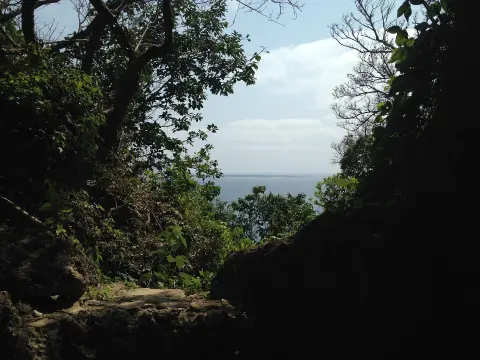
On your way back, look for gaps in the trees toward the sea. The low island on the horizon is Kudaka. In Ryukyuan belief it is the island of the gods, and kings once came to Sefa-utaki and faced toward it in prayer. Some say that seeing it from here completes the visit. Take a quiet moment before you descend.
Things you might not know
- Men were once forbidden here; the kingdom's highest religious leader was a woman.
- The site closes for three days twice a year, on dates set by the lunar calendar, for traditional rituals.
- Kudaka Island, visible from the area, is about five kilometres offshore.
Researched November 2026 from: en.wikipedia.org, japan-guide.com, okinawa-nanjo.jp, whc.unesco.org. Fees and hours change, so check on the day.