💎 Hidden gem · Park Avenue, Winter Park, 10 km from central Orlando
Charles Hosmer Morse Museum of American Art
Tiffany glass, rescued from fire, glowing on Park Avenue
🎧 Listen to this guide · about 5 min
Pop your earphones in and we'll walk you round.
Welcome to Winter Park, and to the Morse Museum. Outside, Park Avenue is all brick paving, oak trees and small shops. Step inside and the light changes. Stained glass windows glow in deep blues, greens and golds. Lamps shine like jewels. This museum holds the world's largest collection of works by Louis Comfort Tiffany, the great American artist in glass. And at its heart is a chapel, made for the 1893 World's Fair in Chicago, which you can walk into and sit in. Take your time. Let your eyes adjust. Glass like this needs a slow, patient look.
The story of Charles Hosmer Morse Museum of American Art
The museum was founded in 1942 by Jeannette Genius McKean, who named it after her grandfather, the Chicago industrialist Charles Hosmer Morse. Her husband, Hugh McKean, an artist and later president of Rollins College, became its first director. Hugh had studied at Tiffany's Long Island estate, Laurelton Hall, as a young artist.
In 1957 Laurelton Hall was badly damaged by fire. The McKeans travelled north and bought what they could save: windows, lamps, architectural pieces and parts of the chapel Tiffany had made for the 1893 World's Columbian Exposition. For years much of it stayed in storage.
The museum began on the Rollins College campus, moved in 1978, and opened at its present home on Park Avenue in 1995. The reconstructed Tiffany Chapel opened to the public in 1999, and a new wing devoted to Laurelton Hall followed in 2011. Tiffany, son of the founder of the New York jewellers Tiffany and Company, spent decades experimenting with glass, and the chapel was one of his great showpieces. After the fair it was installed in the crypt of the Cathedral of St. John the Divine in New York, before Tiffany later took it back to Laurelton Hall.
The setting
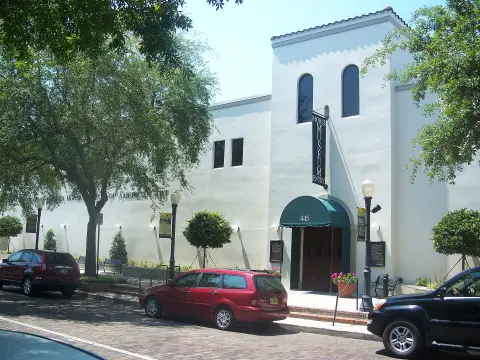
The museum is a low, light coloured building on North Park Avenue, in the heart of Winter Park's shopping street, a short walk from Central Park and the railway station. Inside, galleries flow into one another. Windows and lamps are lit from within, so the rooms feel dim and calm. The Tiffany Chapel fills its own space, with mosaics and a great cross shaped chandelier. The Laurelton Hall wing recreates parts of the estate, including the Daffodil Terrace with its glass-topped columns. There is also American art pottery, paintings and decorative arts.
Why it matters
Without the McKeans, much of what you see here would have been lost to the fire or scattered. The Morse keeps Tiffany's work together, so you can understand him as a designer of whole spaces, not just lamps. It is also a gift to the community. Each winter it lights Tiffany windows in Central Park for Christmas, and on Friday evenings from November to April it opens free to everyone.
Your walk-through
The stops a guide would take you to, in order.
-
1
Park Avenue entrance
Before you go in, look along Park Avenue, with its brick road, boutiques and cafes, and across to Central Park with its oaks and lawns. Winter Park grew in the late 1800s as a winter retreat for northerners escaping the cold. Rollins College is just down the road. The museum fits right in, small on the outside, rich within.
-
2
Tiffany lamps and windows
In the first galleries, look at the lamps and leaded glass windows. Tiffany developed new kinds of glass, rippled, streaked and layered, so that colour seems to live inside the material itself. Notice how a single piece of glass can show both sky and water, or the veins of a leaf. Stand back, then step close. The effect changes.
-
3
The Tiffany Chapel
Now the chapel. Tiffany made it for the 1893 World's Columbian Exposition in Chicago, where it amazed visitors. Later it was moved, stored and badly damaged, then rescued by the McKeans after the 1957 fire. It took years of careful work to rebuild it here, and it opened in 1999. Sit on a bench and look up at the glowing cross shaped chandelier and the shimmering mosaics.
-
4
Laurelton Hall wing
This wing, opened in 2011, brings back pieces of Tiffany's own country home on Long Island. Tiffany designed every detail of Laurelton Hall, from windows to furniture to gardens. Look for the Daffodil Terrace, with columns crowned by glass daffodils. It shows Tiffany as a designer of whole worlds, inside and out.
-
5
Art pottery and American paintings
Before you leave, explore the art pottery galleries, including hundreds of pieces from the Rookwood company of Cincinnati. There are also American paintings and decorative arts from the late 1800s and early 1900s. It all helps set Tiffany in his time, when American artists were looking for a style of their own. Then step back out into the Florida sun.
Things you might not know
- The Tiffany Chapel was first shown at the 1893 World's Columbian Exposition in Chicago.
- The McKeans bought surviving Tiffany pieces after a fire damaged Laurelton Hall in 1957.
- Admission is free on Friday evenings from 4 to 8 p.m., November to April.
Researched November 2026 from: en.wikipedia.org, morsemuseum.org, morsemuseum.org. Fees and hours change, so check on the day.