⭐ Must-see · Frogner Park, 4 km from central Oslo
Vigeland Sculpture Park
One man's lifetime in stone and bronze, from cradle to grave
🎧 Listen to this guide · about 6 min
Pop your earphones in and we'll walk you round.
Welcome to Frogner Park, and to the work of Gustav Vigeland. Everything you will see on this walk, more than two hundred sculptures, the gates, the bridge, the fountain, even the patterns in the paving, was designed by one man. He spent most of his working life on it. The people here are naked, but not in a classical, heroic way. They are ordinary bodies, babies and grandparents, lovers, a furious little boy, all caught in the middle of living. Locals come here to jog, to walk their dogs, to sit on the grass in summer. You can wander here at any hour, for free. Let's follow the long straight line from the main gate to the Wheel of Life.
The story of Vigeland Sculpture Park
Gustav Vigeland was born in 1869 in southern Norway and became the country's leading sculptor of his time. In the early twentieth century he was asked to make a fountain for a square in central Oslo. The project grew and grew. Vigeland reached an agreement with the city: Oslo would give him a studio and pay his costs, and in return his work would belong to the city. The fountain and his other monuments were eventually given a home here in Frogner Park, and the area was ready for the fountain in 1924.
Vigeland worked on the plan for decades. The city council released the final plan in 1932. The great granite Monolith was modelled from 1924, the block of stone arrived in 1927, and three stonemasons began carving it in 1929. It took them about fourteen years. The Monolith was first shown to the public at Christmas 1944.
The bridge opened to the public in 1940, and the main gate was put up in 1942. Vigeland died in 1943, before everything was finished, and work continued after his death. His studio and home, a short walk from the park, is now the Vigeland Museum.
The setting
Frogner Park covers about 45 hectares in the west of the city, with lawns, ponds, rose gardens and old trees. Vigeland's installation runs in a straight line of around 850 metres through the middle of it. You enter through the main gate of granite and wrought iron, cross a long bridge lined with bronze figures, pass a children's playground of small statues, reach the great bronze fountain, and climb terraces to the Monolith on its plateau. At the far end, the Wheel of Life closes the axis. On the edge of the park stands Frogner Manor, home to the Oslo City Museum.
Why it matters
Between one and two million people visit this park every year, which makes it one of the most visited attractions in Norway. It matters because it is so human. There are no kings or generals here, just people at every age, playing, fighting, loving, growing old. It is also a rare thing: a complete artistic vision by one person, in a public park, open to everyone day and night. For many Oslo families, it is simply their park.
Your walk-through
The stops a guide would take you to, in order.
-
1
The main gate
We start at the main gate on Kirkeveien. Vigeland designed it in 1926 and reworked it in the 1930s, and it was raised in 1942. Look at the wrought-iron gates and the small granite houses on either side, with their copper roofs. Even here, before any statues, you feel one hand at work. From this point, look straight ahead. The whole installation runs on one line, and on a clear day you can see the Monolith rising at the far end.
-
2
The bridge and Angry Boy
Now the bridge, a hundred metres long, with fifty-eight bronze sculptures along its railings. Men, women and children, alone and together. Some are tender, some tense. Halfway along, on the left as you walk, find the crowd. In the middle is a tiny boy stamping his foot, fists clenched, face screwed up in rage. This is Sinnataggen, the Angry Boy, the most loved figure in the park. His left hand shines gold from all the people who touch it for luck.
-
3
The fountain
This is where it all began. The fountain was first planned for a square in the city centre. Six giants hold up a great bowl, and water pours over its edge. Around the basin, sixty bronze reliefs tell the story of life, from childhood to old age to death. Look down too. The square around you is paved in an eighteen-hundred square metre mosaic of black and white granite, laid out as a maze. If you follow its path, it is about three kilometres long.
-
4
The Monolith
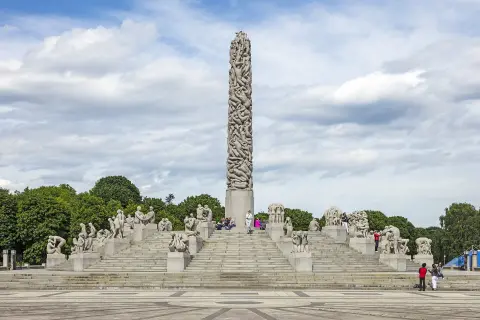
Climb the steps to the plateau. Here is the Monolith, just over fourteen metres of granite, carved from a single block. It holds one hundred and twenty-one human figures, twisting, climbing, clinging to each other as they rise to the top. Three masons carved it over about fourteen years. People have read it as a struggle for life, or a journey towards something spiritual. Vigeland didn't explain it. Around it, thirty-six granite groups show people through every stage of life.
-
5
The Wheel of Life
Walk on to the end of the axis. The Wheel of Life was carved in 1933 and 1934. Four adults, a child and a baby are joined in a ring, holding each other, going round and round with no beginning and no end. After all those separate figures, this is Vigeland's last word on the park: life is a circle. Turn around here and look back along the line you came. From up here, the whole park makes sense.
Things you might not know
- The Monolith is 14.12 metres tall and was carved from a single granite block.
- The granite mosaic around the fountain forms a maze roughly three kilometres long if you follow its path.
- Gustav Vigeland died in 1943, the year before the Monolith was first shown to the public.
Researched November 2026 from: en.wikipedia.org, visitnorway.com, visitoslo.com. Fees and hours change, so check on the day.