⭐ Must-see · 1st arrondissement, Right Bank, 1 km from central Paris
The Louvre
A royal palace that became the whole world's attic of wonders
🎧 Listen to this guide · about 6 min
Pop your earphones in and we'll walk you round.
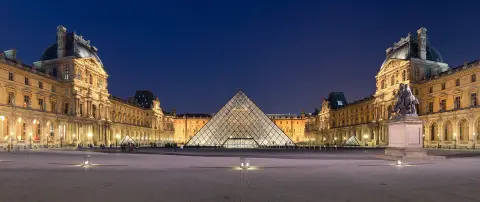
Welcome to the Louvre. Take a moment before you rush inside. Look around the courtyard. The long golden wings around you were home to French kings for centuries. Now they hold paintings, statues and treasures from almost every corner of the ancient and modern world. In the middle sits the glass pyramid, sharp and modern, reflecting the old stone. Some people loved it from day one. Some still argue about it. Today we will not try to see everything. Nobody can. Instead we will meet a few old friends, hear how a fortress became a museum, and learn how to come back and find your own favourite corner.
The story of The Louvre
The story starts around 1190. King Philip Augustus built a fortress here to guard the western edge of Paris while he was away on crusade. You can still see its thick lower walls in the basement, under the Sully wing.
As the city grew, the fortress lost its purpose. In 1546 King Francis I began turning it into a Renaissance palace, with the architect Pierre Lescot. Later kings kept adding wings, and the building slowly stretched along the river. Then, in 1682, Louis XIV moved his court to Versailles, and the Louvre was left to artists, academies and royal collections.
The French Revolution changed everything. On 10 August 1793 the palace opened as a public museum, so that the nation's art belonged to the people. Napoleon filled it with works taken on his campaigns, many of which were later returned. In 1989 the architect I. M. Pei completed the glass pyramid as a new main entrance, and the museum has kept growing ever since.
The setting
The Louvre sits on the Right Bank of the Seine, between the Tuileries Garden to the west and the old heart of Paris to the east. The palace forms a giant U shape around the Cour Napoléon, where the pyramid stands. Its three wings are named Denon, Sully and Richelieu. Denon, along the river, holds the Italian paintings and the Mona Lisa. Sully wraps around the older square courtyard, the Cour Carrée, and holds the medieval moat and much of the Egyptian collection. Richelieu, along rue de Rivoli, holds Napoleon III's apartments and French sculpture under glass roofs. From the pyramid you look straight down a long line through the Arc du Carrousel, the Tuileries and on to the Champs-Élysées.
Why it matters
The Louvre is the most visited art museum on Earth, and it shaped the very idea of a public museum. Its founding in 1793 said something radical: that great art belongs to everyone, not only to kings. Today it holds collections from ancient Mesopotamia, Egypt, Greece and Rome, through to European painting and decorative arts. Scholars, students and painters with easels still work here. For Paris, it is also a living palace. Its courtyards and passages are part of daily walks across the city, and the pyramid has become a meeting point for the whole world.
Your walk-through
The stops a guide would take you to, in order.
-
1
The glass pyramid
Stand back and look up. The pyramid is made of glass panels set in a light steel frame, and it lets daylight pour into the great hall below. I. M. Pei designed it to solve a simple problem. The old museum had no proper main entrance. He placed the entry underground and marked it with glass, so it would not hide the palace behind it. It opened in 1989. People were angry at first. Now it is hard to imagine the courtyard without it.
-
2
Medieval Louvre, Sully wing
Go down into the lower level of the Sully wing. Here are the real foundations of Philip Augustus's fortress, uncovered during excavations in the 1980s. You walk along the old moat, beside the base of the round keep. Run your eyes over the stones. Some still carry the marks of the masons who cut them more than eight centuries ago. This is the seed from which the whole palace grew.
-
3
Winged Victory of Samothrace
Climb the Daru staircase and she appears above you, wings spread, standing on the prow of a stone ship. This Greek statue was found on the island of Samothrace in 1863. She has no head and no arms, yet she seems to move. Look at the marble cloth pressed against her body, as if a sea wind were blowing right through the stairwell. She was made to celebrate a victory at sea, more than two thousand years ago.
-
4
The Mona Lisa, Salle des États
Here is the most famous painting in the world. Leonardo da Vinci painted it in the early 1500s, and King Francis I brought it into the royal collection. In 1911 it was stolen by Vincenzo Peruggia, a man who had worked at the museum, and it was missing for more than two years. Take your moment, then turn around. Facing her is Veronese's huge Wedding Feast at Cana, the largest painting in the museum, and far fewer people look at it.
-
5
Venus de Milo
Head to the Greek galleries on the ground floor of the Sully wing. The Venus de Milo was discovered in 1820 on the island of Melos, and soon came to the Louvre. Walk all the way around her. See how she twists gently, with her weight on one leg. Nobody knows for sure what her missing arms were doing. That mystery is part of her charm.
-
6
Napoleon III Apartments
End in the Richelieu wing, in the rooms built for Napoleon III's minister of state in the 1850s and 1860s. After all that marble, this is pure velvet and gold. Crystal chandeliers, red drapes and painted ceilings show how the Second Empire liked to party. It reminds you that the Louvre was a working seat of government almost until the twentieth century.
Things you might not know
- The Louvre opened as a public museum on 10 August 1793, during the French Revolution.
- The Mona Lisa was stolen in 1911 and recovered in Florence in 1913.
- You can still walk around the foundations of the original 12th-century fortress in the basement.
Researched November 2026 from: louvre.fr, en.wikipedia.org, en.wikipedia.org, whc.unesco.org. Fees and hours change, so check on the day.