⭐ Must-see · Petra Archaeological Park, Wadi Musa, 4 km from central Petra
The Royal Tombs
A wall of kings carved in coloured stone
🎧 Listen to this guide · about 6 min
Pop your earphones in and we'll walk you round.
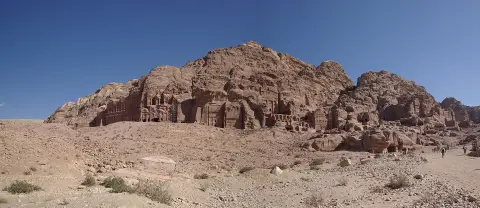
Turn right from the colonnaded street and look up at the cliff called Jabal al-Khubtha. Spread across its face, like a row of palaces, are the Royal Tombs. There are four great facades here, each a different shape, each glowing in its own swirl of colour. Late in the day the sun swings round and lights them directly, and the whole mountainside turns warm red and amber. You can climb the stairs to the tombs and step inside. The rooms are vast and cool, and their ceilings ripple with bands of pink, blue and yellow stone. This is where you feel how wealthy and proud Nabataean Petra once was.
The story of The Royal Tombs
The name Royal Tombs is a modern one, given because these monuments are so grand that they seem fit for kings. Their owners are not known for certain. The Urn Tomb, the largest, was probably carved around 70 AD. It is thought by many scholars to be the tomb of King Malichus II, who died that year, or of his predecessor Aretas IV.
The tombs had a second life. In the Byzantine period, when Petra was a Christian city with its own bishop, the great hall of the Urn Tomb was turned into a church. A painted Greek inscription records its dedication by a bishop named Jason in 446 or 447 AD. Workers cut apses into the back wall at that time, and you can still see them.
Along the same cliff, a little to the north, is the tomb of Sextius Florentinus, a Roman governor of the province of Arabia in the early 2nd century AD, with a Latin inscription. It shows that after Rome annexed the kingdom in 106 AD, important Romans chose to be buried in the Nabataean way.
The setting
From south to north you meet the Urn Tomb, the Silk Tomb, the Corinthian Tomb and the Palace Tomb. The Urn Tomb stands on a high terrace built over arched vaults, with a courtyard framed by colonnades, reached by a staircase. The Silk Tomb is small but famous for its rock, streaked in waves of rose, white and blue. The Corinthian Tomb mixes a classical upper storey, similar to the Treasury, with a Nabataean lower level, much eroded. The Palace Tomb is the widest, with three storeys, the top partly built from masonry because the cliff ran out. Many think it imitates a Roman palace front.
Why it matters
The Royal Tombs show the Nabataean approach to death as a public statement of power. Facades like these were meant to be seen from the city centre, telling everyone who mattered. The church in the Urn Tomb records Petra's long Christian chapter, which visitors often forget. And the cliff is one of the best places to see Petra's famous sandstone colours up close, the reason it is called the rose-red city.
Your walk-through
The stops a guide would take you to, in order.
-
1
The view from the colonnaded street
Before you climb, stand back on the street and see all four tombs together. Notice how they line up across the mountainside, like houses facing a square. They were made to be admired from here. Pick out the Urn Tomb on the right on its high terrace, and the Palace Tomb on the left, wide and stacked like a building of several floors.
-
2
The Urn Tomb terrace and vaults
Climb the stairs to the Urn Tomb. On the way look at the arches under the terrace. These vaults were built to hold up the courtyard, extending the platform out from the cliff. At the top, turn and enjoy the view over the city. High on the facade there are three small openings; one may once have been sealed with a carved portrait, and some say it held a burial.
-
3
Inside the Urn Tomb church
Step inside the great hall. It is about the size of a small church, and that is exactly what it became. Look at the back wall for the shallow curves cut into the rock. They are apses made when the tomb was dedicated as a church in the 440s. Look up too. The ceiling is a swirl of natural colour, as if painted, but it is simply the layered sandstone.
-
4
The Silk Tomb
Walk a few steps north to the Silk Tomb. The facade is weathered, but stand close and look at the stone itself: ribbons of rose, cream, grey and blue flow across it. This is why it is named for silk. It is one of the most photographed rock surfaces in Petra. Try to see it in late afternoon, when the colours deepen.
-
5
The Corinthian and Palace Tombs
Next come the Corinthian Tomb and, beyond it, the Palace Tomb. The Corinthian Tomb's upper storey echoes the Treasury, with a round pavilion in the centre. The Palace Tomb is enormous, with rows of columns and doorways. Look at the very top left corner: the cliff was not tall enough, so the builders finished it with stone blocks. Scholars still debate who was buried in these tombs.
-
6
The Tomb of Sextius Florentinus
If you have energy, follow the path north around the cliff to the Tomb of Sextius Florentinus. Above its doorway is a Latin inscription naming this Roman governor of Arabia. It is a quiet spot with fewer visitors. It shows how, after Rome took over, Roman officials still chose to be buried in a Nabataean-style tomb carved in this cliff.
Things you might not know
- The Urn Tomb was converted into a church dedicated by Bishop Jason in 446 or 447 AD.
- The top of the Palace Tomb was finished with masonry because the cliff was not tall enough.
- The Urn Tomb is thought to belong to King Malichus II or Aretas IV, but no one knows for sure.
Researched November 2026 from: en.wikipedia.org, madainproject.com, memphistours.com, visitpetra.jo. Fees and hours change, so check on the day.