⭐ Must-see · Swargashram, Rajaji Tiger Reserve, 6 km from central Rishikesh
The Beatles Ashram (Chaurasi Kutia)
Where the White Album was written, now returning to forest
🎧 Listen to this guide · about 5 min
Pop your earphones in and we'll walk you round.
Come in, through the gate and into the trees. This is Chaurasi Kutia, better known as the Beatles Ashram. In early 1968, four young men from Liverpool came here to learn meditation. Today the buildings are roofless, the paths are soft with leaves, and the forest is slowly taking it all back. You will walk past strange stone domes, empty halls and walls painted with bright murals. Listen. Birds, wind in the trees, sometimes a far-off temple bell. It is easy to imagine guitars on the rooftops and long talks into the night. Take your time. This is a place for wandering slowly.
The story of The Beatles Ashram (Chaurasi Kutia)
In 1961 the spiritual teacher Maharishi Mahesh Yogi leased this forest land on the east bank of the Ganges. The academy was built in 1963 with a 100,000 dollar gift from the American heiress Doris Duke. It was called the International Academy of Meditation and trained teachers of Transcendental Meditation. The band did not come alone. Cynthia Lennon, Pattie Boyd, Jane Asher and Maureen Starkey travelled with them.
The Beatles flew into Delhi on 16 February 1968 and came here with their partners. Other guests that season included the singer Donovan, the actress Mia Farrow, Mike Love of the Beach Boys and the jazz flautist Paul Horn. Ringo Starr left first, then Paul McCartney, and the last of the band left on 12 April. John Lennon and Paul McCartney wrote a remarkable number of songs here, and most of them ended up on the double album The Beatles, known as the White Album.
The lease ran out in 1981. The land returned to the forest department and later became part of Rajaji Tiger Reserve, and the buildings fell into ruin. Fans slipped in to leave tributes on the walls, and in 2012 an artist set up a mural space in the old lecture hall. In December 2015 the forest department opened the site to the public. In 2018 it marked fifty years since the Beatles' visit.
The setting
The ashram spreads across a wooded hillside above the Ganges, just south of Swargashram, with views across the river to Muni Ki Reti. Paths wind between the ruins under tall trees. The name Chaurasi Kutia means eighty-four huts. You will see small stone meditation cells, many shaped like beehives or domes, with tiny doors and windows. There are larger buildings too, including the old lecture hall, now covered in murals, the bungalow where the Maharishi lived and long dormitory blocks. Because it is inside a tiger reserve, the forest is protected, and you may see langurs, peacocks and many birds.
Why it matters
For music lovers, this is a pilgrimage site. Songs written here shaped one of the most famous albums ever made. The Beatles' stay also helped bring Indian meditation, and Rishikesh itself, to a world audience, and the stream of Western seekers that followed changed the town for good. Today the site is also a lesson in time and nature. Without upkeep, concrete gives way to roots and moss. The murals, added by artists and fans, have turned a ruin into an open-air gallery.
Your walk-through
The stops a guide would take you to, in order.
-
1
Entrance and ticket gate
Start at the forest department gate. Notice that you are entering a tiger reserve, not a museum, so stay on the paths. The ticket helps fund protection of this forest. Look at the map board near the entrance to get your bearings. The ruins are spread out on the slope, so plan to wander up and back rather than in a straight line.
-
2
The meditation domes
Here are the strange stone domes, stacked like little beehives. Each was a private cell for meditation, with just enough room to sit. Crouch down and look inside. It is cool, dim and quiet. Imagine spending hours in here in silence. Some guests found it hard. Others, like Lennon and McCartney, came out full of new songs.
-
3
The lecture hall murals
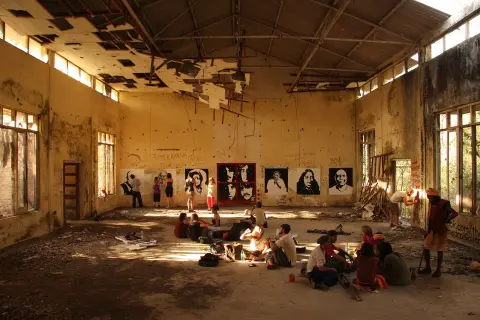
Now step into the big hall, its walls covered with paintings. This space began as a lecture hall. From 2012 an artist turned it into a gallery of Beatles portraits, mandalas and messages of peace, and later a mural project added more. Look at the faces of the four Beatles, and the many symbols from Indian art painted beside them.
-
4
The Maharishi's bungalow
Follow the signs to the bungalow where Maharishi Mahesh Yogi lived and taught. It sits a little apart, with views over the river. Students would gather here for talks and evening sessions. The building is ruined now, but you can still trace the rooms and the terraces. Pause and enjoy the view across the Ganges to the town.
-
5
Dormitory blocks and rooftops
Finish at the long dormitory blocks where guests lived. They have several floors, with rows of small rooms. Climb carefully if the stairs are open, and look out from the top over the trees. Photos from 1968 show the band and friends sitting on roofs and terraces like these. Stay a while, listen to the forest, then head back down slowly.
Things you might not know
- The academy was built in 1963 with a 100,000 dollar gift from heiress Doris Duke.
- Chaurasi Kutia means eighty-four huts.
- Most of the songs on the 1968 White Album were written during or just after the Beatles' stay here.
Researched November 2026 from: en.wikipedia.org, smithsonianmag.com, thenewsminute.com. Fees and hours change, so check on the day.