🚗 Day trip · Khartang village, Payariq district, 30 km from central Samarkand
Imam al-Bukhari Memorial Complex
Honouring the scholar whose book shaped Islamic learning
🎧 Listen to this guide · about 5 min
Pop your earphones in and we'll walk you round.
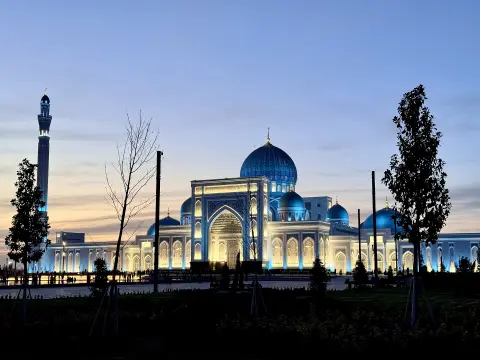
Welcome to the memorial of Imam al-Bukhari, in the village of Khartang north of Samarkand. For Muslims across the world, al-Bukhari's name is known from childhood, because his collection of the sayings and deeds of the Prophet is regarded by Sunni Muslims as the most reliable after the Quran. Pilgrims travel here from Indonesia, Turkey, Pakistan and far beyond. The complex was rebuilt and greatly enlarged, reopening in 2026, so you will see fresh marble, carved wood and soaring minarets. Come with respect and curiosity. This is first and foremost a place of prayer, and visitors are welcome to share its calm.
The story of Imam al-Bukhari Memorial Complex
Muhammad ibn Ismail al-Bukhari was born in Bukhara in 810. As a young man he travelled widely across the Islamic world, collecting reports of the words and actions of the Prophet Muhammad. He examined hundreds of thousands of narrations and selected only those he judged most reliable. His collection, known as Sahih al-Bukhari, was completed around 846 and contains just over seven thousand reports including repetitions.
In his last years he left Bukhara and settled in Khartang, near Samarkand, where he died in 870. A mosque and library were built near his grave in the sixteenth century, but in the Soviet period the site fell into neglect. Tradition holds that in 1961 the Indonesian president Sukarno asked the Soviet leader Nikita Khrushchev to restore it.
After independence, Uzbekistan rebuilt the memorial between 1997 and 1998. In the 2020s a far larger complex was planned around it. It reopened in spring 2026, during Ramadan, and reports say more than a million people visited in its first month.
The setting
The complex lies in farming country about 25 kilometres north of central Samarkand. The new ensemble covers around 45 hectares. A grand gateway leads into a vast courtyard able to hold tens of thousands of worshippers on festival days. Four minarets rise about 75 metres, and the main mosque holds more than ten thousand people. A cluster of domes covers prayer halls and galleries. The heart of the site is the mausoleum: the tombstone you see is a cenotaph, while al-Bukhari's actual grave lies in a crypt below. Museum pavilions present his life and work, and a separate visitor centre with hotels and parking stands nearby.
Why it matters
For hundreds of millions of Sunni Muslims, al-Bukhari's collection is a foundation of religious law and practice, which makes this one of the most important pilgrimage sites in Central Asia. It also reflects Uzbekistan's effort to celebrate its role in Islamic scholarship, from al-Bukhari to the scientists of Samarkand. For visitors of any background, it is a chance to see living faith on a large scale and to learn about a scholar whose method of checking sources still impresses historians.
Your walk-through
The stops a guide would take you to, in order.
-
1
Main gateway
Pause at the main gateway and look up at the carved and tiled portal. The design draws on Samarkand's Timurid tradition, with modern materials and scale. Notice the calligraphy around the arch. Then take a moment to adjust your clothing and slow your pace, as you are entering a place of worship.
-
2
Great courtyard and minarets
Step into the courtyard. On festival days this space fills with worshippers praying in long rows. Look up at the four minarets, each about 75 metres tall. Turn slowly and take in the domes around you. The sheer scale is meant to honour the scholar, and to welcome the pilgrims who come in their thousands.
-
3
The mausoleum
Now walk to the mausoleum. Inside, a stone cenotaph marks the place of al-Bukhari's grave, which lies in a crypt beneath. Pilgrims stand quietly here and recite prayers. Please keep silent, do not photograph people at prayer, and follow the guidance of the attendants.
-
4
Main mosque
If it is not prayer time, you may be able to look into the main mosque. Notice the carved wooden doors and columns, an old Uzbek craft, and the painted and gilded ceilings. Remove your shoes before entering, and keep to the visitors' area.
-
5
Museum pavilions
Finish in the museum pavilions. They tell the story of al-Bukhari's travels and method, and of how hadith were collected and checked. Look for displays of historic manuscripts and Qurans. It is a good place to understand why one man's careful scholarship still matters to so many people.
Things you might not know
- Al-Bukhari was born in Bukhara in 810 and died in Khartang in 870.
- The tombstone you see is a cenotaph; his real grave is in a crypt below.
- Reports say more than a million people visited the rebuilt complex in its first month after reopening in 2026.
Researched November 2026 from: en.wikipedia.org, en.wikipedia.org, euronews.com, kun.uz. Fees and hours change, so check on the day.