🚗 Day trip · Córdoba, 140 km from central Seville
Mosque-Cathedral of Córdoba
A forest of arches where a mosque and a cathedral meet
🎧 Listen to this guide · about 6 min
Pop your earphones in and we'll walk you round.
Welcome to the Mosque-Cathedral of Córdoba. Walk in from the Courtyard of the Orange Trees, and your eyes need a moment to adjust. Then they appear: rows and rows of columns, holding double arches of red brick and white stone, stretching away in every direction like a forest. It is calm and cool and dim. For more than two centuries this was one of the greatest mosques in the world. Then, in the middle of it, a cathedral rose up. Today both live under one roof. There is no other building quite like it. Let's walk in among the arches.
The story of Mosque-Cathedral of Córdoba
In 785 or 786, the Umayyad ruler Abd al-Rahman I began building a great mosque here, on the site of a Christian church. The Umayyads had fled Damascus and made Córdoba their capital. As the city grew, so did the mosque. Abd al-Rahman II extended it in the ninth century. In the 960s, al-Hakam II added a new prayer hall and the famous mihrab, decorated with gold mosaics made with the help of craftsmen sent from Byzantium. In the 980s, the powerful minister Almanzor added a final extension, making it one of the largest mosques in the world.
In 1236 Ferdinand III of Castile took Córdoba, and the mosque was consecrated as a cathedral. For three centuries, chapels were added within the old structure. Then, in 1523, work began on a large Renaissance and Gothic nave in the middle of the building. So the story goes, Emperor Charles V later regretted it, saying they had destroyed something unique to build something found anywhere.
The bell tower was built around the old minaret in the late sixteenth and seventeenth centuries. UNESCO listed the building in 1984, and later extended the listing to the historic centre of Córdoba. Today it is still the cathedral of the Diocese of Córdoba, with Mass celebrated every day.
The setting
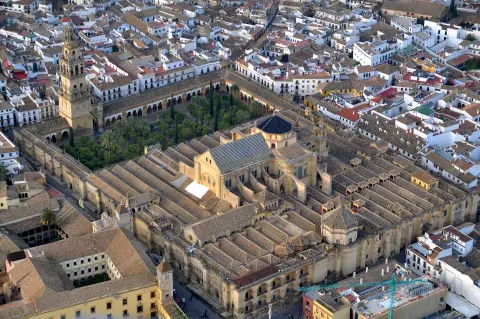
The Mosque-Cathedral stands in the old town of Córdoba, a few steps from the Roman bridge over the Guadalquivir. High walls with decorated gateways surround it. On the north side lies the Courtyard of the Orange Trees, with fountains and rows of trees, and the bell tower rising over the main gate. Inside, the prayer hall is a vast space filled with hundreds of columns, many reused from Roman and Visigothic buildings, holding horseshoe arches in two tiers. At the far south wall is the mihrab. In the centre rises the Christian cathedral, with its high vaults, choir stalls and altar.
Why it matters
The Mosque-Cathedral is one of the great monuments of Islamic architecture and one of the most visited sites in Spain. It reflects the brilliance of Córdoba under the Umayyads, when the city was among the largest in Europe. It also shows how later Christian rulers chose to keep, rather than destroy, much of the mosque. It remains an active Catholic cathedral, with Masses held daily, and its mixed history continues to spark debate and wonder.
Your walk-through
The stops a guide would take you to, in order.
-
1
Courtyard of the Orange Trees
Start in the Courtyard of the Orange Trees. Here worshippers once washed before prayer at the fountains. Look at the rows of trees, planted in lines that continue the rows of columns inside. Above you rises the bell tower, built around the old minaret. In spring, the scent of orange blossom fills the air. Buy your ticket, and walk toward the great hall.
-
2
Abd al-Rahman I's prayer hall
Step inside. You are in the oldest part, built by Abd al-Rahman I in the 780s. Look at the columns, of different heights and colours, many reused from older buildings. To reach the right height, the builders added a second tier of arches on top. The red and white stripes, made of brick and stone, give the effect of endless movement. Wander between them slowly and let the space surround you.
-
3
The mihrab of al-Hakam II
Now walk to the south wall, to the mihrab, the niche that marks the direction of prayer. This is the jewel of the building, built in the 960s. Look at the golden mosaics around the arch, with glass tiles glowing in green, gold and red. They were made with the help of craftsmen from Byzantium. Look up too, at the domes in front, with ribs crossing like stars. Few places in the world show such skill.
-
4
Cathedral nave
Now walk to the centre, to the cathedral. Suddenly the low arches give way to a tall nave of stone, flooded with light. Building began in 1523 and continued for more than a century. Look at the carved mahogany choir stalls, a masterpiece of Baroque woodwork. The contrast with the arches around is striking. You are standing in a church inside a mosque, a meeting of two worlds.
-
5
Roman bridge
End outside, on the Roman bridge over the Guadalquivir. Walk out to the middle and look back. You'll see the walls of the Mosque-Cathedral, the bell tower rising above the old town and the river below. The bridge has been rebuilt many times since Roman days, but its line has crossed this river for two thousand years. Take a deep breath before heading back for the train.
Things you might not know
- Work on the mosque began in 785 or 786 under Abd al-Rahman I.
- Construction of the Christian nave in the centre of the mosque began in 1523.
- Visits are free Monday to Saturday from 8:30 to 9:30, for individual visitors.
Researched November 2026 from: mezquita-catedraldecordoba.es, whc.unesco.org, en.wikipedia.org. Fees and hours change, so check on the day.