🚗 Day trip · Gulf of Suez, off Sha'ab Ali reef, 50 km from central Sharm El Sheikh
SS Thistlegorm Wreck
A wartime cargo ship that became a museum under the sea
🎧 Listen to this guide · about 6 min
Pop your earphones in and we'll walk you round.
Good morning, and well done for getting up so early. The boat leaves in the dark, because the Thistlegorm lies a long sail away, out where the Gulf of Suez opens to the Red Sea. While we cross, let me tell you what waits below. A British merchant ship, sunk in war, lying upright on the sand. Her holds are still full. Trucks, motorcycles, boots and rifles, all frozen in the moment the bombs fell. This is a war grave as well as a dive site. Nine men died here, so we will dive with care and respect. Check your gauges, listen to the briefing, and stay close to your guide.
The story of SS Thistlegorm Wreck
The Thistlegorm was built by J.L. Thompson and Sons in Sunderland, in north-east England. She was launched in April 1940 and completed that June, a sturdy cargo ship of just under 4,900 gross tons and about 126 metres long. Her captain was William Ellis.
In 1941 she sailed for Egypt with supplies for the British forces fighting in North Africa. Her cargo included Bedford trucks, Universal Carrier armoured vehicles, motorcycles, Bren guns, rifles, aircraft parts and railway wagons, with two steam locomotives lashed on deck. While she waited at an anchorage in the Gulf of Suez, German Heinkel bombers found her. In the early hours of 6 October 1941, two bombs struck. The ammunition in her rear hold exploded and the ship sank. Four sailors and five naval gunners were killed.
Jacques Cousteau located the wreck in the early 1950s, guided by information from local fishermen. Then she was largely forgotten. In the early 1990s, as Sharm El Sheikh grew into a diving resort, a dive boat returned to the site, and the Thistlegorm soon became one of the most visited wrecks on earth.
The setting
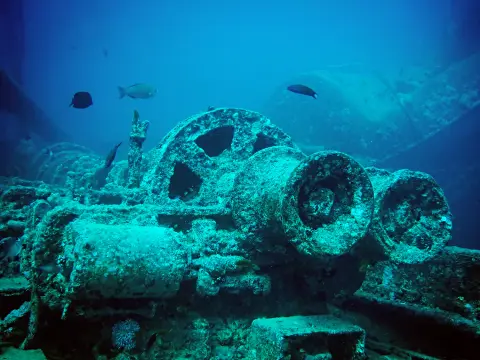
The wreck sits upright on a sandy seabed at about 30 metres, near the reef of Sha'ab Ali at the mouth of the Gulf of Suez. The bow is largely intact. Toward the stern, the force of the explosion tore the ship apart, and debris lies scattered across the sand. The holds open from the deck, so divers can look down into rows of cargo, and swim inside with a guide. One of the locomotives lies on the seabed beside the hull, thrown clear by the blast. The water here can be choppy, and currents can be strong, which is why boats tie onto the wreck with lines and divers descend along them. Visibility is often good, but it changes with the weather.
Why it matters
The Thistlegorm is a rare thing: a time capsule from the Second World War that you can visit in person. Historians value her cargo because it shows exactly what a supply ship carried to the desert war. Divers value her because few wrecks offer so much to see at recreational depths. She is also a grave. Nine men died here, and their memory deserves respect. Never take anything from the wreck. Over the years, souvenir hunters have removed many items, and every piece taken makes the site poorer for everyone who follows. Look, photograph, and leave her as you found her.
Your walk-through
The stops a guide would take you to, in order.
-
1
The descent line and the bow
We go down the line together, slowly, equalising as we go. As the shape appears below, head for the bow. It is the most intact part of the ship, rising from the sand with its rails still in place. Pause here and get your breathing settled. Look along the deck toward the stern and you can understand the size of her. Fish gather around the bow, and the coral that has grown over the steel softens its hard lines.
-
2
Hold number one
Next we look into the forward hold. Here you can see trucks, motorcycles and boxes of supplies, stacked as they were loaded in Britain. Look closely at the motorcycles, still in neat rows. Some divers find this moment strangely moving, because it is so ordinary. These were tools for soldiers, waiting to be unloaded. If conditions allow and you are trained, your guide may lead you inside. Keep off the bottom, move slowly and do not stir up the silt.
-
3
The lower holds and vehicles
Lower down, the cargo grows more varied. Your guide will point out rifles, boots, tyres and vehicle parts. Torches bring out the colours that the depth has stolen. Remember that this is an old steel ship under constant attack from salt water. Do not touch, do not pull and do not take. Watch your gauges carefully here. Time passes quickly when there is so much to see, and the depth is greater than it feels.
-
4
The bridge and the midships
Back outside, we swim along the deck to the bridge area. This is where the captain and officers ran the ship. Much of the superstructure is now covered in growth, and glassfish often hang in the shade. Look up toward the surface from here. The silhouette of the boats above, the shafts of light, the long shape of the hull below. It is one of the most memorable views in Red Sea diving.
-
5
The blast zone at the stern
Toward the stern, everything changes. This is where the bombs struck and the ammunition exploded. Steel plates are bent and twisted, and wreckage spreads across the sand. It is a sobering place. This is where the men lost their lives. Hover quietly for a moment. Then look for the stern itself, where a gun still points toward the sky, and the propeller below.
-
6
The locomotive on the seabed
Finally, look for one of the two locomotives, lying on the sand off the side of the ship where the blast threw it. It is an extraordinary sight, a railway engine on the floor of the sea. Fish weave through its frame. From here we return to the line and begin our slow ascent, with a safety stop on the way up. The second dive of the day usually explores a different part of the wreck.
Things you might not know
- The Thistlegorm was only about eighteen months old when she sank in October 1941.
- She was carrying two steam locomotives on deck, and one now lies on the seabed beside the hull.
- Jacques Cousteau found the wreck in the early 1950s using information from local fishermen.
Researched November 2026 from: en.wikipedia.org, emperordivers.com, liveaboard.com. Fees and hours change, so check on the day.