🚗 Day trip · Bol, island of Brač, 45 km from central Split
Zlatni Rat Beach
A golden tongue of pebbles that moves with the wind
🎧 Listen to this guide · about 5 min
Pop your earphones in and we'll walk you round.
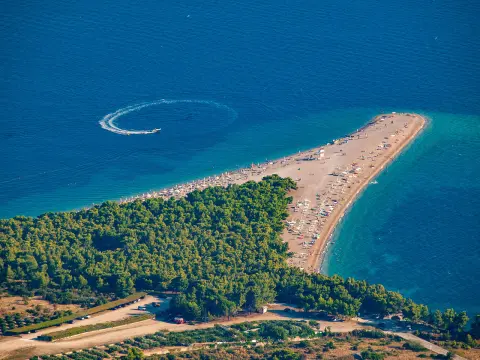
From the catamaran, you will see it long before you land. A slim point of pale pebbles stretching out from the green coast of Brač into deep blue water, lined with pine trees and shaped like a tongue, or a horn. This is Zlatni Rat, the Golden Cape. Its tip bends and shifts with the wind and the waves, sometimes pointing one way and sometimes the other. On calm mornings it is peaceful, with swimmers floating in glassy water. On summer afternoons the wind arrives, and suddenly the sea is full of colourful sails. Kick off your shoes. This is beach time.
The story of Zlatni Rat Beach
Brač is an island of stone and olive groves. Its white limestone was quarried in Roman times and used in Diocletian's Palace, and later in many buildings around the Adriatic. The town of Bol, on the island's south coast, grew up around a harbour and a Dominican monastery founded in the fifteenth century.
For centuries, Zlatni Rat was simply a stretch of shore used by local people. The spit itself is a natural formation of pebbles, carried and shaped by the currents and waves along this coast.
In the twentieth century, as tourism grew in Dalmatia, Bol and its beach became famous. The steady summer wind made it a favourite spot for windsurfers, and Bol became one of the main windsurfing centres on the Adriatic. The spit is now protected as a geomorphological phenomenon, a natural landform valued for its shape and the way it changes.
The setting
Zlatni Rat lies about two kilometres west of Bol, on the southern coast of Brač, facing the island of Hvar across the channel. The spit is made of small, smooth pebbles. When it was measured in 2015, its east side was about 377 metres long and its west side about 479 metres, but these numbers change. Pine woods cover its base, offering shade. The water drops off quickly into clear, deep blue. Behind the beach, the slopes rise steeply to Vidova Gora, the highest peak of all the Adriatic islands. A promenade shaded by pines links Bol town to the beach.
Why it matters
Zlatni Rat is one of the most photographed beaches in Croatia and a symbol of the Dalmatian coast. But it is also a small natural wonder: a beach that is never quite the same twice. Most changes happen between autumn and spring, when strong winds and currents reshape the tip. Its protected status reflects that. For visitors, it offers simple pleasures done perfectly: clear water, warm pebbles, pine shade and wind.
Your walk-through
The stops a guide would take you to, in order.
-
1
Bol harbour
Arrive at the harbour of Bol. It is a small, friendly town with stone houses along the water. Take a few minutes before heading to the beach. Look along the coast to the west, and you can just see the point of Zlatni Rat reaching out into the sea.
-
2
The pine promenade
Walk west along the seaside promenade, about two kilometres of shaded path under pine trees. Along the way, small rocky coves invite you to stop and swim. You will pass hotels and cafés, but the sea is always at your side, a deep clear blue.
-
3
The base of the spit
At the base of Zlatni Rat, the pines give way to open pebbles. This is the best place to find shade and set up for the day. Look at the shape of the spit stretching away from you. Is its tip turned east or west today? That depends on the recent winds and currents. Come back another season, and it may look different.
-
4
The tip
Walk out to the very tip. The water is clear on both sides, and it gets deep quickly, so take care if you are not a strong swimmer. In summer, the westerly afternoon wind, the maestral, often pushes the tip a little toward the east. Stand at the end and you will feel the sea on three sides of you.
-
5
Windsurf beach and the view of Vidova Gora
Finish on the western side, where windsurfers rig their sails in the afternoon. Watch them race across the channel toward Hvar. Then turn around and look up at Vidova Gora, the mountain behind Bol. It is the highest peak of the Adriatic islands, and from its top the whole spit looks like a tiny white arrow pointing out to sea.
Things you might not know
- The shape and length of Zlatni Rat change with wind, waves and currents; in storms the tip can shift within hours.
- Measured in 2015, the east side was about 377 metres and the west side about 479 metres long.
- Vidova Gora, the peak above Bol, is the highest point of all the Adriatic islands.
Researched November 2026 from: en.wikipedia.org, bol.hr, jadrolinija.hr. Fees and hours change, so check on the day.