⭐ Must-see · Kalamaja, Põhja-Tallinn, 1 km from central Tallinn
Telliskivi Creative City
Old railway sheds, fresh paint and Tallinn's creative heartbeat
🎧 Listen to this guide · about 5 min
Pop your earphones in and we'll walk you round.
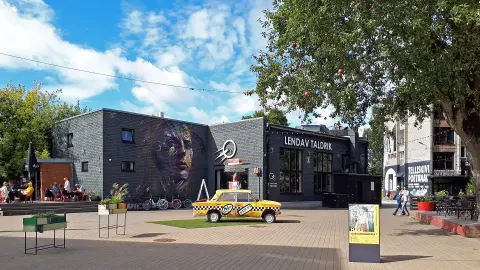
Leave the Middle Ages behind for a while. Just a short walk past the railway station, you step into a different Tallinn. Red brick sheds and grey factory halls are covered in giant murals. Bicycles lean against old loading ramps. Music drifts from a café, someone is printing T-shirts in a doorway, and the smell of coffee and fresh bread is everywhere. This is Telliskivi Creative City, built in the shell of an old railway works. It is where young Tallinn comes to work, eat, shop and argue about art. You will not find ancient treasures here, but you will feel the energy of a small country that loves design, start-ups and good food. Wander slowly, and keep your camera ready for the walls.
The story of Telliskivi Creative City
This story begins with the railway. In 1870 the Baltic Railway opened its line and Tallinn's main station, Balti Jaam, just next door. Alongside it came the railway's main workshops, where engines and carriages were built and repaired. For a time it was the largest industrial employer in the city, and the workers' wooden houses of Kalamaja grew up around it.
The site stayed industrial through the twentieth century, through two world wars and the Soviet era. After Estonia regained independence in 1991, many of these heavy industries closed, and the halls stood empty.
In 2007 the businessman Jaanus Juss founded Telliskivi Creative City to give the old buildings a new life. The first tenant, the headquarters of the Tallinn Black Nights Film Festival, moved in in 2009. Studios, start-ups, shops and restaurants followed. In 2019 Fotografiska, the Swedish photography museum, opened its Tallinn branch here. Next door, the old Balti Jaam market was rebuilt as a modern food and goods hall.
The setting
Telliskivi stands on Telliskivi Street, at the edge of the Kalamaja district, just west of the railway station. The complex is made up of ten buildings with more than 25,000 square metres of space, set around open yards. Old brick workshops sit beside plain concrete blocks from later decades. Many walls are painted floor to roof with murals by Estonian and visiting artists, and the murals change over time. Inside are more than 300 companies, nearly 30 shops, about a dozen restaurants, two theatres and seven galleries. Step out the back and you are among the colourful wooden houses of Kalamaja, the old fishermen's and workers' quarter, now one of the most loved neighbourhoods in the city.
Why it matters
Telliskivi shows how Tallinn reinvented itself. A city once known for heavy industry now prides itself on design, technology and culture, and this is where you can see that shift up close. It is also a model of reuse rather than demolition. Instead of flattening old factories, the city let artists and small firms move in. For locals it is a weekday office, a weekend market and an evening out in one place. For you, it is the best spot in Tallinn to meet the city's present, after spending your morning with its past.
Your walk-through
The stops a guide would take you to, in order.
-
1
Balti Jaam Market
Start at Balti Jaam Market, beside the railway station. Downstairs you find farmers' stalls with smoked fish, rye bread and berries. Upstairs there are second-hand clothes, antiques and Soviet-era curiosities. Have a look at the food court, where you can taste anything from Estonian dumplings to Georgian bread. It is a good place to warm up before the walk.
-
2
The railway crossing and station
Walk out past the low station building of Balti Jaam. The railway arrived here in 1870, and with it came the workshops you are about to enter. Notice how the old tracks still shape this neighbourhood, with long buildings running parallel to the lines. Cross carefully toward Telliskivi Street.
-
3
The main yard and murals
Enter the main yard of Telliskivi. Look up at the walls. Some murals are huge, covering whole factory fronts, others are tiny stencils tucked beside a drainpipe. The art changes regularly, so what you see today may be gone next year. Take your time and look for the details, the small jokes, the local references.
-
4
Fotografiska Tallinn
At the far end, in a former factory hall, is Fotografiska Tallinn, which opened in 2019. It shows changing exhibitions by well-known and young photographers. Even if you skip the galleries, step into the lobby, and if you can, go up to the restaurant for a coffee and a view over the rooftops of Kalamaja and the Old Town towers.
-
5
Design shops and studios
Wander through the side buildings. Here you will find small design shops selling Estonian linen, ceramics, jewellery and clothing, many made by the people behind the counter. Upstairs are offices and studios. On some weekends the yard fills with a flea market, where locals sell everything from vinyl records to grandmother's teacups.
-
6
Kalamaja wooden houses
Finish by stepping out into the streets of Kalamaja behind the complex. Look at the two-storey wooden houses with their painted boards and stone ground floors. They were built for workers and fishermen in the late nineteenth and early twentieth centuries. Today they are restored with care, and their quiet gardens feel a world away from the busy yard you just left.
Things you might not know
- The Baltic Railway's main workshops opened on this site in 1870, together with Balti Jaam station.
- The first tenant, in 2009, was the headquarters of the Tallinn Black Nights Film Festival.
- The complex holds more than 300 companies, about 90 percent of them creative businesses.
Researched November 2026 from: en.wikipedia.org, telliskivi.cc, visittallinn.ee. Fees and hours change, so check on the day.