⭐ Must-see · Adeje, 6 km from central Tenerife
Barranco del Infierno
The ravine of hell that hides a green, singing heart
🎧 Listen to this guide · about 5 min
Pop your earphones in and we'll walk you round.
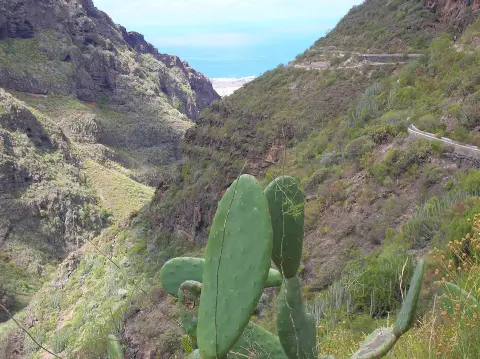
Do not let the name scare you. Barranco del Infierno means Hell's Ravine, but what waits inside is surprisingly gentle. We start just above the old town of Adeje, on a dry, sunny hillside full of cactus and spurge. As we walk, the walls of the ravine close in, the air cools, and willows and ferns appear. Then you hear it. Falling water, in the south of Tenerife, where water is precious. The trail ends at a waterfall in a rocky amphitheatre. It is a short adventure, not too hard, and only a limited number of people may enter each day, so it rarely feels crowded.
The story of Barranco del Infierno
The ravine has been used by people for a very long time. The Guanches made homes and burial places in its many caves, some with engravings on their walls. Remains and objects found in the area are now kept in the Museum of Nature and Archaeology in Santa Cruz. Adeje itself was the seat of one of the native kingdoms of Tenerife before the Spanish conquest.
After the conquest, the water from the ravine became valuable for farming. Channels carried it down to the fields and sugar mills around Adeje. The name Hell's Ravine may come from the dizzying cliffs and the difficult paths, but nobody is quite sure.
In modern times the gorge became popular with walkers, and that brought problems. The trail was closed after a fatal accident in 2009, and again in 2015 for safety work, reopening in February 2016. It is now a special nature reserve with a managed path, compulsory booking, helmets for every visitor and a daily limit of about 300 people. It still closes on days of rain or strong wind, when rockfall is a danger.
The setting
The ravine cuts deep into the slopes above Adeje, its walls rising steeply on both sides. The path is about six and a half kilometres there and back, with a gentle climb of around 250 metres. At first the hillside is dry, with tabaiba and cardón cactus. Higher up, a thin stream runs year round, and the plants change to willows, reeds and ferns. Canary pines cling to the cliffs above. At the end, the gorge narrows into a tall rock bowl where the waterfall drops into a small pool.
Why it matters
Barranco del Infierno is one of the most visited protected areas on Tenerife. It protects rare plants and birds, and the archaeology of its caves. It also shows how important water has always been in the dry south. For visitors staying on the coast, it is the easiest way to step into wild Tenerife without a long drive. The booking system keeps numbers low, and that is what keeps the ravine quiet and green.
Your walk-through
The stops a guide would take you to, in order.
-
1
Meeting point in Adeje
We gather at the top of Calle Los Molinos in Adeje, at the reception hut. Show your booking and collect your helmet. Look down over the rooftops of Adeje and the coast. The old church of Santa Úrsula stands just below. Fill your bottle, because the first stretch is in full sun.
-
2
Hillside viewpoint
The path climbs gently along the side of the ravine. Pause at the first viewpoint. Below you the barranco drops away. Look at the plants around your feet. The tall cactus-like plant is cardón, a native spurge, not a true cactus. Its milky sap is poisonous, so do not touch. Lizards will be sunbathing on every rock.
-
3
Caves in the ravine walls
Look across at the cliffs and you will see dark openings in the rock. These are some of the caves the Guanches used as homes, stores and burial places. They are protected, and you may not enter them. Try to imagine families living here, with the stream below and goats grazing on the slopes.
-
4
Into the green
Now the path turns into the ravine and drops to the stream. Suddenly the light softens and the air smells of damp earth. Willows lean over the water. You will cross the stream on stones and little bridges. Listen for the song of canaries and chiffchaffs. This sudden green is the reason people have treasured this place for so long.
-
5
The waterfall
At the end, the walls close into a tall rock bowl. Water slides and drops down the face into a pool. Its flow changes with the season, from a thin thread in summer to a proper cascade after winter rain. Rest here, but stay behind the barriers. Then walk back the same way, enjoying the views towards the sea.
Things you might not know
- Only about 300 visitors are allowed into the ravine each day.
- Helmets are compulsory for every walker.
- The trail ends at what is described as the highest waterfall on Tenerife.
Researched November 2026 from: barrancodelinfierno.es, en.wikipedia.org, webtenerife.co.uk. Fees and hours change, so check on the day.