🚗 Day trip · Hase, Kamakura, 55 km from central Tokyo
Great Buddha of Kamakura (Kotoku-in)
Seven centuries of calm in bronze
🎧 Listen to this guide · about 5 min
Pop your earphones in and we'll walk you round.
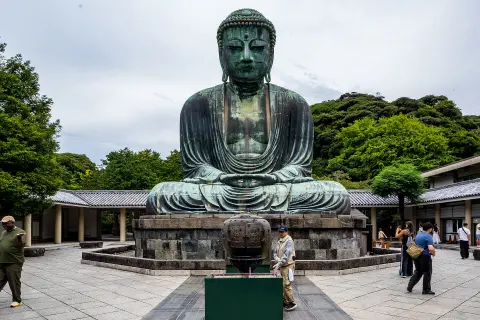
Welcome to Kamakura, once the capital of Japan's first samurai government. Through the gate, past the pines, you will see him: the Great Buddha, seated in the open air, hands resting in his lap, eyes half-closed in meditation. He is huge, more than eleven metres of bronze, and yet the feeling is not of power but of perfect calm. The weather has turned him a soft green. People come from all over the world simply to stand here and look up at his face. Take your time. Walk around him. You can even step inside. And as you do, imagine the centuries of storms and pilgrims he has quietly watched.
The story of Great Buddha of Kamakura (Kotoku-in)
In the 1200s, Kamakura was the seat of the shoguns, and the city thrived. Minamoto no Yoritomo had set up Japan's first samurai government here in the late 1100s. Records say the casting of this bronze Buddha began in 1252, funded largely by donations collected by a priest named Joko. It replaced an earlier wooden statue. The sculptor's name is not known for certain.
The Buddha is Amida, the Buddha of infinite light, who promises rebirth in a pure land to all who call his name. At first he sat inside a great wooden hall. Records say that hall was damaged by storms in the 1300s, and it was finally lost in the late 1400s. Many accounts say a tsunami in 1498 swept it away. The hall was never rebuilt, and ever since, the Buddha has sat in the open air.
In the 1700s, a priest named Yuten led a restoration of the statue and the temple, which is called Kotoku-in and belongs to the Jodo, or Pure Land, school. In 1923 the Great Kanto Earthquake damaged the base, and later work in the 1960s strengthened the statue against future quakes. It is a National Treasure of Japan.
The setting
Kotoku-in sits in the Hase district of Kamakura, a few minutes inland from the sea, in a valley ringed by wooded hills. You enter through a gate guarded by two fierce kings, then walk up a short path under pines. The Buddha sits on a stone platform in a wide courtyard, open to the sky. The statue stands about 11.3 metres high, around 13.35 metres with its base, and weighs about 121 tonnes. It is hollow, cast in sections. Behind it, small paths lead past a hall called Kangetsudo and a stone carved with a poem.
Why it matters
The Great Buddha is a symbol of Kamakura and one of the best-known images of Japan. It shows the great skill of medieval Japanese bronze casters, and the deep popularity of Pure Land Buddhism, which promised salvation to ordinary people. For many visitors, it is not just a statue but a moment of peace. People of all faiths stand before him in silence. He has survived storms, a tsunami and earthquakes, and his calm face reminds us that some things last.
Your walk-through
The stops a guide would take you to, in order.
-
1
Niomon Gate
Enter through the Niomon, the gate with two guardian kings, one with his mouth open, one with his mouth closed. Together they mean the beginning and the end of all things. They glare to scare away evil. Pass between them and walk along the path. Just ahead, through the pine trees, you will catch your first glimpse of the Great Buddha's head and shoulders.
-
2
Front of the Buddha
Now stand in front of him. Look at the hands, resting in his lap with thumbs touching, the gesture of deep meditation. Look at the face, slightly bowed, eyes half-closed. Many people say he seems to look down at each visitor. Notice the green colour, caused by the bronze weathering over centuries. Faint traces of gold leaf can still be seen on his cheek, so it is said.
-
3
Inside the statue
For a small extra fee, you can step inside the Buddha. Go down the narrow steps into the hollow body. Look at the walls, and you will see the seams where the bronze sections were cast and joined, layer upon layer. It is cool and dim inside, and it shows how medieval workers built such a giant without modern machines. Come out the way you entered, slowly.
-
4
Side and back view
Walk around to the side and back of the statue. Look at the two small windows set into his back, which let air and light into the hollow body. From here you also see the great curve of his shoulders and the scale of the platform. The foundation stones of the old hall that once covered him still lie around the courtyard. Imagine the huge wooden roof that once stood above.
-
5
Kangetsudo hall and poem stone
Behind the statue, follow the path to the quiet Kangetsudo hall, said to have come from Korea, and look for a stone engraved with a poem by Yosano Akiko, a famous early twentieth-century poet. In it she calls the Buddha handsome, even though he is a Buddha. It is a playful line. Look back at the statue through the trees, and decide for yourself.
Things you might not know
- Records say the casting of the bronze Buddha began in 1252.
- The statue has sat in the open air since its hall was lost in the late 1400s.
- The Buddha is hollow, and visitors can step inside for a small extra fee.
Researched November 2026 from: kotoku-in.jp, en.wikipedia.org, gltjp.com. Fees and hours change, so check on the day.