⭐ Must-see · Kensington Market / Spadina Avenue, 2 km from central Toronto
Kensington Market and Chinatown
Toronto's immigrant story, told in fruit stalls and murals
🎧 Listen to this guide · about 6 min
Pop your earphones in and we'll walk you round.
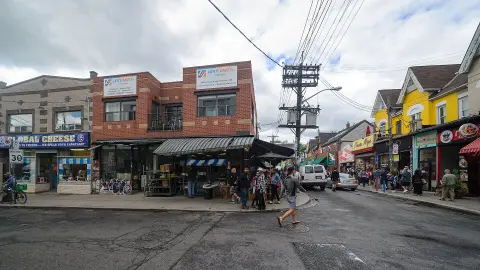
Welcome to the part of Toronto that never quite agreed to grow up. Kensington Market is a tangle of narrow streets and old Victorian houses, painted every colour you can imagine. Front porches are shops. Murals climb the walls. The smell of coffee, fresh bread, spices and fried dough drifts out of doorways. Just to the east, Spadina Avenue turns into Chinatown, with fruit piled high on the sidewalk and bakeries selling warm buns. Over a century, people from Eastern Europe, Italy, Portugal, the Caribbean, Asia, Latin America and Africa have all called this corner home. Walk slowly. Taste things. Say hello. This is the neighbourhood that best explains how Toronto became Toronto.
The story of Kensington Market and Chinatown
The story begins in 1815, when George Taylor Denison, a veteran of the War of 1812, bought land here between Queen Street and Bloor Street. The green space now called Bellevue Square was the parade ground for his cavalry troop. In the 1850s the estate was divided into lots, and by the 1880s rows of small houses had gone up for Irish and Scottish labourers.
In the early twentieth century Jewish families from Eastern Europe, along with Italians, moved here from the crowded old district known as The Ward. They opened shops in their front rooms and sold from stalls on the street. By the 1920s this was simply called the Jewish Market, and tens of thousands of Jewish residents lived in and around it.
As those families moved north after the Second World War, new arrivals took their place. Portuguese immigrants from the Azores came in the 1950s, followed by people from the Caribbean, East Asia, Central America and Africa. Chinatown grew along Spadina Avenue next door. In November 2006 Kensington Market was designated a National Historic Site of Canada, honouring it as a living example of immigrant life in the city.
The setting
Kensington is bounded by College Street to the north, Spadina Avenue to the east, Dundas Street West to the south and Bathurst Street to the west. Inside those lines the streets are short and crooked. Most shops and cafés cluster on Augusta Avenue, Kensington Avenue, Baldwin Street and Nassau Street. Many are in narrow houses with the shop built out over the old front garden. Bellevue Square, a small park with big trees, sits near the western edge. Spadina Avenue, wide and busy with streetcars, forms the eastern edge, and its sidewalks are lined with Chinese grocers, bakeries, herbalists and restaurants, especially around the corner of Dundas Street.
Why it matters
Kensington matters because it was never planned as an attraction. It grew from people making a living in a new country, and it still does. Locals fight hard to keep big chains out, and so far they have mostly won. On Pedestrian Sundays, held since 2004 on the last Sunday of the month outside winter, cars are banned and the streets fill with music. For visitors, it is a lesson in how a city absorbs newcomers. Each wave left its traces in a shop sign, a church, a bakery recipe, while the place itself kept its scruffy, independent spirit.
Your walk-through
The stops a guide would take you to, in order.
-
1
Spadina and Dundas
Begin at the corner of Spadina Avenue and Dundas Street, the heart of Toronto's downtown Chinatown. Look at the shop signs in Chinese and English, the roast meats hanging in windows and the fruit stands spilling onto the sidewalk. Streetcars rumble down the middle of the road. Try a bakery for a warm pineapple bun or an egg tart. Then turn west along Baldwin or Dundas and step into Kensington.
-
2
Kensington Avenue
Kensington Avenue is the market's oldest shopping strip. Here, a century ago, Jewish merchants sold fish, chickens and dry goods from their front porches. Today you see vintage clothing shops with racks out front, little food counters and walls covered in murals. Look at how the shops are built onto the fronts of narrow houses. You can still see the old rooflines above the signs.
-
3
Augusta Avenue and Baldwin Street
Turn onto Augusta Avenue and then Baldwin Street, the food corner of the market. Cheese shops, spice sellers, bakeries, butchers, fishmongers and fruit stands crowd together. The flavours change every few doors, from Portuguese to Caribbean to Latin American to Middle Eastern. Buy a little of something you have never tasted. That is the spirit of the place. Shopkeepers here are used to curious visitors and usually happy to explain.
-
4
The Garden Car
Look for an old car with plants growing out of it. This is the Garden Car, a public art piece that doubles as a tiny community garden. It was built in 2006 by a local group called Streets are for People, and it has been in the market since 2007. It is a cheerful protest against traffic and a symbol of how residents see their streets: as places for people first.
-
5
Bellevue Square Park
End in Bellevue Square, a small green park under tall trees. This was George Taylor Denison's parade ground two centuries ago, where his cavalry drilled. Now it is where locals sit with coffee and children climb the play structure. Nearby, on Denison Square, stands the Kiever Synagogue from the 1920s, one of the few reminders of the old Jewish Market still serving its original purpose. Sit for a while and watch the neighbourhood go by.
Things you might not know
- Bellevue Square Park was once the parade ground of a cavalry troop raised by George Taylor Denison.
- Kensington Market became a National Historic Site of Canada in November 2006.
- Pedestrian Sundays, car-free street festivals, began here in 2004.
Researched November 2026 from: en.wikipedia.org, en.wikipedia.org. Fees and hours change, so check on the day.