⭐ Must-see · Stephansplatz, Innere Stadt
St. Stephen's Cathedral
A stone forest at the centre of the old city
🎧 Listen to this guide · about 6 min
Pop your earphones in and we'll walk you round.
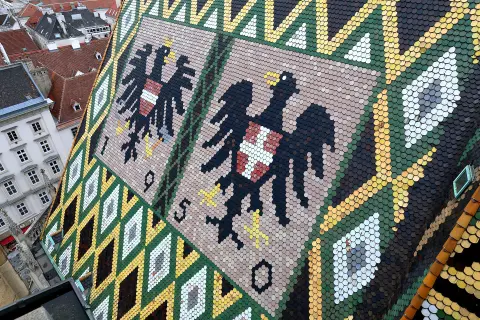
Here we are at Stephansplatz, the very centre of Vienna. Lift your eyes. That tower in front of you, the south tower, rises more than 136 metres, and for centuries it was the tallest thing anyone in this city had ever seen. Locals call the cathedral simply Steffl, a fond nickname for the tower. Now look at the roof, with its bright zigzag pattern of glazed tiles. You will not find another roof quite like it. Inside, it is cool and dim, scented with candles and stone. Mozart was married here, and his funeral was held here too. We will walk through the great doors, look at the carved pulpit, and, if your legs are willing, climb the tower stairs.
The story of St. Stephen's Cathedral
A first church stood here by 1147, just outside the walls of what was then a small town. Its Romanesque west front, with the Giant's Door and the two Heathen Towers, still survives, and it is the oldest part of the building.
In 1359 Duke Rudolf IV, known as the Founder, laid the stone for a much grander Gothic church. Over the next century the nave and choir grew, and the south tower was finished in 1433. A north tower was begun in 1450 but never completed. It was capped with a small Renaissance top in the 1500s. Vienna only became a bishop's seat in 1469, so the church was a cathedral in ambition long before it was one in name.
The cathedral survived the Ottoman sieges of 1529 and 1683. Its worst night came in April 1945, at the end of the Second World War, when fires from nearby buildings spread to the roof. The roof timbers burned, and the great bell, the Pummerin, fell and shattered. The people of Austria paid for the rebuilding, with each province donating a part. The cathedral reopened in 1952, and a new Pummerin, cast from the metal of the old one, was hung in the north tower.
The setting
The cathedral fills the middle of Stephansplatz, where the main shopping streets of Graben and Kärntner Strasse meet. It is built of limestone, now dark in places with age. The steep roof is covered with about 230,000 glazed tiles. On the south side they form a double-headed eagle, the symbol of the Habsburg empire. Inside, three tall aisles of about equal height make a hall church, with slender pillars rising like trees. The main altar at the east end shows the stoning of Saint Stephen. Underneath lie the catacombs, with old burial chambers and the ducal crypt.
Why it matters
For Vienna, St. Stephen's is far more than a church. It is the city's landmark, the place where the New Year is rung in by the Pummerin, and a symbol of how Austria rebuilt itself after 1945. It is still a working cathedral, with daily services, so it holds both worshippers and visitors. Its tower is still the point from which many Viennese judge distance and height. When you see the roof from any hill around the city, you know where the centre is.
Your walk-through
The stops a guide would take you to, in order.
-
1
Giant's Door and Heathen Towers
Start at the west front, facing the main door. This Romanesque doorway, called the Giant's Door, dates from the 1200s. Look at the carved figures and strange beasts around the arch. On either side rise the Heathen Towers, about 65 metres tall. Legend says they stand on the site of a pagan shrine, which is how they got their name. Look on the wall to the left for old iron measures that merchants once used to check cloth and bread.
-
2
Nave
Step inside and let your eyes get used to the half light. The nave is tall and narrow, with pillars full of statues on little platforms. Walk slowly toward the altar. Notice how the light from the high windows falls on the stone. People come in all day to pray and light candles, so speak softly. Even in a crowd, this space has a deep stillness.
-
3
The Pilgram Pulpit
Look for the stone pulpit against a pillar on the left of the nave. It was carved around 1500. The four Fathers of the Church sit around it, each one with a very human face. Below the stairs, a man leans out of a window, holding a compass. For a long time he was said to be the builder Anton Pilgram, signing his work. Experts still argue about who carved the pulpit, but the little window-gazer remains everyone's favourite.
-
4
Wiener Neustadt Altar and tomb of Frederick III
At the east end, to the left, find the Wiener Neustadt Altar, a carved and painted winged altar from 1447. To the right is the great red marble tomb of Emperor Frederick III, who died in 1493. It took decades to carve and is covered with hundreds of small figures. Frederick's motto AEIOU appears on many of his monuments, though nobody knows for sure what he meant by it.
-
5
South Tower climb
Now, for those with strong legs, the south tower. The entrance is outside, on the south side. There are 343 steps up a narrow spiral staircase to the watchman's room. Take it slowly. At the top, small windows open onto the whole city: the roofs of the old town, the Ferris wheel in the Prater, and the green hills of the Vienna Woods. In earlier centuries, a fire watcher lived up here.
-
6
North Tower and the Pummerin
If you prefer a lift, the north tower has one, up to a viewing platform near the great bell. This is the Pummerin, cast in 1951 from the metal of the old bell that crashed down in the fire of 1945. It weighs about twenty tonnes. It rings only on special days, such as Easter and the New Year. From here you also get a close view of the patterned roof tiles and the double-headed eagle.
Things you might not know
- The south tower is about 136 metres high and was finished in 1433.
- The roof is covered with about 230,000 glazed tiles forming eagles and coats of arms.
- Mozart married Constanze Weber here in 1782, and his funeral blessing was held here in 1791.
Researched November 2026 from: stephanskirche.at, shop.stephanskirche.at, en.wikipedia.org. Fees and hours change, so check on the day.