⭐ Must-see · Lagos old town
Church of Santo António and Lagos Museum
By the Tralover editorial team · Fact-checked · How we research
A plain white door that opens onto a room of gold
🎧 Listen to this guide · about 6 min
Pop your earphones in and we'll walk you round.
Welcome to the Church of Santo António, the little church that astonishes everyone who walks into it. From the street it looks almost modest, a white front with two small bell towers. Then you step inside, and the world turns to gold. Carved wood covers almost every surface, swirling with leaves, angels, birds and fruit, all gilded and glowing in the soft light. Blue and white tiles run along the lower walls, and the ceiling is painted to look as if it opens up into the sky. To reach it, you will walk through the Lagos town museum, a delightful collection of everything from Roman finds to sacred robes and an eight-legged goat. Come in, and let your eyes adjust.
The story of Church of Santo António and Lagos Museum
The church was built at the start of the eighteenth century and dedicated to Saint Anthony. It was commissioned by the military, and for a long time it was known as Santo António dos Militares, the soldiers' church. Lagos was a garrison town and, from 1576 until 1755, the capital of the Algarve. So the story goes, Saint Anthony himself was enrolled in the town's infantry regiment and given a soldier's rank and pay, which were spent on the church.
The great earthquake of 1 November 1755 devastated Lagos. The church was damaged but not destroyed, and it was restored by 1769. The magnificent gilded woodwork you see today is the work of the carvers Gaspar Martins and Custódio de Mesquita. In 1924 the church was declared a National Monument.
The museum grew up beside it. It was founded around 1930 by a local scholar, Dr José Formosinho, and started life in the church's sacristy. Over the decades he and others gathered archaeology, coins, sacred art, folk crafts and curiosities from all over the region. The museum closed in 2017 for a thorough renovation, more than a thousand objects were restored, and it reopened in October 2021 with new displays and new lighting for the church.
The setting
The church stands on a quiet street in the southern part of the old town, close to the sea wall and the Ponta da Bandeira fort. It is small, a single nave with a raised choir at the back. The interior is a jewel box of Baroque decoration. Gilded carving frames the high altar and climbs the walls in twisted columns, garlands and figures. Below it, blue and white tile panels line the walls. Large painted canvases hang between the carvings, and the wooden ceiling is painted in perspective so that it seems to rise far above you. The museum wraps around the church, with rooms on archaeology, religious art, military history, natural history and Algarve crafts.
Why it matters
This is Lagos at its most splendid. The church shows the wealth and devotion of a port town in the eighteenth century, when gold from Brazil flowed into Portuguese churches. It also survived the 1755 earthquake when so much of Lagos fell, so it is a rare window on the town before the disaster. The museum gives you the story of Lagos and the western Algarve in one visit, from prehistoric stones to the Battle of Lagos in 1759. Together they make the best hour of culture you can spend in the old town.
Your walk-through
The stops a guide would take you to, in order.
-
1
The façade
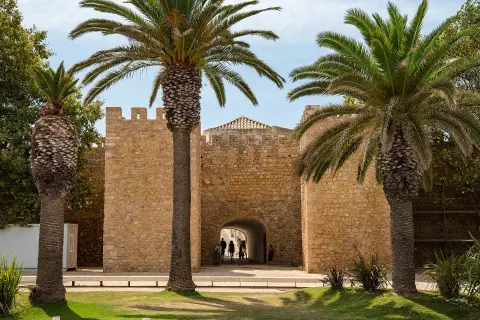
Stand on the street and look at the front. It is plain, almost austere, with two little bell towers that do not quite match. Nothing here prepares you for what is inside. Remember the soldiers who paid for it. This was their church, in a town full of barracks, walls and cannon facing the sea. Then push open the door and step through.
-
2
The museum rooms
Enter through the museum. Take your time in the first rooms. You will find Roman and earlier finds from around Lagos, coins, and sacred robes from the sixteenth century, associated by tradition with the last Mass of King Sebastião before he sailed to his death in Morocco in 1578. There are also cannonballs and relics from the Battle of Lagos, fought at sea in 1759.
-
3
The cabinet of curiosities
Do not miss the cabinet of curiosities. Like the private collections of old, it mixes the beautiful and the strange. Look for African art, a saddle said to have belonged to Queen Estefânia, and the museum's most famous resident, a goat with eight legs. Children love it. Adults usually laugh and then look twice. Every object here was gathered by people who loved this town.
-
4
Into the church
Now step through into the church. Stop just inside and look up. Gilded wood rises around you, carved into angels, vines, shells and birds. Try to follow a single garland with your eyes and you will lose it among a hundred others. Then look up again at the painted ceiling, designed to make the roof seem to open into a higher space.
-
5
The high altar and Saint Anthony
Walk forward to the high altar. In the centre stands the figure of Saint Anthony, the patron of the church. Remember the old story that he was once listed as a soldier of the Lagos regiment. Look down at the blue and white tiles along the walls. They were added in the eighteenth century and tell their own stories in paint.
Things you might not know
- The church was long known as Santo António dos Militares because it was commissioned by the military.
- Lagos was the capital of the Algarve from 1576 until the earthquake of 1755.
- The museum's most famous exhibit is a goat with eight legs.
Researched November 2026 from: en.wikipedia.org, barlavento.pt, en.wikipedia.org, idealista.pt. Fees and hours change, so check on the day.