🚗 Day trip · Dahshur, Giza Governorate, 40 km from central Cairo
Dahshur (Red Pyramid and Bent Pyramid)
By the Tralover editorial team · Fact-checked · How we research
Sneferu's experiments in stone, in quiet desert
🎧 Listen to this guide · about 5 min
Pop your earphones in and we'll walk you round.
Welcome to Dahshur. Look around. Open desert, a big sky, and two huge pyramids, with hardly anyone else in sight. That is the magic of this place. These pyramids were built by King Sneferu, the father of Khufu, who built the Great Pyramid at Giza. Here you see Sneferu working out how to build a true pyramid. One changes its angle halfway up. The other, the Red Pyramid, got it right. Today we will see both, and if you are willing to bend and climb, we will go deep inside the Red Pyramid, to chambers built more than four and a half thousand years ago. Bring water, and be ready for a strong ammonia smell inside.
The story of Dahshur (Red Pyramid and Bent Pyramid)
Dahshur was the southern part of the great cemetery of Memphis. Around 2600 BC, King Sneferu, the first king of the Fourth Dynasty, chose this site for his ambitious building projects. He had already worked on a pyramid at Meidum, further south. At Dahshur, he set out to build the first true, smooth-sided pyramid.
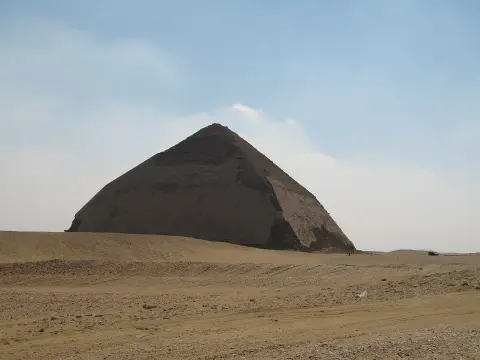
His first attempt is the Bent Pyramid. Its builders started at a steep angle of about 54 degrees. Partway up, it seems problems with stability forced them to change to a gentler slope of about 43 degrees. The result is that distinctive bent shape. Sneferu then built a second pyramid about a kilometre to the north. This is the Red Pyramid, named for the reddish tint of its stone. It was built at the gentler angle from the start, and it became the first successful smooth-sided pyramid in Egypt.
Later kings of the Middle Kingdom, such as Amenemhat III, also built pyramids here, though these are now in poor condition. Dahshur lay inside a military zone for much of the twentieth century and only opened to visitors in the 1990s. In 2019, the Bent Pyramid's interior opened to visitors for the first time in decades.
The setting
Dahshur lies on the edge of the Western Desert, south of Saqqara, with palm groves and a small lake on the valley side. The Red Pyramid stands to the north, about 105 metres tall, with a broad base around 220 metres on each side. The entrance is high up on the north face, reached by stairs. Inside, a long sloping passage leads down to three chambers with high, stepped corbelled ceilings. The Bent Pyramid stands to the south, still keeping much of its smooth outer casing. Further east, you can see the dark, crumbling mound of Amenemhat III's Black Pyramid. The landscape is open and quiet, with sand stretching to the horizon.
Why it matters
Dahshur is where Egyptian builders learned how to make a true pyramid. Without Sneferu's trials here, Khufu's Great Pyramid would not exist. Only the two biggest pyramids at Giza are larger than the Red Pyramid. Dahshur is part of the UNESCO World Heritage site Memphis and its Necropolis, and it gives visitors a rare chance to see these giants in near solitude. For travellers, it is one of the best places near Cairo to go inside a great pyramid without long queues.
Your walk-through
The stops a guide would take you to, in order.
-
1
The Red Pyramid exterior
Stand back and look at the Red Pyramid. See the reddish stone, which gives it its name. Its slope is gentler than the Giza pyramids, about 43 degrees, giving it a broad, solid look. This is the first true pyramid that worked. Notice how quiet it is here. You may have it almost to yourself. Walk around the base for a sense of its size.
-
2
Red Pyramid entrance passage
Climb the stairs up the north face to the entrance. Then go down the long, low passage, bent over, holding the rail. It is narrow and steep, and the air is warm and stale. Go slowly. At the bottom, the passage opens up into the first chamber. You are now deep inside a building more than 4,500 years old.
-
3
Red Pyramid chambers
Look up at the ceiling. It rises in steps, each layer of stone set a little further in, until they meet high above you. This is called corbelling. It spreads the weight of the pyramid above. Move on to the second and third chambers. The last was probably the burial chamber, damaged long ago by tomb robbers. Take a moment to stand still and listen to the silence.
-
4
Bent Pyramid viewpoint
Now drive or walk south to the Bent Pyramid. Look at its shape. The lower part is steep, the upper part gentler. This was a mid-course correction, probably because the steep angle was causing problems. Notice how much of its smooth white casing survives. It shows how these pyramids once looked. The contrast with the Red Pyramid is striking.
-
5
Bent Pyramid interior and satellite pyramid
If it is open, go inside the Bent Pyramid, which reopened to visitors in 2019. The passages are long and steep. Then look at the small satellite pyramid beside it, perhaps linked to the king's spirit. From here, look east across the desert to the dark Black Pyramid of Amenemhat III, from much later in history.
Things you might not know
- The Red Pyramid is Egypt's first successful smooth-sided pyramid.
- The Bent Pyramid's slope changes from about 54 to about 43 degrees.
- Only Khufu's and Khafre's pyramids at Giza are larger than the Red Pyramid.
Researched November 2026 from: egymonuments.gov.eg, en.wikipedia.org, en.wikipedia.org, whc.unesco.org. Fees and hours change, so check on the day.