💎 Hidden gem · Sacsayhuaman, 5 km from central Cusco
Inkilltambo
By the Tralover editorial team · Fact-checked · How we research
Carved rock and water channels in Cusco's quiet hills
🎧 Listen to this guide · about 6 min
Pop your earphones in and we'll walk you round.
You stand in the hills above Cusco, where the air carries the cool breath of the Andes. Inkilltambo waits quietly in the San Sebastián district, part of the larger Sacsayhuamán Archaeological Park. This small Inca site rises along a gentle slope in the Cachimayo micro-watershed at roughly 3,548 meters. Stone terraces step down the hillside, water channels trace ancient paths, and a great granite outcrop forms the heart of the place. You have left the city behind for terraces and carved stone that speak of Inca care for water and ceremony. The site feels intimate, its structures framed by the valley and distant peaks.
The story of Inkilltambo
Pre-Inca peoples of the Qotakalli, Killke, and Lucre cultures occupied the area and began shaping the rocky outcrop and soils. Construction of the Inca complex is attributed to the reign of Inca Wiracocha around 1420 to 1438 CE. His son Pachacutec later restructured the site, strengthening its religious role as part of the empire's ceque system of sacred lines radiating from Cusco's Coricancha temple. Inkilltambo became one of approximately 350 huacas across the four suyus, here in Antisuyo, dedicated especially to water worship.
Chroniclers such as Bernabé Cobo and others recorded its place in imperial ritual. Agricultural terraces supported production while channels directed sacred water. After the Spanish conquest the site lost its central function and fell into quieter use. Between 2015 and 2017 the Dirección Desconcentrada de Cultura de Cusco carried out major restoration, excavating 72 units and rebuilding walls, channels, enclosures, and paths with an investment of more than 4.6 million soles.
The setting
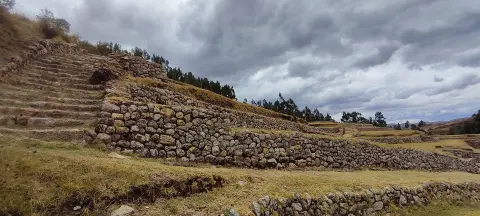
The site occupies the left bank of a small river in the Kallachaca ravine, on the eastern side of the Cusco valley. A large granite outcrop dominates the center, its natural form enhanced by Inca carving. Around it spread rectangular stone enclosures, stepped agricultural terraces that follow the slope, and a network of irrigation channels and stairways. The terraces create level surfaces for cultivation while the channels still carry water in places. Paths and low walls organize movement through the complex. From higher points the view opens across the valley toward Cusco and the surrounding ridges.
Why it matters
Inkilltambo matters as a huaca where Inca engineers blended ritual, agriculture, and water management. It formed part of the ceque system that linked sacred places across the empire and supported the cult of water essential to Andean life. Today it preserves evidence of how the Incas integrated built forms with the living landscape. The restored site offers visitors a direct encounter with that heritage in a setting far quieter than the main Sacsayhuamán terraces. Its continued protection underscores ongoing efforts to safeguard Cusco's Inca legacy.
Your walk-through
The stops a guide would take you to, in order.
-
1
The descending path and first terraces
You begin your walk on the upper slope where broad stone terraces step down the hillside. Look at the careful fitting of the retaining walls and the way they turn the natural gradient into usable land. These andenes once supported crops that fed the community and perhaps offerings. Water channels run alongside the paths, directing flow from higher springs. Pause here to feel the scale of Inca landscape engineering before you descend further into the core of the site.
-
2
The main granite huaca
The path brings you to the great carved rock that anchors the entire complex. This huaca rises as a natural outcrop shaped by Inca hands. Notice the smoothed surfaces and the way the stone seems to grow from the earth. The rock served as a focal point for ceremony, its form respected and enhanced rather than fully remade. Stand before it and sense its presence as the spiritual center of Inkilltambo.
-
3
The carved niches and interior spaces
Examine the trapezoidal niches cut into the rock, some opening outward and others reached through narrow passages. Five main niches remain visible. Inside, the spaces connect by short corridors. These features likely held offerings or served ritual purposes tied to water and ancestry. The precision of the carving shows the same mastery seen in larger Cusco monuments, here applied to a sacred outcrop.
-
4
The irrigation channels and aqueducts
Follow the stone-lined channels that weave through the terraces and around the huaca. Some still carry water today. The Incas designed these systems to manage flow, prevent erosion, and bring water to fields and ritual spaces. Watch how the channels turn corners and drop levels with small falls. This hydraulic network reveals the site's dual role in agriculture and the veneration of water as a life-giving force.
-
5
The rectangular enclosures
Among the terraces stand the low walls of roughly sixty-eight rectangular and square structures. These once formed dwellings or storage rooms associated with the huaca. Observe the fine stonework in some sections and the way the buildings cluster near the rock. They speak of daily life and administration alongside ceremony. Walk among them to picture the people who maintained this place.
-
6
Upper paths and valley views
Climb a short stairway or path to a higher vantage. From here the terraces spread below you and the river valley opens toward Cusco. The layout becomes clear: everything radiates from the central rock. Take a moment to absorb the harmony between stone, water, and mountain. This perspective shows why the Incas chose and shaped this precise spot.
Things you might not know
- Inkilltambo formed one of roughly 350 huacas in the Inca ceque system of sacred lines.
- Construction began under Inca Wiracocha around 1420–1438 CE and was expanded by Pachacutec.
- Major restoration in 2015–2017 by Cultura Cusco involved 72 excavation units and over 4.6 million soles of work.
Researched November 2026 from: es.wikipedia.org, culturacusco.gob.pe, trexperienceperu.com, illakunturtravel.com, cocatambo.com. Fees and hours change, so check on the day.