⭐ Must-see · Miniloc Island, Bacuit Bay, 12 km from central El Nido (Palawan)
Big Lagoon
By the Tralover editorial team · Fact-checked · How we research
Paddle between stone walls into a silent green room
🎧 Listen to this guide · about 6 min
Pop your earphones in and we'll walk you round.
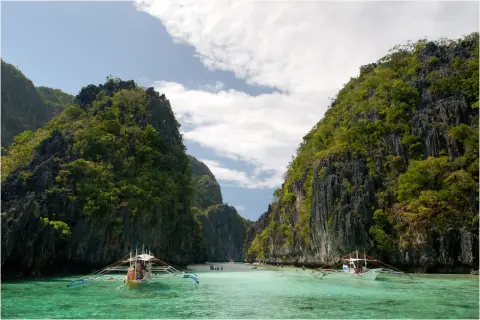
Welcome to Big Lagoon. Our boat stops here, at the mouth, because engines are not allowed inside. From now on it is your arms, a paddle and the water. Look ahead. Grey limestone rises straight out of the sea on both sides, streaked black and hung with green. The water is so shallow at first that you can see every ripple of sand. Then it deepens, and the colour shifts from pale jade to a dark, cool emerald. Sound changes too. The wind drops, the voices from the boats fade, and you hear birds and the drip of your paddle. Take your time. This is a place to drift, not to race. Keep your life vest on, stay with your kayak partner, and let the cliffs close in around you.
The story of Big Lagoon
The rock around you is far older than any people who have paddled here. El Nido's limestone formed from ancient sea life over many millions of years, from the Permian onward, and was later lifted, cracked and carved by rain and waves into the towers you see. Swiftlets nest in cracks in cliffs like these, and their edible nests gave the whole town its Spanish name, El Nido, the nest, adopted by law in 1954. Before that the town was called Bacuit, a name the bay still carries.
For most of its history this lagoon was known only to fishermen. Things began to change in the late 1970s, when visiting divers started exploring Bacuit Bay, and in 1982 a small dive camp opened on Miniloc Island, the start of what became El Nido Resorts. Travellers followed, and island hopping grew into the main way of life for the town.
With the crowds came the need for rules. In 1998 the waters and islands here became part of the El Nido-Taytay Managed Resource Protected Area. In December 2018 the protected area board set visitor limits for the lagoons. Today Big Lagoon takes around 60 visitors and 30 kayaks per time slot, and boats must book their slot ahead. That is why your boat may wait at the entrance for a while.
The setting
Big Lagoon cuts deep into the northern end of Miniloc Island, on the western side of Bacuit Bay, about twelve kilometres by boat from El Nido town. The entrance is a broad, shallow channel, sometimes only waist deep at low tide, so guides often ask you to swim or paddle the first stretch. Inside, the lagoon opens into a long basin hemmed in by sheer karst walls. The cliffs are pocked with small caves and overhangs, and tough trees cling to every ledge. Mangroves and pandan grow where the rock meets the water. The far end of the lagoon is quiet and sheltered, with water that stays calm even when the open bay is choppy. Visiting hours run from about seven in the morning to four in the afternoon.
Why it matters
Big Lagoon is the picture most people carry in their heads when they think of El Nido, and it sits at the heart of Tour A, the most popular island-hopping route. It also shows how the town is learning to protect what it sells. Engine bans, slot bookings and the lagoon user fee all exist so that the water stays clear and the cliffs stay quiet. When you pay your Eco-Tourism Development Fee and the lagoon fee, that money goes toward managing this protected area. Paddle gently, keep sunscreen to a minimum, and leave nothing behind.
Your walk-through
The stops a guide would take you to, in order.
-
1
The boat mooring at the mouth
This is where the motor stops. Look at how the water changes from deep blue behind you to pale green ahead. That colour comes from shallow white sand under clear water. Rent a two-seat kayak here if you have not booked one, and check your life vest straps. If the tide is low, you may need to wade or swim the first part. Go slowly over the shallows so you do not scrape the coral and sand.
-
2
The entrance channel
Now the cliffs start to rise on either side. Keep to the middle of the channel. Look up at the rock and you will see sharp, jagged edges, the result of rainwater slowly dissolving limestone over a very long time. It is sharp enough to cut skin, so keep your hands on the paddle. Listen for the change in sound as the walls close in.
-
3
The first basin
Here the lagoon widens. Stop paddling for a moment and let the kayak drift. The water is deeper now, a richer green, and fish often move just below the surface. Look along the waterline for small notches cut into the rock. Those are made by the tide and waves eating into the base of the cliff, slowly undercutting it. Some of the overhangs above you were shaped the same way.
-
4
The cliff walls
Turn your kayak and look straight up. Trees and shrubs grow out of cracks with almost no soil. In crevices high on cliffs like these, swiftlets build their nests, the same nests that gave El Nido its name. Monitor lizards and sea eagles also live around Bacuit Bay, so keep an eye on the ledges and the sky. Stay quiet for a minute and you will hear birds echo off the stone.
-
5
The inner end of the lagoon
This is the calmest part of Big Lagoon. On a still morning the cliffs reflect perfectly in the water. It is the spot where most people take their photos, so be patient and share the space. Notice how little wind reaches here. That shelter is why the water is so clear. When you are ready, turn back slowly and paddle out the way you came, keeping right to let others pass.
Things you might not know
- Motorised boats are not allowed inside Big Lagoon, so every visitor enters by kayak or by swimming.
- Since December 2018 the lagoon has had a visitor cap of about 60 people and 30 kayaks per time slot.
- El Nido was called Bacuit until 1954, when it was renamed after the edible swiftlet nests found in its cliffs.
Researched November 2026 from: en.wikipedia.org, suroy.ph, philstar.com. Fees and hours change, so check on the day.