⭐ Must-see · Bled, 1 km from central Lake Bled
Bled Castle
By the Tralover editorial team · Fact-checked · How we research
A thousand years on the edge of a cliff
🎧 Listen to this guide · about 6 min
Pop your earphones in and we'll walk you round.
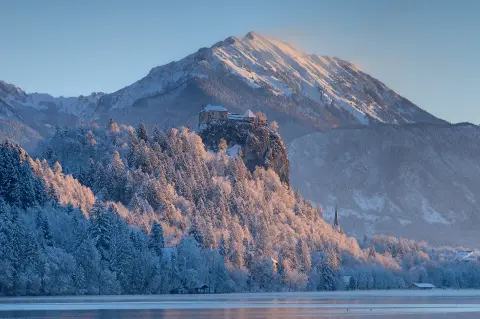
Look up from the lakeshore and you can't miss it. Bled Castle clings to the top of a sheer rock wall, its red roofs and stone towers hanging over the water. Up there, you walk through a gate, cross a drawbridge, and step into two courtyards joined by a stone stair. Then you reach the terrace, and the whole lake opens below you, with the island in the middle and the Julian Alps on the horizon. This is where bishops once looked out over their lands. Today it's a museum, a chapel, a printing works and a wine cellar, all inside the same old walls. Take a deep breath at the top. You've earned the view.
The story of Bled Castle
The story begins with an emperor's gift. In 1004 the German emperor Henry II gave the estate of Bled to Bishop Albuin of Brixen, in today's South Tyrol. The castle itself appears in writing for the first time in a deed of donation issued by Henry II to the bishops of Brixen on 22 May 1011. That makes it one of the oldest castles in Slovenia.
The bishops of Brixen held Bled for about eight centuries, ruling from far away and leaving the castle in the hands of local managers. The oldest part is a Romanesque tower. Over the following centuries, walls, towers and Renaissance buildings were added around it. The chapel in the upper courtyard was built in the sixteenth century and repainted around 1700 with illusionistic frescoes.
In the twentieth century the castle was in need of care. The architect Anton Bitenc led a long renovation after the Second World War, keeping its medieval character while preparing it for visitors. Today it is run as a museum and is one of the most visited attractions in the country.
The setting
The castle sits on a rocky cliff on the northern shore of Lake Bled, about 130 metres above the water. The approach is through a gate and over a drawbridge spanning a moat. Inside, the buildings stand around two courtyards. The lower courtyard holds service buildings, the wine cellar and the printing works. A staircase climbs to the upper courtyard, where you find the chapel, the museum and the restaurant. The upper terrace looks south over the lake, with Bled Island below, Osojnica's forested ridge behind it, and the Julian Alps, including Triglav on clear days, to the west.
Why it matters
For centuries Bled Castle was the seat of power over the land around the lake, and its first written mention in 1011 is one of the earliest for any castle in Slovenia. Today it holds the story of the lake, from Bronze Age finds to the rise of Bled as a spa town. The castle also keeps old crafts alive, with a working printing press and demonstrations of handmade paper. The poet France Prešeren praised this view in his verse. Standing on the terrace, you'll understand why.
Your walk-through
The stops a guide would take you to, in order.
-
1
The gate and drawbridge
Begin at the entrance. The path brings you to a gate, then over a drawbridge across the old moat. In the Middle Ages this was the only way in, and the cliff guarded every other side. Pause on the bridge and look at the walls. Different centuries are stacked on top of each other here, from rough medieval stone to later, neater additions.
-
2
The lower courtyard and printing works
In the lower courtyard, find the castle printing works. Inside is a replica of Gutenberg's fifteenth-century press, the kind used to print the first books in Slovene, written by Primož Trubar. A printer in period dress often sets type and pulls a sheet while you watch. You can also see paper made by hand, sheet by sheet, the slow way.
-
3
The wine cellar
Nearby, step down into the wine cellar. It's cool and dim, lined with bottles from Slovenian winemakers. Ask about the tradition here of bottling your own wine. You may be able to cork and seal a bottle yourself, guided by the cellar keeper. It makes a fine souvenir, and a good story when you open it at home.
-
4
The upper courtyard and chapel
Climb the stairs to the upper courtyard. The small chapel here dates from the sixteenth century and was redecorated around 1700. Look at the walls. The painted columns and arches are an illusion, designed to make the little space feel grand. Above the altar, look for the portraits of Emperor Henry II and his wife, Kunigunde, honouring the gift that began it all.
-
5
The castle museum
The museum tells the story of Bled from the earliest times. Look for the archaeological finds from around the lake, including objects from early burials. Further on, the rooms trace the castle under the bishops of Brixen and the growth of Bled as a health resort in the nineteenth century. Take your time with the windows too. Each one frames a different slice of the lake.
-
6
The terrace
Finish on the terrace. Lean on the wall and look straight down the cliff to the water. The island sits in the middle of the lake, its church tower pointing up at you. Behind it rises the forested ridge of Osojnica. To the west, on clear days, you'll see Triglav, the highest mountain in Slovenia. Stay a while. The light changes the colour of the lake almost every minute.
Things you might not know
- The castle's first written mention is a deed dated 22 May 1011.
- The bishops of Brixen in South Tyrol owned Bled for about eight centuries.
- The castle printing works has a replica of a Gutenberg-style press.
Researched November 2026 from: en.wikipedia.org, blejski-grad.si, blejski-grad.si. Fees and hours change, so check on the day.