⭐ Must-see · Belém, 7 km from central Lisbon
Jerónimos Monastery
By the Tralover editorial team · Fact-checked · How we research
Stone lace, sea ropes and the tomb of Vasco da Gama
🎧 Listen to this guide · about 7 min
Pop your earphones in and we'll walk you round.
Welcome to Belém, where Lisbon meets the wide mouth of the Tagus. Stand back for a moment and take in the length of this building. More than three hundred metres of pale limestone, glowing honey-gold when the sun is low. This is the Jerónimos Monastery, the building Portugal raised to thank heaven for the sea route to India. Look closely and the stone seems to move. Ropes, knots, coral, sea creatures and armillary spheres twist around every doorway. It is a monastery, yes, but it is also a love letter to the ocean. And when we are done, the most famous custard tarts in the country are waiting a few steps down the road.
The story of Jerónimos Monastery
Before the monastery there was a small chapel here on the riverbank, looked after by monks of the Order of Christ. Tradition says Vasco da Gama and his crew spent the night in prayer there before sailing for India in July 1497. When Gama came home with the sea route to the East, King Manuel I decided to build something far grander. Work began at the start of the 1500s, paid for largely with a share of the profits from the spice trade.
The first master builder was Diogo de Boitaca. Later João de Castilho took over and gave the church and cloister much of their richest carving. The king handed the monastery to the monks of the Order of Saint Jerome, the Hieronymites, who were asked to pray for his soul and for the sailors setting out from this shore. Remarkably, the great earthquake of 1755, which flattened much of Lisbon, left the monastery standing with only modest damage.
In 1833 the religious orders were dissolved and the monks left. The buildings became a school and orphanage, the Casa Pia. In 1880 the remains of Vasco da Gama and a tomb honouring the poet Luís de Camões were placed in the church. In 1983 UNESCO listed the monastery, together with Belém Tower, as a World Heritage Site. And in December 2007 European leaders signed the Treaty of Lisbon inside these walls.
The setting
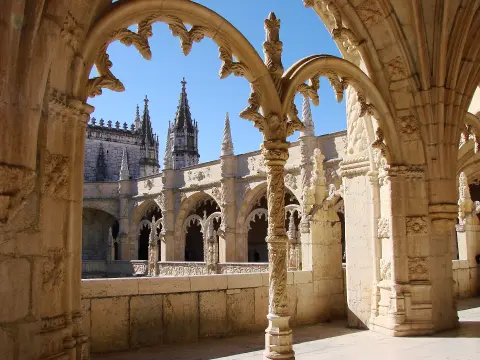
The monastery runs parallel to the river, facing a wide garden square, the Praça do Império. When it was built, the water came much closer than it does today. The style is called Manueline, after the king. It mixes late Gothic structure with sea motifs and early Renaissance detail. The church, Santa Maria de Belém, has one wide hall where slim octagonal columns rise and open out like palm trees into a ribbed vault. Beside it sits the two-storey cloister, a square of arcades carved so finely it looks like lace. The western end of the long wing now holds the National Archaeology Museum, and the Maritime Museum sits nearby.
Why it matters
For Portuguese people this is more than a beautiful building. It is where the nation keeps some of its heroes. Vasco da Gama lies here, Camões is honoured here, and the poet Fernando Pessoa was reburied in the cloister in 1985. The monastery is the purest example of the Manueline style, a way of building found almost nowhere else in the world. It captures the confidence and wealth of a small kingdom that suddenly found itself at the centre of global trade. It is still a working parish church, so you share it with locals who come here to pray, marry and baptise their children.
Your walk-through
The stops a guide would take you to, in order.
-
1
South portal
Start outside, facing the side of the church. This tall south doorway is the work of João de Castilho. It is crowded with saints and prophets under little stone canopies. On the central pillar stands a figure usually identified as Henry the Navigator, the prince who sponsored early voyages down the African coast. Above, Our Lady of Belém watches over the river. Look for the armillary sphere, the king's personal emblem, and the cross of the Order of Christ, which sailed on Portuguese ships.
-
2
Church nave
Step inside the church, which you can usually visit free. Let your eyes travel up. The columns look far too slender to carry this stone roof, and yet the vault has stood for five centuries and rode out the 1755 earthquake. Near the top they spread into ribs like the fronds of a palm tree. Many Portuguese see the sea in it too, with the ribs like rigging. The light here is soft and golden in the late afternoon.
-
3
Tombs of Vasco da Gama and Camões
Just inside the main entrance, under the low choir, are two carved tombs from the late nineteenth century. On one side lies Vasco da Gama, whose remains were brought here in 1880. Opposite him is the tomb of Luís de Camões, the poet who told Gama's voyage in the epic The Lusiads. Whether the poet's bones are really inside is uncertain, since he died poor and his grave was lost. Look at the carvings of ships and a lyre, symbols for the sailor and the poet.
-
4
The cloister
Now the cloister, the heart of the monastery. Walk slowly around both levels. Every arch is carved with twisted ropes, leaves, coral, shells and strange creatures. The lower gallery is heavier, the upper one lighter and more open, from a later phase of work. This was where the monks walked, read and prayed. Stand in a corner and look across the courtyard. The arches are cut at an angle so the square feels softer, almost rounded.
-
5
Fernando Pessoa's tomb
In the lower cloister you will find a simple modern tomb. It belongs to Fernando Pessoa, perhaps Portugal's most loved modern poet. He died in 1935 and was moved here in 1985, fifty years later. Pessoa wrote under many invented names, each with its own style and life story. It feels right that this restless, many-sided writer rests among the carved dreams of the Discoveries. Lisboans often leave him small notes and flowers.
-
6
Pastéis de Belém
Leave the monastery and turn right along Rua de Belém. That queue is for Pastéis de Belém, which has been selling custard tarts here since 1837. The story goes that the recipe came from the monks next door, who sold sweets after the monastery closed. Inside are blue-and-white tiled rooms that go back much further than the line suggests, so you can often sit down. Eat the tart warm, with a shake of cinnamon and icing sugar.
Things you might not know
- The Treaty of Lisbon, which reshaped how the European Union works, was signed in the monastery in December 2007.
- The poet Fernando Pessoa was reburied in the cloister in 1985, fifty years after his death.
- After the monks left in 1833, the monastery was used for many years as the Casa Pia school and orphanage.
Researched November 2026 from: whc.unesco.org, en.wikipedia.org, visitlisboa.com, gov.pt. Fees and hours change, so check on the day.