⭐ Must-see · Le Morne Peninsula, south-west coast, 60 km from central Mauritius
Le Morne Brabant
By the Tralover editorial team · Fact-checked · How we research
A mountain of refuge above the bluest lagoon
🎧 Listen to this guide · about 6 min
Pop your earphones in and we'll walk you round.
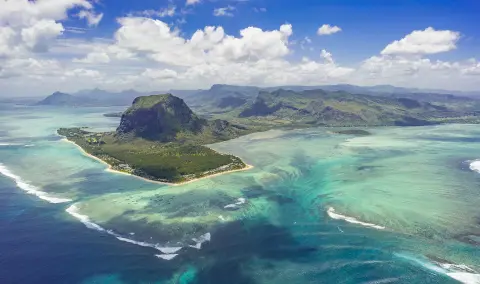
Welcome to Le Morne. Look up, and there it is: a great block of dark rock rising straight out of the sea, its cliffs streaked green with forest. At its feet, a curve of pale sand runs into water so clear it looks lit from below. This is the corner of Mauritius that ends up on every postcard. But stay with me for a moment, because Le Morne is far more than a pretty view. For the people of this island it is a sacred place, a mountain that once sheltered men and women who ran from slavery. Today you can swim in the lagoon, watch the kitesurfers dance on the reef, or climb the slopes at sunrise. Whatever you choose, you are standing on ground that carries a deep and moving memory.
The story of Le Morne Brabant
When the Dutch, and then the French, ran Mauritius as a colony, the island's economy rested on enslaved people brought from Madagascar, mainland Africa and India. Some escaped. They were called maroons, and many fled to the wildest parts of the island. Le Morne, steep and almost cut off from the mainland, became their best-known refuge. In the caves and on the narrow summit plateau, small groups lived in hiding through the eighteenth and early nineteenth centuries.
Slavery was abolished in Mauritius on the first of February 1835. Legend says that soon afterwards a party of soldiers climbed towards the summit to bring the news, and that the maroons, believing they were about to be captured, threw themselves from the cliffs rather than be taken back into slavery. No document proves the story, but it is told across the island and it gave the mountain its power as a symbol.
In 2008 UNESCO inscribed the Le Morne Cultural Landscape on the World Heritage List, recognising the mountain as an exceptional witness to resistance against slavery. Since 1987 the first of February has been marked as the day of the abolition of slavery, and Le Morne is the place where that memory is honoured each year.
The setting
Le Morne Brabant stands on a small peninsula at the far south-west of the island. The mountain is a remnant of ancient volcanic rock, worn into sheer walls on almost every side. Its slopes hold some of the last patches of native forest on this coast, including rare plants such as the boucle d'oreille, Trochetia boutoniana, the national flower of Mauritius. Around the base runs a wide lagoon, protected by a coral reef where the ocean swells break in long white lines. On the eastern side you will find the public beach, shaded by casuarina trees, and a row of resorts. From the air, the reef here creates the famous illusion of an underwater waterfall, as sand and silt pour off the shelf into deeper water.
Why it matters
For Mauritians, Le Morne is a place of memory. Many families on the island trace their roots to enslaved people, and the mountain gives that history a face and a place to stand. The UNESCO listing protects not just the rock but the whole landscape around it, including the village of Le Morne and the beach. It is also one of the world's great kitesurfing spots, and the trail to the cross on the shoulder of the mountain is the island's most popular hike. Respect both sides of the mountain: the beauty and the grief.
Your walk-through
The stops a guide would take you to, in order.
-
1
The International Slave Route Monument
Start at the foot of the mountain, near the main road, where you will find a circle of sculpted stones. This is the International Slave Route Monument. Each stone was contributed in memory of the enslaved, and the central piece stands for freedom breaking out of chains. Take a moment here. It is quiet, often windy, with the cliffs towering behind. This is where the island gathers to remember on the first of February, and it is the right place to begin understanding Le Morne.
-
2
The trailhead and lower slopes
The hiking trail starts close to the main road on the north side. The first part winds gently through scrub and old forest, past boulders and roots, with glimpses of the lagoon opening up behind you. Go slowly and watch your footing on loose stones. Look out for native shrubs clinging to the rock. On a clear morning the light turns the cliffs gold, and you can hear the reef long before you see it.
-
3
The cross viewpoint
After a steep scramble you reach a metal cross on a rocky shoulder of the mountain. This is where most walkers stop, and for good reason. Below you the lagoon spreads out in every shade of blue and green, the reef draws a white line along the edge, and the hotels look like toys. The final climb to the true summit beyond the cross is a protected and much harder section, and you will need a licensed guide to go further.
-
4
Le Morne public beach
Back down, drive round to the public beach. This is where local families come on Sundays with pots of curry and music. The sand is soft and pale, and the lagoon is calm and shallow close to shore. Find a spot under the casuarina trees and look back at the mountain. From here it seems to float on the water. A swim here, with that rock above you, is one of the great pleasures of Mauritius.
-
5
The kitesurf lagoon
Walk south along the beach and you will see the sky filled with bright kites. The steady trade winds and the wide, flat lagoon make this one of the most famous kitesurfing spots in the world. Out on the reef is a wave known to surfers as One Eye, which draws experts from far away. You do not need to ride to enjoy it. Sit and watch the riders leap and turn against that great dark mountain.
Things you might not know
- Le Morne Brabant rises 556 metres straight from the lagoon.
- UNESCO added the Le Morne Cultural Landscape to the World Heritage List in 2008.
- Slavery was abolished in Mauritius on 1 February 1835, a date still marked every year.
Researched November 2026 from: whc.unesco.org, en.wikipedia.org, en.wikipedia.org. Fees and hours change, so check on the day.