⭐ Must-see · Chuo Ward, 3 km from central Osaka
Osaka Castle
By the Tralover editorial team · Fact-checked · How we research
Stone, gold and the siege that ended an age
🎧 Listen to this guide · about 6 min
Pop your earphones in and we'll walk you round.
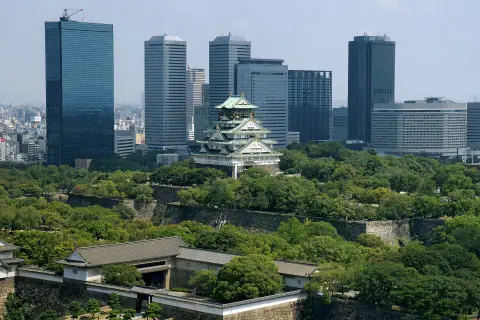
Welcome to Osaka Castle. Before you go in, stop and look up. The white keep rises on a cliff of grey stone, its roofs trimmed with gold, golden fish flashing at the very top. This is the castle that Toyotomi Hideyoshi built to show the whole country who was in charge. It was also where his family's story ended, in fire, during one of the great sieges of Japanese history. The tower you see is a modern rebuild, but the walls and moats around you are the real thing, and they are enormous. Today we will cross a moat, stand beside a single stone the size of a room, and climb to the top for a view over the city. Take your time. Every gate here was designed to slow an army down.
The story of Osaka Castle
This hill once held Ishiyama Hongan-ji, a fortified temple of a powerful Buddhist sect. In 1583, after it had been abandoned, Toyotomi Hideyoshi began building his castle on the site. Hideyoshi was the warlord who unified Japan, and he wanted a fortress to match. The main keep was finished in 1585, and the whole castle was completed in 1597. Hideyoshi died the following year, leaving a young son, Hideyori.
Power soon passed to Tokugawa Ieyasu. In the winter of 1614 Ieyasu besieged Osaka Castle, and in the summer of 1615 he returned and took it. The castle burned and the Toyotomi line came to an end. That victory secured more than two hundred and fifty years of Tokugawa rule.
The Tokugawa then buried Hideyoshi's castle and built a new one on top, from 1620, with even taller stone walls. The walls you see today come from that rebuilding. Its keep was struck by lightning and burned in 1665, and for centuries the castle stood without one. In 1931 the people of Osaka paid for a new keep in reinforced concrete. It survived the bombing of 1945, which destroyed the army arsenal nearby, and it was fully restored in 1997. Today the stone walls and moats are protected as a Special Historic Site.
The setting
The castle sits at the northern end of the Uemachi plateau, a raised ridge that gave it a natural advantage over the low, river-cut city around it. Two rings of moats protect the inner compound, one wet and one partly dry, and both are lined with steep curved walls of fitted granite. The keep is five storeys on the outside and eight inside, built on a high stone base. Inside, it is a modern museum with lifts. Around it lies Osaka Castle Park, a wide green space of lawns, plum and cherry groves and sports grounds. Several original Tokugawa-era gates and turrets still stand, including the Otemon main gate and the Sengan turret.
Why it matters
Osaka Castle is the city's symbol and its link to a turning point in Japanese history. Hideyoshi made Osaka a great commercial city, and the fall of his castle in 1615 began the long Tokugawa peace. The 1931 keep matters too. It was built with public donations, a sign of how much the people of Osaka cared about their past. Today the park is where the city breathes: joggers at dawn, families under the cherry trees in spring, school groups learning their history inside the tower.
Your walk-through
The stops a guide would take you to, in order.
-
1
Otemon Gate
We enter by Otemon, the main gate, on the west side. Notice how the path turns sharply once you pass through. You walk into a square courtyard enclosed by walls, then turn to pass through a second gate. This is a masugata, a box trap. An enemy force pushing through would be packed tight and shot at from above. The gate and its walls date from the Tokugawa rebuilding and are protected as Important Cultural Properties.
-
2
Sakuramon Gate
This is Sakuramon, the Cherry Blossom Gate, the main southern entrance to the inner compound. It crosses the dry inner moat. Stand on the bridge and look down at how deep the moat is and how smoothly the stone walls curve up. Those curves made the walls hard to climb and very strong. Imagine looking up from the bottom with armour on and arrows coming down.
-
3
Tako-ishi, the Octopus Stone
Pass through Sakuramon and look at the wall of the courtyard straight ahead. That single slab is Tako-ishi, the Octopus Stone, the largest stone in the castle walls. Its face is roughly the size of a small apartment. Stones like this were brought by boat and dragged here by thousands of workers, supplied by feudal lords who were ordered to help build the shogun's castle. Look closely at other stones around the park and you may spot carved marks, the crests of the lords who sent them.
-
4
Main keep exterior
Here is the keep. Look at the roofs: under each gable sit golden tigers, and on the top ridge two golden shachihoko, fish with tiger heads that were believed to protect buildings from fire. The design copies the style of Hideyoshi's time, which was showier than the later Tokugawa castles. The original Toyotomi keep was finished in 1585. This one dates from 1931, restored in 1997.
-
5
Museum floors
Inside, take the lift up and walk down through the museum. The floors tell Hideyoshi's story, from his humble birth to ruling the country. Look for the folding screens that show the Summer Siege of 1615 in great detail, with soldiers, fleeing townspeople and burning buildings. There are also replicas of armour and helmets. It is a lot of history, so pick a floor or two and take it slowly.
-
6
Observation deck
The eighth floor is an open deck right under the roof. Walk all the way round. To the west is the business district, to the north the river, and in the park below you can trace the lines of the moats and walls. On a clear day you can see far across the plain toward the mountains. Picture this view in 1615, filled with two armies.
Things you might not know
- The stone walls you see were built by the Tokugawa from 1620, burying Hideyoshi's original castle beneath them.
- The keep stood empty of a tower from 1665, when lightning burned it, until 1931.
- The 1931 concrete keep was paid for by donations from the people of Osaka.
Researched November 2026 from: en.wikipedia.org, osakacastle.net, osaka-info.jp. Fees and hours change, so check on the day.