⭐ Must-see · 7th arrondissement, Left Bank, 2 km from central Paris
Musée d'Orsay
By the Tralover editorial team · Fact-checked · How we research
Where trains once arrived, the Impressionists now hold court
🎧 Listen to this guide · about 6 min
Pop your earphones in and we'll walk you round.
Welcome to the Musée d'Orsay. Before you look at a single painting, look up. That great curved roof of iron and glass once sheltered steam trains. Now it lets soft daylight fall on sculptures lined along the old platforms. This is the home of the Impressionists. These were painters who left the studio, went outside and tried to catch light, weather and everyday life as it flickered past. Many were mocked in their day. Now people cross oceans to see them. We will walk from the great hall up to the top floor, stop by the famous clock, and meet a few of the paintings that changed how the world sees.
The story of Musée d'Orsay
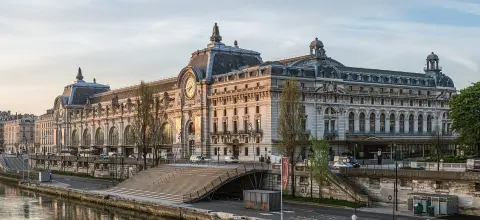
This building began as a railway station. For the World's Fair of 1900, the Paris–Orléans railway company built the Gare d'Orsay, designed by the architect Victor Laloux. It opened that year, with a grand hotel attached. Its stone front was made to match the elegant Louvre across the river.
But trains soon grew longer, and from 1939 the platforms were too short for main-line services. The station was used for suburban trains, then for many other things. In the 1960s and 1970s it faced demolition. The building was saved, and in 1977 the government decided to turn it into a museum.
The Musée d'Orsay opened in December 1986. It brought together French art from 1848 to 1914, the years between the Louvre's collections and modern art. Many Impressionist works came from the Jeu de Paume and the Louvre. Since then the museum has been refreshed several times, and a long programme of works to improve visitor spaces began in 2026.
The setting
The museum stands on the Left Bank, right on the quay, facing the Tuileries Garden across the Seine. Its long stone façade carries two big clocks and the names of the cities the railway once served. Inside, the main hall follows the line of the old tracks, a long nave under an arched glass roof. Sculptures stand on the ground floor. Galleries rise on both sides in terraces. The Impressionist and Post-Impressionist paintings are on the top floor, the fifth level, where the light is best. From there, windows behind the clock faces look out over the river to Montmartre.
Why it matters
Orsay tells the story of how modern art was born. Here you see the shift from grand academic painting to the bold, sketchy brushwork that critics first laughed at. It holds the largest collection of Impressionist and Post-Impressionist paintings in the world. It is also a model for giving an old industrial building a new life. For many visitors, standing in front of a Monet or a Van Gogh here is the moment the history of art suddenly feels personal.
Your walk-through
The stops a guide would take you to, in order.
-
1
The great hall
Stand at the top of the central aisle. This is where the trains came in. Look at the gilded clock above the entrance and the stucco roses on the ceiling arch. Down the middle, sculptures line the old platform. Many are from the late 1800s, made for the public halls of a confident, growing Paris. Take it slowly. The hall itself is one of the museum's great works.
-
2
Courbet galleries
Before the Impressionists, there was Gustave Courbet. He painted ordinary people, life-size, with no polish, and it shocked the art world. Look for his huge Burial at Ornans, a village funeral painted on the scale normally kept for kings and saints. It is a quiet rebellion. Courbet said, in effect, that real life deserved a big canvas too. The painters upstairs followed that idea outdoors.
-
3
The giant clock
Climb to the fifth floor and find the great clock window. From inside, you see its glass face from behind, with the hands moving slowly, and Paris through the gaps. Across the Seine are the Tuileries, and on the hill, the white domes of Sacré-Cœur. Everyone takes a photo here, so be patient. It is worth it.
-
4
Impressionist gallery
Now the stars. Look for Monet, with his poppy fields and his views of Rouen Cathedral painted at different times of day. Find Renoir's Bal du moulin de la Galette, a Sunday dance in Montmartre with sunlight dappled through the trees. See how the brushstrokes are loose and quick. Up close they are just dabs of colour. Step back and the scene comes alive. That is the magic trick.
-
5
Degas and his dancers
Nearby are the ballet scenes of Edgar Degas. He loved the backstage moments, the yawns and stretches, more than the bows. Look for his little wax-modelled dancer cast in bronze, with a real fabric skirt and hair ribbon. When the original was shown in 1881, critics were startled by how real she looked. Today she is one of the museum's most loved figures.
-
6
Van Gogh rooms
End with Vincent van Gogh. Here you can see his self-portrait with swirling blue background, painted in 1889, and his bedroom at Arles. Look at the thick paint, laid on in ridges you could almost touch. Van Gogh sold very little in his lifetime. Now these rooms are often the most crowded in the museum. Stand still for a minute and let the colour do its work.
Things you might not know
- The building opened as the Gare d'Orsay railway station in 1900.
- The museum covers French art from 1848 to 1914, bridging the Louvre and modern art collections.
- Its two façade clocks have windows you can stand behind on the top floor.
Researched November 2026 from: musee-orsay.fr, en.wikipedia.org, parisjetaime.com. Fees and hours change, so check on the day.