⭐ Must-see · Old Town and Lesser Town, 1 km from central Prague
Charles Bridge
By the Tralover editorial team · Fact-checked · How we research
Six centuries of footsteps between the Old Town and the castle
🎧 Listen to this guide · about 7 min
Pop your earphones in and we'll walk you round.
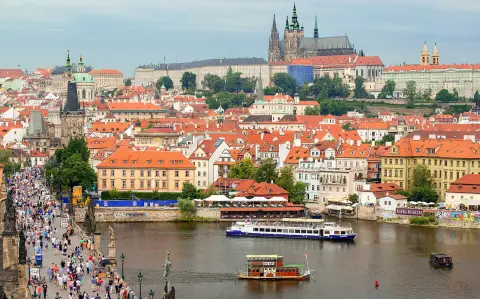
Good morning, and welcome to Charles Bridge. If you came early, you made the right choice. At this hour the stone is cool, the river is quiet, and the statues stand in grey silhouette against a pale sky. Behind us is the Old Town. Ahead, on the hill, is Prague Castle, with the spires of St Vitus rising above the roofs. For centuries this was the only way across the Vltava in Prague. Kings rode over it to their coronations. Armies fought on it. Today it belongs to painters, musicians and people like us. Take a breath, look both ways along the river, and let the city wake up around you. We will walk slowly, from the Old Town tower to the Lesser Town towers, and stop at a few statues with good stories.
The story of Charles Bridge
Before this bridge there was another. The Judith Bridge, one of the oldest stone bridges in Central Europe, stood near here until a great flood wrecked it in 1342. Prague needed a new crossing, and King Charles IV, who was also Holy Roman Emperor, laid the foundation stone in 1357. Tradition says he chose the date and minute with care, the ninth of July at 5.31 in the morning, so the numbers read the same forwards and backwards. Whether or not that is true, people in Prague love the story.
The builder was Peter Parler, the same master who was working on St Vitus Cathedral. The work took decades and finished early in the fifteenth century. For most of its life the bridge was simply the Stone Bridge, or the Prague Bridge. It has officially carried the name of Charles only since 1870.
The statues came much later. The first, John of Nepomuk, was set up in 1683, and others followed through the Baroque age, paid for by religious orders and noble families. The bridge has suffered too. In 1648, in the last days of the Thirty Years' War, Swedish troops fought their way onto it and damaged the Old Town tower. In 1890 a flood brought down two arches, which were rebuilt. Most statues you see today are copies. Many originals are kept safe in the Lapidarium of the National Museum and in the casemates of Vyšehrad.
The setting
The bridge is about 516 metres long and almost ten metres wide, carried on sixteen arches of sandstone blocks. It does not run in a perfectly straight line. Look along it and you will notice a gentle bend. At the Old Town end stands the Old Town Bridge Tower, one of the finest Gothic towers in Europe. At the Lesser Town end, two towers of different heights frame a gate, with the dome of St Nicholas Church beyond. Thirty statues and groups line the parapets. Below, the Vltava flows north, and just upstream you can see the weirs and the island of Kampa, with the little Čertovka stream cutting it off from the Lesser Town.
Why it matters
Charles Bridge is the spine of the old city. It joins the merchants' Old Town to the Lesser Town and the castle, and so it was part of the Royal Way, the route of coronation processions. Today it is part of the Historic Centre of Prague, listed by UNESCO in 1992. It is also simply loved. People meet here, propose here and say goodbye here. Street artists and musicians work under a licence system, so the bridge still feels like a living street, not a museum. Come back at night too, when the lamps are lit and the castle glows above the water.
Your walk-through
The stops a guide would take you to, in order.
-
1
Old Town Bridge Tower
Start under the great Gothic gate. Look up at the eastern face. Peter Parler's workshop carved it, with the seated figures of Charles IV and his son Wenceslas IV, and above them the patron saints of Bohemia. The coats of arms show the lands Charles ruled. This side was meant to impress anyone entering the Old Town. You can climb the tower for a small fee. From the gallery at the top you see the whole bridge curving towards the castle, which is a fine first view.
-
2
Crucifix and Calvary
On the right as you walk, find the bronze crucifix. A cross has stood on this spot since the Middle Ages, and the bronze figure dates from the seventeenth century. Look for the gold Hebrew letters around it. They were added in 1696, paid for, according to the record, by a fine imposed on a Jewish man accused of mocking the cross. In 2000 small plaques were added in Czech, English and Hebrew to explain this painful history. It is worth a quiet pause here.
-
3
St John of Nepomuk
Now the most famous statue, on the right, halfway along. John of Nepomuk was a priest who was thrown into the Vltava from this bridge in 1393, on the orders of King Wenceslas IV. Legend says he refused to reveal the queen's confessions. His statue of 1683 is the oldest on the bridge. Below it are bronze reliefs, polished bright by hands. People touch them for luck, and a tradition says that touching them means you will return to Prague.
-
4
The cross on the parapet
A little further on, look for a small brass cross set into the parapet between statues. This is said to mark the spot where John of Nepomuk was thrown into the river. Some people place their fingers on it and make a wish. Lean over and look down at the water. Imagine the bridge at night in the fourteenth century, without lamps or crowds, only the sound of the river below.
-
5
St Luitgard
On the left side, find the statue of St Luitgard, made by Matthias Bernard Braun in 1710. Many people think it is the finest on the bridge. The saint, who was blind, kneels as Christ leans down from the cross to let her kiss his wounds. Look at the movement in the stone and the way the figures seem to lean out over the river. Braun was only in his twenties when he carved it. The original is now protected, and this is a careful copy.
-
6
Lesser Town Bridge Towers
We finish at the two towers on the Lesser Town side. The lower one is older and once belonged to the Judith Bridge. The taller one dates from the fifteenth century and matches the style of the Old Town tower. Between them is a gate leading to Mostecká Street and up towards the castle. Turn around before you go through. Look back along the bridge, at the statues, the river and the spires of the Old Town. That is the picture people take home.
Things you might not know
- The bridge has officially been called Charles Bridge only since 1870.
- The statue of St John of Nepomuk, set up in 1683, is the oldest on the bridge.
- A flood in 1890 brought down two of its arches, which were later rebuilt.
Researched November 2026 from: en.wikipedia.org, whc.unesco.org, prague.eu. Fees and hours change, so check on the day.