🚗 Day trip · Hvítá canyon, Bláskógabyggð, 115 km from central Reykjavik
Gullfoss
By the Tralover editorial team · Fact-checked · How we research
Golden Falls, saved by a farmer's stubborn daughter
🎧 Listen to this guide · about 6 min
Pop your earphones in and we'll walk you round.
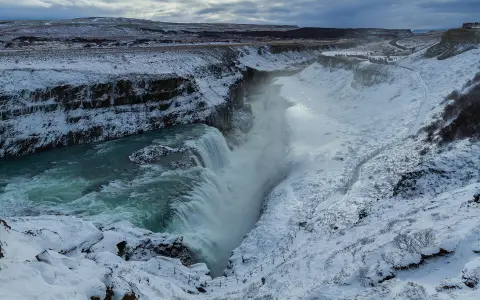
Listen. Before you see it, you will hear it, a deep endless roar rising from the ground. Then the path turns, and there it is: Gullfoss, the Golden Falls. A wide glacial river drops down one broad step, turns sharply, and then plunges again into a narrow canyon, vanishing in a cloud of spray. On a sunny day, rainbows hang in the mist. In winter, the falls are wrapped in ice and snow, with frozen columns along the canyon walls. Stand on the path and feel the cold spray on your face. We will walk down to the lower viewpoint, climb to the top for the great view, and hear the story of the woman who loved this waterfall.
The story of Gullfoss
The river here is the Hvítá, the White River, which flows from Hvítárvatn lake at the edge of the Langjökull glacier. It carries glacial silt, which gives it its milky colour, and in summer melt it swells mightily.
In the early twentieth century, as Iceland began to think about hydropower, foreign investors became interested in Gullfoss. The waterfall belonged to the farm of Brattholt, owned by Tómas Tómasson. The falls were leased to investors who planned a power plant here. Tómas's daughter, Sigríður Tómasdóttir, fought hard against the plan. So the story goes, she walked the long road to Reykjavik many times to argue her case, and even threatened to throw herself into the falls if the dam was built. How much her campaign changed the outcome is still debated by historians, but the scheme failed, partly for lack of money, and the lease ran out.
Gullfoss was later sold to the Icelandic state, and on 9 March 1979 it was declared a protected nature area. Sigríður became a symbol of nature protection in Iceland, and today a stone memorial with her profile stands above the falls.
The setting
Gullfoss lies in the Hvítá canyon in south-west Iceland, near the edge of the highlands. The river drops first about 11 metres, then turns and plunges about 21 metres into a crevice, a total of about 32 metres. The canyon below is around 20 metres wide and 2.5 kilometres long, cut through layers of lava and sediment. In summer, an average of about 141 cubic metres of water passes every second. Two viewing areas sit on the eastern bank: an upper car park with a visitor centre and café, and a lower path that leads close to the edge of the first drop. Beyond, on clear days, you can see the white dome of Langjökull glacier to the north.
Why it matters
Gullfoss is a symbol of Iceland's choice to protect its wild places. Here, a waterfall that could have powered industry was left free. It is also one of the country's most visited sights, the turning point of the Golden Circle. Only ten minutes away is Geysir, where the hot spring Strokkur erupts every few minutes, so the two make a perfect pair. For you, it is a chance to feel the raw power of an Icelandic river up close.
Your walk-through
The stops a guide would take you to, in order.
-
1
The upper viewpoint
Begin at the top, near the visitor centre. From this platform you see the whole picture: the wide river flowing toward you, the first step, the sharp bend, and the second drop disappearing into the canyon. It looks almost as if the river falls into the earth. On a clear day, look north for the white line of Langjökull, where this water began its journey. On sunny afternoons, rainbows form in the spray.
-
2
Sigríður's memorial
Near the upper path, look for a stone memorial with the profile of a woman. This is Sigríður Tómasdóttir, the farmer's daughter from Brattholt, remembered for her fight to save the falls. Whatever her exact role, she became a symbol of nature protection in Iceland. Pause here a moment, then turn to look at the falls again. Imagine pipes and turbines where the water now runs free.
-
3
The stairs down
Now take the stairs and path down toward the lower viewpoint. In winter, parts of the lower path may be closed for safety when it is icy. Please respect the ropes and signs. Every year, careless visitors take risks here. As you descend, the roar grows louder, and the spray thickens. Check your camera lens. You will need to wipe it.
-
4
The lower path by the first drop
Here you stand on a rocky ledge beside the first drop. Feel the ground shake a little. The water rushing past you came from a glacier days ago. Watch how it curls over the edge, turns white, and slams down into the canyon. In winter, ice builds up on the rocks in strange shapes, like giant sugar crystals. Wear waterproofs. You will get wet, and that is part of the joy.
-
5
The canyon view
Before you leave, look downstream along the canyon. The walls are dark basalt and sediment, steep and narrow. The river has been carving this gorge since the end of the last ice age, slowly moving the falls upstream. Watch the mist drifting down the canyon. On the way back to Reykjavik, stop at Geysir, about ten minutes away, to watch Strokkur shoot a column of water high into the air.
Things you might not know
- Gullfoss falls in two stages, about 11 and 21 metres, into a canyon about 2.5 kilometres long.
- Gullfoss was declared a protected nature area on 9 March 1979.
- The Hvítá river that feeds the falls flows from Hvítárvatn lake at the edge of Langjökull glacier.
Researched November 2026 from: en.wikipedia.org, umhverfisstofnun.is, co2.ust.is, guidetoiceland.is. Fees and hours change, so check on the day.